
Managing staff permissions is an important part of running a telecom business efficiently and securely. As telecom providers, ITSPs, VoIP businesses and MSPs grow, more employees become involved in customer management, billing, payments, reporting, support and day-to-day operations. While having a larger team helps businesses scale, it also creates a need for better control over who can access specific information and perform particular actions. Without proper access controls, employees may accidentally modify billing records, access confidential customer information, change pricing configurations or perform tasks outside their responsibilities. These risks can affect operational efficiency, customer trust and financial accuracy. Staff Permissions Management helps telecom businesses organise employee access based on job responsibilities. By assigning appropriate permissions to each staff member, businesses can improve security, reduce operational mistakes and maintain better control over their billing systems. In this guide, we will explore how telecom businesses can manage staff permissions effectively, why user access control matters and how a structured permission management approach can support business growth. Staff Permissions Management is essential for telecom businesses that handle large volumes of customer information, billing transactions, service records and financial data. Different employees need access to different parts of the business, and giving everyone unrestricted access can create unnecessary risks. For example, a customer support executive may need to view customer accounts, check service status and review invoices. However, that employee may not need permission to change product pricing, modify billing rules or approve financial adjustments. Similarly, a billing team member may need access to invoices, payment records and billing reports, while a sales executive may primarily need customer details, leads, quotations and contract information. A structured permission system helps businesses maintain this separation of responsibilities. It allows employees to perform their work efficiently while protecting sensitive information and critical system functions. The key benefits include: Improved security across business operations Reduced risk of accidental changes Better protection of customer and financial data Clearer employee responsibilities Greater accountability for system activities Improved compliance and internal governance For telecom providers, permission management is not simply a technical setting. It is an important operational practice that supports business stability and sustainable growth. Before implementing User Permissions Management, businesses should identify the different employee roles within their organisation. Every team has its own responsibilities, and permissions should reflect the tasks employees need to complete. Common roles within telecom businesses include: Administrators manage system configurations, employee accounts, business settings and overall platform operations. Their access may include managing staff permissions, configuring integrations and overseeing important system settings. Administrator privileges should be restricted to trusted personnel because they can make significant changes to the platform. Billing employees typically manage invoices, billing cycles, payments, adjustments, outstanding balances and financial reports. They require access to billing-related functions but may not need full administrator privileges. Customer support employees handle customer queries, service requests, account updates and invoice-related questions. They generally need read access to important customer and billing information, along with permission to update specific customer records. Sales employees manage leads, quotations, customer relationships, packages and contracts. Their access should focus on sales-related functions without allowing unnecessary access to financial configuration or administrative settings. Technical employees may manage service provisioning, product configurations, service status, integrations or technical support tasks. Their access should be limited to operational features relevant to their responsibilities. Identifying these roles makes Staff Role Configuration easier and helps businesses avoid giving employees permissions they do not require. Role-Based Access Control (RBAC) is one of the most effective approaches to managing permissions in a telecom billing environment. Instead of assigning individual permissions to every employee manually, businesses create roles with predefined access levels. Employees are then assigned roles according to their job responsibilities. For example, a telecom billing platform may include roles such as: Using RBAC simplifies User Role Management, particularly when businesses have dozens or hundreds of employees. When a new employee joins, the administrator can assign an existing role rather than configuring access from scratch. When an employee changes departments, their role can be updated to match their new responsibilities. This approach makes permission management more consistent, easier to maintain and less prone to errors. One of the most important principles of Billing System Security is the principle of least privilege. It means employees should receive only the access required to complete their assigned duties. For example, a customer support executive might need to: View customer account details Check service subscriptions View invoices Review payment status Update approved customer information Create support-related notes However, the same employee may not need permission to: Delete customer accounts Change billing rates Modify tax configurations Approve refunds Create administrator accounts Edit payment gateway settings Limiting access reduces the impact of mistakes, misuse or compromised employee credentials. Businesses should avoid giving full access simply because it is convenient. Instead, they should evaluate what each employee actually needs to do and configure permissions accordingly. The principle of least privilege should apply to every department, including finance, sales, customer support, technical operations and management. Effective Staff Access Control requires more than deciding which modules employees can access. Businesses should also define what actions employees can perform within each module. A well-designed Telecom Billing Platform may allow administrators to configure individual permissions such as: View: Access records and information without making changes. Create: Add new records, customers, quotations or transactions. Edit: Modify existing records and information. Delete: Remove records where permitted. Approve: Authorise transactions, adjustments or specific business activities. Export: Download records or reports. Manage: Configure settings, rules or module-specific options. For example, a billing employee may be allowed to create invoices and edit draft invoices but may not delete finalised invoices or approve high-value adjustments. A support employee may be allowed to view payment records without changing financial transactions. This granular approach to Billing Software Permissions helps telecom providers create better access controls and reduce unnecessary exposure of important business data. Telecom businesses regularly handle confidential information, including customer contact details, billing history, service subscriptions, payment records, contract details and usage-related information. Not every employee needs access to all these records. Businesses should carefully evaluate which information is necessary for each role. Access controls are also important when designing customer-facing systems, where role-based permissions help protect customer information and maintain appropriate access to billing records. For example, finance employees may require detailed payment information to complete reconciliation, while sales employees may only need customer account status and service details. Customer support staff may need to review invoice balances without accessing unnecessary financial configuration. Employee Access Management should also consider sensitive actions such as downloading customer lists, exporting billing reports, viewing payment information or modifying account details. By restricting access to sensitive information, businesses can strengthen Billing System Security and reduce the possibility of internal data misuse. Where possible, organisations should also use audit logs, activity tracking and access monitoring to identify unusual behaviour or unauthorised changes. Permission management should not be treated as a one-time activity. Employee responsibilities can change as the business grows, departments evolve and new services are introduced. A sales executive may eventually become a sales manager. A billing employee may move into finance management. An employee may leave the company, while a new team member takes over their responsibilities. Businesses should regularly review employee access to ensure that permissions remain appropriate. A practical review process may include: Reviewing all active employee accounts. Checking each employee's assigned role. Identifying unnecessary or outdated permissions. Removing access to modules no longer required. Updating permissions following departmental changes. Disabling accounts immediately when employees leave. Reviewing administrator accounts and privileged access. Access Management for Telecom Providers becomes more effective when these reviews are part of regular operational procedures. Businesses may conduct reviews monthly, quarterly or whenever significant staff changes occur, depending on their size and security requirements. A strong permission system should also help businesses understand who performed a particular action and when it happened. Audit logs are especially valuable for telecom billing operations because even small changes can affect invoices, payment records, customer subscriptions or revenue calculations. For example, activity logs may help administrators identify: Who modified a customer account Who changed a billing configuration Who updated a price plan Who adjusted an invoice Who approved a payment-related action Who created or modified staff permissions When an employee accessed or changed specific records Audit trails improve accountability and make it easier to investigate errors, resolve disputes and review operational activities. When combined with appropriate Staff Access Control, activity tracking provides businesses with better visibility into how their billing platform is being used. Permissions alone cannot provide complete security if employee accounts are not properly protected. Telecom providers should combine access management with strong account security practices. Recommended measures include: Enforcing strong and unique passwords Using multi-factor authentication (MFA), where available Avoiding shared employee accounts Disabling inactive accounts Restricting administrator access Reviewing login activity Providing secure access to authorised employees Following appropriate password reset procedures Each employee should have an individual account so that their actions can be tracked accurately. Shared accounts make accountability difficult because businesses cannot reliably identify which person performed a specific action. Combining secure authentication with appropriate permissions helps create a more reliable and secure billing environment. Managing staff permissions manually can become time-consuming as telecom businesses expand. A growing organisation may have employees across multiple departments, locations or operational teams. Telecom Billing Software with flexible permission settings can simplify these processes by allowing administrators to create reusable roles, manage user access centrally and update permissions when responsibilities change. Automation can support several important activities: Assigning predefined roles to new employees Updating access when employees change departments Removing permissions when responsibilities change Disabling accounts when employees leave Maintaining consistent access rules across teams Supporting periodic access reviews Automated User Permissions Management reduces repetitive administrative work and helps prevent inconsistent permission assignments. For growing VoIP providers, ITSPs and MSPs, having centralised permission management can make a significant difference to daily operations. Even businesses with access control systems can make mistakes when managing employee permissions. Avoiding these common issues can help improve security and operational efficiency. Providing unrestricted access to all employees may appear convenient, but it increases the risk of accidental changes and security problems. Administrator access should be limited to employees who genuinely require it. When employees move between departments, their previous permissions should be reviewed. Retaining access to unrelated modules can create unnecessary security risks. Shared accounts make it difficult to track individual actions. Every employee should have a unique account with permissions assigned to their specific role. Staff permissions can become outdated over time. Regular reviews help ensure that employees have access only to the functions and information they currently need. Customer and financial data exports can create additional security risks. Businesses should limit export permissions to authorised employees and monitor sensitive data downloads. Avoiding these mistakes helps telecom providers establish more reliable and secure access management practices. A modern Telecom Billing Platform should provide centralised tools for managing employees, roles, permissions and business access. Instead of managing security separately across multiple systems, businesses can use a unified platform to control access to customer management, billing, invoicing, payments, products, price plans, contracts and reports. A flexible system can help administrators: Create staff accounts and assign roles Configure permissions for individual modules Control view, create, edit and delete actions Restrict access to sensitive information Manage administrator privileges Review employee access Monitor staff activity Update permissions as the business grows For telecom businesses that manage multiple services, customer accounts and billing operations, centralised permission management can reduce administrative complexity while improving security. The goal is to make sure employees can complete their work without unnecessary restrictions while maintaining appropriate control over business-critical operations. Staff Permissions Management is a fundamental part of operating a secure, efficient and scalable telecom billing business. As teams grow and business processes become more complex, controlling employee access to customer information, billing operations, financial records and system settings becomes increasingly important. By implementing Role-Based Access Control, following the principle of least privilege, separating permissions by action, reviewing employee access regularly and maintaining audit logs, telecom providers can reduce security risks and improve operational accountability. A well-structured permission management strategy allows employees to work confidently within their responsibilities while helping businesses protect sensitive information and maintain accurate billing operations. For VoIP providers, ITSPs and MSPs, investing in better User Access Control is not just about security. It is about creating a reliable foundation for business growth, efficient teamwork and long-term operational stability. Staff Permissions Management is the process of controlling what employees can access and which actions they can perform within a business system. It helps organisations protect sensitive information and assign access according to employee responsibilities. It helps telecom providers protect customer information, financial records, billing configurations and business operations. It also reduces accidental changes, improves accountability and ensures employees access only the tools they need. Role-Based Access Control (RBAC) is a security approach in which permissions are assigned to predefined job roles rather than individual employees. Employees receive access based on their responsibilities, making permission management easier and more consistent. Billing staff generally need access to invoices, billing cycles, payment records, customer billing information and financial reports. Their permissions should be limited to the activities required for their role, with sensitive actions requiring additional authorisation where appropriate. Staff permissions should be reviewed regularly, such as monthly or quarterly, and whenever employees change roles, departments or employment status. Regular reviews help remove outdated or unnecessary access. User Access Control restricts access to sensitive billing information and system functions. It reduces the possibility of unauthorised changes, protects customer data and helps businesses maintain accountability through individual employee accounts and activity tracking. Yes. Depending on the platform, telecom billing software can support role-based access, predefined permission profiles, centralised user management, account updates and activity monitoring. These features help businesses manage staff access more efficiently. A user role represents an employee's responsibilities, such as billing executive, support agent or administrator. User permissions define the specific actions that employee can perform, such as viewing, creating, editing, deleting or approving records.1. Why Staff Permissions Management Matters
2. Understand Different Staff Roles Before Assigning Permissions
Administrator
Billing and Finance Team
Customer Support Team
Sales and Account Management Team
Technical and Operations Team
3. Use Role-Based Access Control (RBAC)
4. Follow the Principle of Least Privilege
5. Separate View, Create, Edit and Delete Permissions
6. Protect Sensitive Customer and Financial Information
7. Review and Update Staff Permissions Regularly
8. Maintain Accountability Through Audit Logs
9. Secure Staff Accounts with Strong Authentication
10. Automate Permission Management Wherever Possible
11. Common Staff Permission Management Mistakes to Avoid
Giving Every Employee Administrator Access
Keeping Permissions After Employees Change Roles
Using Shared Login Accounts
Ignoring Permission Reviews
Allowing Unrestricted Data Exports
12. How a Telecom Billing Platform Supports Better Permission Management
Conclusion
Frequently Asked Questions (FAQs)
1. What is Staff Permissions Management?
2. Why is Staff Permissions Management important for telecom businesses?
3. What is Role-Based Access Control (RBAC)?
4. What permissions should telecom billing staff have?
5. How often should staff permissions be reviewed?
6. How does user access control improve billing system security?
7. Can telecom billing software automate staff permission management?
8. What is the difference between user roles and user permissions?
How to Manage Staff Permissions in Telecom Billing Platforms
Bhargav
Nov 26, 2026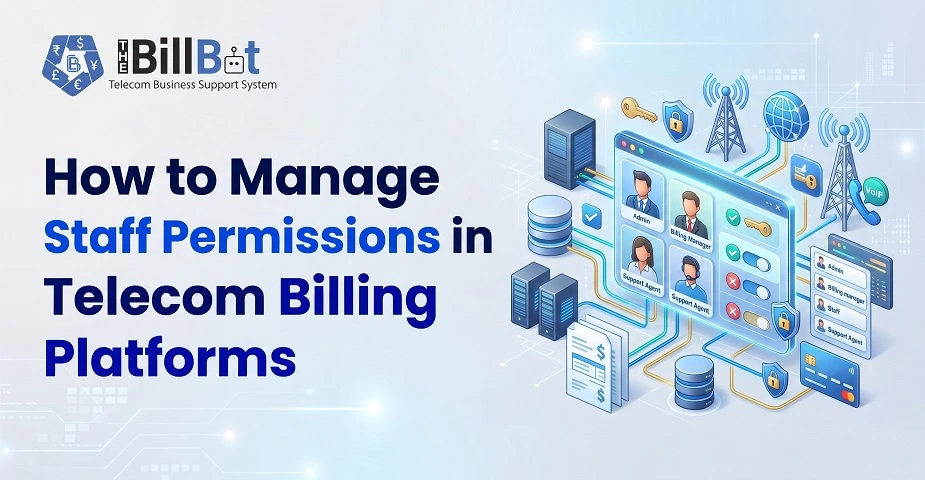
Table of Contents
- 1. Why Staff Permissions Management Matters
- 2. Understand Different Staff Roles Before Assigning Permissions
- Administrator
- Billing and Finance Team
- Customer Support Team
- Sales and Account Management Team
- Technical and Operations Team
- 3. Use Role-Based Access Control (RBAC)
- 4. Follow the Principle of Least Privilege
- 5. Separate View, Create, Edit and Delete Permissions
- 6. Protect Sensitive Customer and Financial Information
- 7. Review and Update Staff Permissions Regularly
- 8. Maintain Accountability Through Audit Logs
- 9. Secure Staff Accounts with Strong Authentication
- 10. Automate Permission Management Wherever Possible
- 11. Common Staff Permission Management Mistakes to Avoid
- Giving Every Employee Administrator Access
- Keeping Permissions After Employees Change Roles
- Using Shared Login Accounts
- Ignoring Permission Reviews
- Allowing Unrestricted Data Exports
- 12. How a Telecom Billing Platform Supports Better Permission Management
- Conclusion
- Frequently Asked Questions (FAQs)
- 1. What is Staff Permissions Management?
- 2. Why is Staff Permissions Management important for telecom businesses?
- 3. What is Role-Based Access Control (RBAC)?
- 4. What permissions should telecom billing staff have?
- 5. How often should staff permissions be reviewed?
- 6. How does user access control improve billing system security?
- 7. Can telecom billing software automate staff permission management?
- 8. What is the difference between user roles and user permissions?
Author : Bhargav
Published : 26 Nov 2026
Related Articles
Explore more insights

25 Nov 2026 / Bhargav
How to Customise Telecom Invoice Templates for Different Customer Segments
24 Nov 2026 / Bhargav
How to Validate Customer and Subscription Data After Billing Migration
23 Nov 2026 / Bhargav