Telecom billing involves much more than generating invoices. Providers must manage customer accounts, process usage records, apply pricing rules, calculate recurring charges, collect payments and monitor outstanding balances. When these activities rely heavily on manual work, even a small mistake can lead to billing delays, incorrect invoices and additional pressure on support teams. This is where Custom Telecom Billing Workflows can make a meaningful difference. By designing billing processes around specific business requirements, telecom providers can automate repetitive tasks, reduce manual intervention and improve the overall customer experience. Every telecom business operates differently. An Internet Telephony Service Provider (ITSP) may need detailed call usage calculations, while a Managed Service Provider (MSP) may handle recurring service fees, bundled packages and multiple billing cycles. A flexible workflow helps businesses manage these requirements without relying on disconnected tools or time-consuming manual processes. In this guide, we explore what custom telecom billing workflows are, which activities can be automated and how the right billing system can help telecom businesses operate more efficiently. Custom Telecom Billing Workflows are structured processes designed to manage billing activities according to a telecom provider's services, pricing models, customer agreements and operational requirements. Instead of following the same fixed process for every customer, businesses can configure workflows to reflect their actual operations. For example, one customer may receive a monthly invoice for a recurring service, while another may be billed according to call usage, data consumption or a combination of services. A well-designed workflow connects the different stages of billing, from capturing service usage to generating invoices and tracking payments. Typical workflow activities include: Creating and updating customer accounts. Collecting and processing call detail records (CDRs). Applying pricing rules and recurring charges. Calculating service usage and additional fees. Generating and sending invoices. Scheduling payment reminders. Recording payments and monitoring overdue balances. Producing reports for financial and operational teams. With the right Telecom Billing Software, these activities can be connected into a consistent process that reduces repetitive work and gives teams better visibility into billing operations. Manual billing becomes increasingly difficult as a telecom business grows. More customers mean more invoices, more usage records, more pricing arrangements and more opportunities for errors. Employees may need to collect information from several systems, verify calculations, prepare invoices and follow up with customers individually. These tasks consume valuable time that could otherwise be spent improving services and supporting business growth. Telecom Billing Automation helps address these challenges by moving repetitive tasks into predefined, configurable workflows. The main benefits include: Less manual work: Routine activities can run automatically according to configured rules. Fewer billing errors: Consistent calculations and validation checks help reduce avoidable mistakes. Faster invoice generation: Automated processes can prepare invoices without requiring employees to handle every step. Improved payment follow-up: Scheduled reminders help businesses maintain consistent collection practices. Better visibility: Centralised billing information makes it easier to monitor invoices, payments and outstanding balances. Greater scalability: Automated processes can support increasing transaction volumes without requiring the same increase in administrative effort. Automation does not remove the need for human oversight. Instead, it allows employees to focus on exceptions, customer queries and decisions that require professional judgement. Customer onboarding is one of the first areas where billing workflow automation can save time. When a new customer signs up, teams may need to create an account, record contact details, assign services, configure pricing and establish billing preferences. If these steps are completed manually across different systems, information can become inconsistent or incomplete. A customised workflow can automate several parts of this process. For example, once a customer record has been approved, the system may assign the relevant service package, apply the appropriate billing profile and prepare the account for its first billing cycle. Depending on the system's integrations and configuration, automation may also support: Customer record creation and updates. Service and package assignment. Billing cycle configuration. Recurring charge setup. Invoice delivery preferences. Notifications when required information is missing. These processes help establish accurate billing information from the beginning and reduce the likelihood of corrections later. For VoIP providers and ITSPs, call detail record processing is an important part of billing. CDRs contain information about calls, such as their duration, destination and other usage details needed for charging. When large volumes of records are processed manually, billing teams can struggle to maintain accuracy and complete billing runs on time. Telecom Billing Process Automation can streamline this activity by processing usage records according to configured rules. An automated workflow may: Import CDRs from connected telephony platforms. Validate records for missing or inconsistent information. Identify duplicate or rejected records. Apply configured rates and charging rules. Calculate billable usage. Flag exceptions for review before invoicing. The exact capabilities depend on the billing platform and the systems connected to it. Automated CDR processing can reduce repetitive data handling and make usage calculations more consistent. It can also help teams identify unusual records before they affect customer invoices. Telecom providers often offer several pricing models. These may include monthly subscriptions, usage-based charges, one-time fees, discounts, bundled services and customer-specific rates. Managing these arrangements manually can become complicated, particularly when different customers have different contracts or billing requirements. Custom Telecom Billing Workflows allow businesses to configure pricing and charging processes according to their service models. For example, a provider may configure a workflow to apply a monthly recurring charge, calculate additional usage and include eligible discounts in the same billing cycle. Customisable Billing Software can also help businesses manage different billing frequencies and pricing arrangements, subject to the platform's supported features. Automating these calculations can reduce the need for spreadsheets and repeated manual adjustments. It also helps billing teams apply pricing rules consistently across customer accounts. Invoice preparation is another activity well suited to automation. Without an automated process, employees may need to collect customer information, calculate charges, check totals, prepare invoice documents and send them individually. This can delay billing, especially when a large number of customers are involved. Telecom Invoice Automation connects these activities into a repeatable process. A configured workflow can generate invoices using approved customer details, recurring fees, rated usage, applicable discounts and taxes according to the system's rules. It may also support: Generating invoices on scheduled billing dates. Applying customer-specific invoice templates. Grouping eligible services on a single invoice. Sending invoices through configured communication channels. Updating invoice statuses. Flagging incomplete or unusual billing information. For example, a business could configure monthly invoices to be generated automatically on a specified date, with exceptions sent to the billing team for review. This reduces administrative effort and helps customers receive invoices more consistently. Generating an invoice is only part of the billing process. Telecom providers also need to collect payments and follow up on overdue accounts. Manual payment follow-ups can be time-consuming. Staff may need to review outstanding invoices, check due dates and contact customers individually. As the customer base grows, maintaining consistent follow-up becomes more difficult. Automated Payment Collection workflows can help organise this process. Depending on the platform and payment integrations available, businesses can configure workflows to: Send reminders before or after an invoice due date. Notify customers when payments are overdue. Track payment statuses received from connected gateways. Update invoice records when payments are confirmed. Flag failed transactions for follow-up. Identify accounts requiring additional attention. For example, a provider could schedule a reminder shortly before an invoice becomes due and another notification after the due date if the balance remains unpaid. Payment automation should follow the provider's agreed payment terms, customer communication preferences and applicable requirements. Automated reminders do not guarantee payment, but they help make the collection process more consistent and easier to manage. Not every billing transaction follows the normal process. A CDR may contain incomplete information, a customer may have an incorrect service assignment, or a payment may fail to reconcile with an invoice. If these issues remain unnoticed, they can create inaccurate invoices, delayed payments and additional support requests. Custom workflows can include validation rules and exception-handling steps to identify unusual situations before they move further through the billing process. For instance, the system could flag an invoice containing an unexpected charge, hold a record that fails validation or notify a team member when a payment cannot be matched to an account. An effective exception workflow should clearly define: What conditions trigger an alert. Which team is responsible for reviewing it. Whether processing should pause. How corrections are recorded. When the transaction can continue. Automation is most effective when routine transactions move forward automatically while unusual cases receive appropriate human attention. Billing data is valuable only when businesses can use it to understand their performance. Telecom providers need to monitor revenue, invoice totals, payments received, outstanding balances and customer billing activity. Gathering this information manually from separate records can make reporting slow and inconsistent. Telecom Billing Workflows can automate parts of reporting and reconciliation by collecting relevant information from connected systems and preparing reports on a defined schedule. Depending on available functionality, reports may cover: Invoices generated during a billing period. Payments received and outstanding balances. Overdue invoices and ageing categories. Revenue by customer or service. Failed payments and billing exceptions. Usage volumes and charge summaries. Scheduled reports can help management review business performance without waiting for employees to compile information manually. Automated reconciliation can also help identify differences between invoices, payment records and transaction data. However, complex discrepancies may still require investigation and approval. Billing workflows often depend on information stored in different business applications. A CRM may contain customer details, a telephony platform may supply usage records, a payment gateway may report transactions, and an accounting system may maintain financial records. When these systems do not communicate effectively, employees may need to copy information between platforms or correct inconsistent records. Telecom Billing Automation Software with suitable integrations can connect these activities and reduce duplicate data entry. For example, a connected CRM may provide customer information to the billing system, while a payment gateway supplies transaction updates. Accounting integrations may then help transfer relevant invoice and payment information into financial records. Before automating these connections, businesses should confirm that the systems support the required integrations, data fields, permissions and error-handling procedures. A well-integrated workflow creates a more consistent flow of information across business operations. Automation should begin with a clear understanding of existing processes rather than simply automating every task. Telecom providers can follow these steps to design practical workflows. Step 1: Map the current billing process. Document how customer accounts, usage, charges, invoices and payments are currently managed. Step 2: Identify repetitive tasks. Look for activities that follow predictable rules, such as scheduled invoice generation, routine validation and payment reminders. Step 3: Define business rules. Establish billing dates, pricing conditions, approval requirements, reminder schedules and exception criteria. Step 4: Choose suitable software. Evaluate whether the billing platform supports the required workflows, service models and integrations. Step 5: Test with representative data. Check normal transactions, unusual usage records, failed payments, pricing changes and corrections before deploying automation widely. Step 6: Monitor performance. Track billing errors, invoice turnaround time, overdue balances and the number of transactions requiring manual intervention. Step 7: Improve continuously. Review exceptions and feedback to identify where additional automation or clearer rules could improve the process. Starting with a few high-impact workflows often makes implementation easier and helps teams understand the benefits before expanding automation. Telecom providers need billing processes that can accommodate their services, pricing structures and operational requirements. The Bill Bot provides a business support system focused on billing and business operations for VoIP providers, ITSPs and MSPs. Its website presents billing, invoicing, payments, usage processing, reporting and integrations as key areas of the platform. For businesses exploring Custom Telecom Billing Workflows, the important consideration is how a billing platform can fit into their existing processes and support their future requirements. Before selecting or configuring a solution, providers should assess the specific automation rules, integrations, approval steps and reporting capabilities they need. Explore The Bill Bot to learn more about its platform and features: https://thebillbot.com/ Custom Telecom Billing Workflows help telecom providers turn repetitive billing activities into more consistent and manageable processes. From customer onboarding and CDR processing to invoice generation, payment reminders, exception handling and reporting, automation can reduce administrative work and improve visibility across billing operations. The most effective approach is not to automate everything without review. It is to identify predictable tasks, define clear business rules and ensure that unusual transactions can be reviewed by the right people. With suitable Telecom Billing Software and carefully configured workflows, ITSPs, VoIP providers and MSPs can build a billing operation that is easier to manage today and better prepared for future growth. Custom Telecom Billing Workflows are configurable processes that manage billing activities according to a telecom provider's services, pricing rules, customer agreements and operational needs. Common examples include customer account setup, CDR processing, usage rating, recurring charges, invoice generation, payment reminders, payment-status updates, exception alerts and scheduled reporting. Automation applies predefined rules and validation checks consistently. It can identify incomplete records, duplicate transactions and unusual charges, although correct configuration and human review remain important. Yes. Suitable billing software can generate invoices using customer records, recurring fees, rated usage and configured pricing rules. Some platforms can also distribute invoices automatically through supported channels. Customisable Billing Software allows providers to configure billing cycles, pricing models, service charges and workflow rules to better match their business requirements, depending on the platform's capabilities. Yes. Supported systems can schedule payment reminders, receive payment-status updates from connected gateways and flag overdue invoices or failed transactions for follow-up. Yes. Smaller providers can begin by automating high-volume or repetitive tasks, such as invoice generation and payment reminders, then expand their workflows as their operations grow. Evaluate supported billing models, workflow configuration, CDR processing, invoice management, payment integrations, reporting, security, scalability and the level of support available. Test the solution against real business scenarios before full implementation.What Are Custom Telecom Billing Workflows?
Why Does Telecom Billing Workflow Automation Matter?
1. Customer Account Setup and Service Activation
2. Call Detail Record Processing and Usage Rating
3. Recurring Charges and Flexible Pricing Rules
4. Invoice Generation and Delivery
5. Payment Reminders and Automated Payment Collection
6. Billing Exceptions and Error Handling
7. Billing Reports and Financial Reconciliation
8. Integrations with CRM, Payment Gateways and Other Systems
9. How to Build an Effective Custom Billing Workflow
How The Bill Bot Can Support Telecom Billing Operations
Conclusion
Frequently Asked Questions (FAQs)
1. What are Custom Telecom Billing Workflows?
2. Which telecom billing tasks can be automated?
3. How does Telecom Billing Automation reduce errors?
4. Can telecom providers automate invoice generation?
5. What is the role of Customisable Billing Software?
6. Can payment collection be automated?
7. Is billing workflow automation suitable for small telecom providers?
8. How should a telecom provider choose billing automation software?
 Book a Demo
Custom Telecom Billing Workflows: What Can Be Automated?
Bhargav
Oct 21, 2026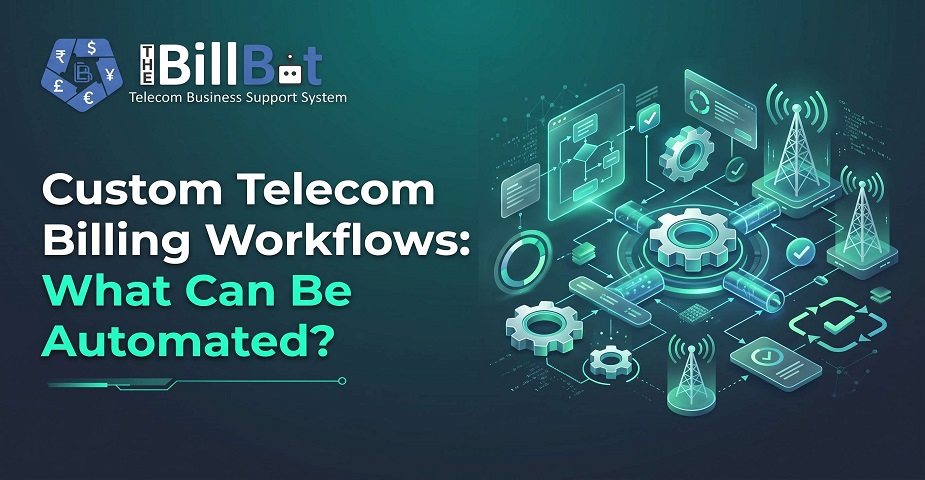
Table of Contents
- What Are Custom Telecom Billing Workflows?
- Why Does Telecom Billing Workflow Automation Matter?
- 1. Customer Account Setup and Service Activation
- 2. Call Detail Record Processing and Usage Rating
- 3. Recurring Charges and Flexible Pricing Rules
- 4. Invoice Generation and Delivery
- 5. Payment Reminders and Automated Payment Collection
- 6. Billing Exceptions and Error Handling
- 7. Billing Reports and Financial Reconciliation
- 8. Integrations with CRM, Payment Gateways and Other Systems
- 9. How to Build an Effective Custom Billing Workflow
- How The Bill Bot Can Support Telecom Billing Operations
- Conclusion
- Frequently Asked Questions (FAQs)
- 1. What are Custom Telecom Billing Workflows?
- 2. Which telecom billing tasks can be automated?
- 3. How does Telecom Billing Automation reduce errors?
- 4. Can telecom providers automate invoice generation?
- 5. What is the role of Customisable Billing Software?
- 6. Can payment collection be automated?
- 7. Is billing workflow automation suitable for small telecom providers?
- 8. How should a telecom provider choose billing automation software?
Author : Bhargav
Published : 21 Oct 2026
Related Articles
Explore more insights
19 Oct 2026 / Bhargav
How API Integrations Connect Telecom Billing With Your Business Systems
16 Oct 2026 / Bhargav
How Real-Time Billing Reports Help Telecom Providers Make Better Decisions
15 Oct 2026 / Bhargav