Introduction
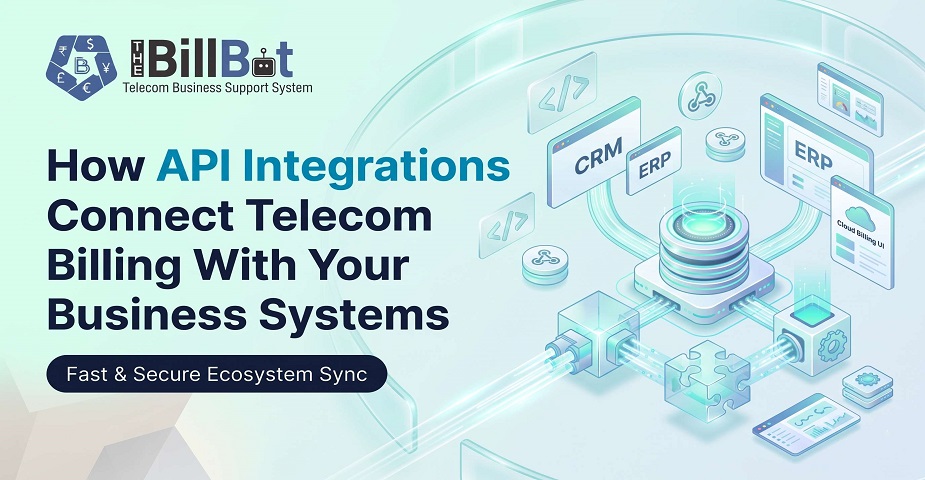
Telecom businesses rely on several systems to manage customers, services, billing, payments, and reporting. As a telecom provider grows, managing these activities across separate platforms can become complicated. Customer information may be stored in a CRM, usage records may come from a PBX or telecom platform, invoices may be generated through billing software, and payments may be handled by a separate payment gateway.
When these systems operate independently, teams often spend unnecessary time transferring data, checking records, correcting errors, and updating customer information manually.
This is where API integrations become valuable. They allow different software applications to communicate and exchange information, helping businesses connect their existing tools and create more efficient workflows.
For Internet Telephony Service Providers (ITSPs), Managed Service Providers (MSPs), and other telecom businesses, API integrations can connect billing platforms with CRM systems, payment gateways, service management tools, and reporting applications. This improves data consistency, reduces repetitive tasks, and supports a more connected business operation.
Understanding how API integrations work and where they can make the greatest difference can help telecom providers build a more reliable and scalable billing environment.
What Are API Integrations?
API stands for Application Programming Interface. It provides a defined way for two software applications to communicate, exchange information, and request specific actions.
In simple terms, an API acts as a bridge between systems that would otherwise operate separately.
For example, when a new customer is added to a CRM system, an API integration can send the relevant customer details to a telecom billing platform. The billing system can then use that information to set up the customer account, assign the appropriate services, and prepare for future invoicing.
Similarly, when an invoice is paid through a payment gateway, an integration can communicate the payment status to the billing platform, allowing the business to update its records and reduce manual reconciliation.
API integrations help businesses connect existing software rather than requiring employees to manage every system separately.
For telecom providers, this approach is particularly useful because billing depends on information from multiple sources, including customer accounts, service subscriptions, call detail records (CDRs), pricing plans, and payment transactions.
Why Are API Integrations Important for Telecom Billing?
Telecom billing involves more than generating invoices. It requires accurate customer information, service records, usage data, pricing rules, payment statuses, and financial reporting.
When these details are spread across disconnected applications, even small inconsistencies can create billing delays or customer service problems.
Telecom billing integrations help address these challenges by enabling relevant information to move between connected systems.
Key benefits include:
Reduced manual work: Automate repetitive data transfers and routine administrative tasks.
Improved data accuracy: Reduce errors caused by duplicate data entry and inconsistent records.
Faster billing processes: Make customer, service, and usage information available to the relevant billing workflows more efficiently.
Better customer experiences: Help teams access more consistent information when answering billing questions.
Improved visibility: Connect billing and payment information with reporting tools for better operational insights.
Greater scalability: Support business growth without increasing manual administration at the same rate.
With the right integration strategy, telecom providers can create a more connected environment that supports both daily operations and long-term business development.
1. How API Integrations Connect Different Business Systems
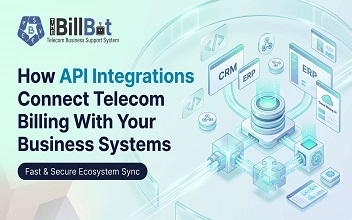
The real value of API integrations comes from connecting the applications that telecom businesses already use.
Instead of maintaining separate processes for sales, service activation, billing, and payments, businesses can create workflows in which information moves between systems when required.
CRM and Billing Integration
A CRM system stores customer details, sales activities, contact information, and customer relationships. A billing platform manages account charges, invoices, payment records, and billing cycles.
Through CRM and billing integration, customer information collected during the sales process can be transferred to the billing platform without requiring employees to enter the same details again.
For example, when a sales team closes a deal, the integration may transfer the customer's name, contact details, selected package, agreed pricing, and billing preferences to the relevant system.
This helps reduce duplicate records and allows teams to move more efficiently from customer acquisition to service delivery and billing.
Payment Gateway Integration
Collecting payments is another important part of telecom billing. Businesses may accept payments through online gateways, bank transfers, or other payment channels.
A payment gateway integration connects the payment platform with the billing system so that payment statuses and transaction references can be exchanged.
When a customer completes an eligible online payment, the integration can notify the billing platform. Depending on the configuration, the invoice status can then be updated and the transaction recorded for reconciliation.
This can reduce the need for manual payment checks and help finance teams identify outstanding invoices more efficiently.
Integration With PBX and Usage Systems
Telecom providers frequently use PBX platforms, call management systems, and other service applications to collect usage information.
For usage-based billing, call detail records contain information about calls and related activity. This data may need to be processed, validated, matched with customer accounts, and rated according to the applicable pricing rules.
With suitable telecom API integrations, usage information can be transferred between compatible systems, helping streamline the journey from usage collection to billing.
The integration must account for data formats, duplicate records, failed transfers, and differences in service identifiers to ensure the information is processed correctly.
Integration With Accounting and Reporting Software
Telecom businesses also need to maintain reliable financial records and monitor business performance.
A billing system can exchange relevant invoice, payment, tax, and customer account information with compatible accounting software. Reporting applications can also receive suitable billing data for analysis.
This type of business system integration helps reduce information silos and gives different teams access to the information they need.
However, the exact data exchanged depends on the capabilities of each application, the API permissions, and the integration configuration.
2. Key Benefits of API Integrations for Telecom Providers
API integrations can improve several areas of telecom business management when they are planned around real operational requirements.
Reduced Manual Data Entry
Entering the same information into multiple applications consumes valuable time and creates opportunities for mistakes.
For example, an employee might enter customer information into a CRM, copy it into a billing system, and then update another platform when a service changes. These repeated steps can become difficult to manage as the customer base expands.
API integrations can automate suitable data transfers between connected applications. Employees can then spend less time updating records and more time supporting customers, resolving issues, and improving business operations.
Improved Billing Accuracy
Accurate billing depends on consistent information across customer accounts, service records, pricing plans, usage data, and payment transactions.
When information is updated manually, different systems may contain conflicting details. An outdated package price or an incorrect account reference can create unnecessary billing investigations.
A well-designed billing system integration helps synchronise relevant information and reduces errors associated with manual transfers.
Automation does not eliminate every billing error. Validation rules, exception handling, reconciliation, and monitoring remain important for maintaining reliable billing records.
Faster Operational Workflows
Connected systems can reduce delays between business activities.
For example, when a customer changes a service package, an integration may communicate the approved change to the billing platform. The billing system can then apply the change according to the effective date and applicable pricing rules.
This can help teams manage account updates, service changes, and billing adjustments more efficiently.
Better Customer Service
Customers expect clear invoices, accurate account information, and timely answers to billing questions.
When CRM, billing, and payment records are connected, support teams can more easily access relevant information without switching between multiple disconnected applications.
This makes it easier to investigate invoice queries, verify payment statuses, and understand the services associated with a customer account.
Improved Business Scalability
As telecom providers acquire more customers and expand their service portfolios, disconnected systems can become increasingly difficult to manage.
Telecom billing automation supported by suitable API integrations can help businesses handle growing transaction volumes and more complex workflows.
Instead of relying entirely on additional manual work, providers can automate repeatable processes while maintaining appropriate checks and controls.
3. Common Use Cases for Telecom API Integrations
API integrations can support a variety of operational workflows. The most useful applications depend on the systems a provider already uses and the challenges it wants to solve.
These integrations can work together to create a more connected operating environment.
For example, a telecom provider could capture a new customer in its CRM, transfer approved service details to its billing platform, process usage information from a compatible PBX, issue an invoice, and receive a payment confirmation from its gateway.
Each step can remain subject to the relevant business rules and checks, but fewer activities need to depend on repeated manual data entry.
4. How to Implement API Integrations Successfully
Choosing to connect systems is only the first step. A successful integration requires planning, technical compatibility, and ongoing management.
Identify Your Business Requirements
Start by identifying the processes that create the most manual work or operational delays.
These may include customer onboarding, service activation, usage imports, invoice generation, payment reconciliation, or financial reporting.
Define what information needs to move between applications, which system should be the source of truth, and what should happen when information changes.
A clear scope helps avoid unnecessary development and keeps the project focused on measurable business benefits.
Check API Compatibility
Not all applications provide the same integration capabilities.
Before implementation, check whether each system supports the required API endpoints, authentication methods, data formats, permissions, and event notifications.
Some applications may offer ready-made connectors, while others may require custom development or an integration platform.
For telecom software integration, compatibility is especially important when connecting systems that process different customer identifiers, service codes, usage formats, or billing rules.
Protect Sensitive Business Data
API integrations may exchange customer details, financial records, usage information, and other business data.
Use appropriate authentication, access controls, encrypted connections, and permissions that limit each integration to the information and actions it needs.
Businesses should also maintain logs, monitor unusual activity, manage credentials securely, and review relevant privacy and compliance requirements.
Security should be part of the initial design rather than an additional step after the integration has been deployed.
Test Before Going Live
Testing helps confirm that information moves correctly between connected systems.
A useful testing process should cover normal transactions as well as unusual situations, such as missing customer details, duplicate usage records, failed payments, API timeouts, and rejected requests.
Verify that invoice totals, customer references, payment statuses, and relevant timestamps remain consistent across systems.
Where possible, use a controlled test environment before enabling the integration for live business operations.
Monitor and Maintain the Integration
APIs can change, credentials can expire, and external services can become temporarily unavailable.
Monitor integration performance, failed requests, processing delays, and data mismatches. Implement retry mechanisms and exception queues where appropriate, while ensuring that retries do not create duplicate invoices or transactions.
Regular reviews help maintain reliable automated billing systems as business requirements and connected applications evolve.
5. Choosing the Right Telecom Billing Software
The effectiveness of API integrations also depends on the billing platform at the centre of your business operations.
Telecom providers should look for telecom billing software that supports their existing systems, business processes, and future requirements.
Important considerations include:
Integration capabilities: Check whether the platform provides suitable APIs, documented endpoints, and compatible connectors.
Flexible billing rules: Ensure it can support the pricing models, billing cycles, and usage-charging requirements of your business.
Customer management: Look for reliable handling of customer accounts, services, packages, and billing information.
Payment processing: Consider how the platform connects with payment gateways and supports payment tracking.
Reporting capabilities: Ensure relevant billing and financial data can be accessed for analysis and reporting.
Security and reliability: Evaluate access controls, audit trails, error handling, and integration monitoring.
Room to grow: Choose a solution that can accommodate additional customers, services, and integrations as your business expands.
The objective is not simply to connect as many applications as possible. It is to build a dependable system in which information reaches the right place at the right time, with the necessary controls to maintain accuracy.
6. How The Bill Bot Can Support Connected Billing Operations
For telecom providers, ITSPs, and MSPs, managing billing alongside customer information, services, payments, and reporting requires a structured approach.
The Bill Bot provides a business support system designed for telecom and IT service providers. A connected billing environment can help businesses bring important operational activities together and reduce dependence on disconnected manual processes.
When evaluating The Bill Bot or any other billing platform for an integration project, businesses should identify the systems they need to connect and confirm the availability of the specific APIs, connectors, and workflows required.
This approach helps ensure that an integration project addresses real operational needs rather than introducing unnecessary complexity.
Explore The Bill Bot to learn more about its billing and business support capabilities.
7. The Future of API Integrations in Telecom
As telecom businesses expand their services and adopt more digital tools, API integrations will continue to play an important role in connecting business applications.
Providers increasingly need efficient ways to exchange customer data, manage service changes, process usage information, track payments, and analyse business performance.
Well-designed integrations can support these needs by improving information flow and reducing repetitive work. They can also make it easier to introduce new applications without rebuilding every existing business process.
However, successful integration depends on more than connectivity. Data quality, security, compatibility, monitoring, and clearly defined business rules remain essential.
Telecom providers that approach integration strategically can build a more flexible operating environment and prepare their billing processes for future growth.
Conclusion
API integrations help telecom providers connect billing software with the business systems they rely on every day. By linking CRM platforms, payment gateways, PBX systems, accounting applications, and reporting tools, businesses can reduce manual data entry and improve the flow of information across their operations.
For ITSPs, MSPs, and telecom service providers, the benefits can include more consistent customer records, smoother billing workflows, improved payment visibility, and better operational efficiency.
The key is to identify the right integration opportunities, choose compatible software, protect business data, and monitor connected workflows carefully.
With a clear strategy, API integrations can help transform disconnected applications into a more efficient and scalable telecom business environment.
Frequently Asked Questions (FAQs)
1. What are API integrations in telecom billing?
API integrations connect telecom billing software with other applications, such as CRM platforms, payment gateways, PBX systems, and accounting tools. They allow compatible systems to exchange information and automate selected business processes.
2. How do API integrations improve telecom billing?
They can reduce manual data entry, improve the consistency of customer and service records, speed up information exchange, and simplify payment tracking. Proper validation and monitoring are still required to maintain billing accuracy.
3. Why are telecom billing integrations important for ITSPs and MSPs?
ITSPs and MSPs often manage multiple customers, services, pricing arrangements, and billing requirements. Integrations help connect their business applications and reduce the administrative effort involved in managing these activities.
4. Can API integrations automate invoice generation?
Yes. Depending on the software capabilities and integration design, APIs can transfer customer, service, and usage information to a billing platform. The platform can then generate invoices according to configured billing rules and schedules.
5. What systems can connect with telecom billing software?
Common examples include CRM systems, PBX platforms, payment gateways, accounting software, service provisioning tools, and business intelligence applications. The available integrations depend on each system's API capabilities and permissions.
6. Are API integrations secure?
API integrations can be secure when they use appropriate authentication, encrypted connections, access controls, logging, and monitoring. Businesses should also manage credentials carefully and review their data protection requirements.
7. What should businesses consider before implementing API integrations?
Businesses should assess their operational requirements, software compatibility, data formats, security controls, implementation costs, error-handling procedures, and ongoing maintenance needs before starting an integration project.
8. How do API integrations support telecom business growth?
They help businesses automate repeatable workflows and exchange information more efficiently. This can reduce administrative pressure as customer numbers, service offerings, and transaction volumes increase.