In the telecom industry, maintaining a steady cash flow is essential for business stability and long-term growth. Telecom service providers manage recurring subscriptions, usage-based charges, call plans, connectivity services and other customer billing activities. While these services generate regular revenue, collecting payments on time can be a persistent challenge. Late payments and overdue invoices can affect daily operations, delay business investments and increase the administrative workload for finance teams. Manually following up with customers, tracking payment dates and reconciling transactions can become increasingly difficult as a telecom business grows. This is where effective Telecom Payment Collection becomes important. By improving invoice accuracy, automating payment reminders and using integrated billing systems, telecom providers can reduce payment delays and manage outstanding balances more efficiently. In this guide, we explore the common causes of overdue telecom invoices and practical ways to improve payment collection, strengthen cash flow and build better customer payment experiences. Telecom Payment Collection refers to the processes and systems used by telecom service providers to collect payments for services delivered to customers. These payments may include monthly subscriptions, call usage, data services, broadband packages, recurring charges and other telecom-related services. An effective payment collection process covers more than sending an invoice and waiting for payment. It involves generating accurate invoices, communicating payment terms, monitoring due dates, sending reminders, recording transactions and following up on outstanding balances. For ITSPs, VoIP providers, telecom operators and managed service providers, a structured collection process helps maintain financial visibility while reducing unnecessary manual work. With suitable telecom billing software, businesses can connect invoicing, payment tracking and customer account management within a more organised workflow. Understanding why customers pay late is the first step towards improving collection performance. Several factors can contribute to overdue invoices. When billing teams prepare invoices manually, they may encounter calculation mistakes, missing charges or delays in sending invoices. These issues can lead to customer queries and postpone payment. Customers may delay payment when invoices contain confusing descriptions, incorrect usage figures or unexpected charges. Clear invoices make it easier for customers to understand what they owe and why. Finance teams managing hundreds or thousands of accounts may struggle to follow up with every customer at the right time. Without a consistent reminder process, invoices can remain unpaid long after their due dates. When payment records are spread across different platforms, identifying completed transactions and outstanding balances becomes more complicated. This can increase reconciliation work and create uncertainty about customer account status. Without reliable reporting, businesses may struggle to identify overdue accounts, recurring late payers and invoices that require immediate attention. As a result, collection activities may happen too late. Addressing these challenges requires a combination of accurate billing, clear communication, automation and consistent monitoring. Accurate and timely invoicing is the foundation of effective payment collection. If invoices are generated late, customers have less time to review charges and arrange payment. Telecom providers can use automated billing systems to generate invoices according to predefined billing cycles. These systems can support recurring subscriptions, usage-based charges, custom pricing and other billing requirements, depending on their configuration. Automation reduces repetitive administrative tasks and helps businesses maintain a consistent invoicing schedule. For better results, providers should regularly review billing rules, customer information, tax settings and usage records to minimise errors before invoices are issued. Following up with customers individually can consume considerable time, especially for businesses with large customer bases. Payment Reminder Automation helps businesses send scheduled notifications before and after invoice due dates. For example, a provider may send a reminder several days before payment is due, another on the due date and a follow-up when an invoice becomes overdue. Reminder messages should include essential information such as the invoice number, outstanding amount, due date and available payment instructions. A polite, consistent approach can encourage customers to pay promptly without creating unnecessary friction. Businesses should also configure reminders to stop or update when payments are recorded, where their systems support this functionality. A complicated payment process can discourage customers from paying promptly. If customers must contact the finance team to request payment instructions or complete several manual steps, the process becomes less convenient. Telecom businesses can simplify payment collection by offering suitable digital payment options, such as online payment links, card payments or bank transfers, depending on their customers and available payment infrastructure. Integrated Telecom Payment Collection Software can help connect invoices with payment workflows, making it easier for customers to settle outstanding balances. Providers should communicate accepted payment methods clearly and ensure that payment instructions are easy to follow. Customers need to understand what they are being charged for before they can confidently approve payment. A professional telecom invoice should clearly display service descriptions, billing periods, recurring charges, usage-based fees, taxes, adjustments and the total amount due. For usage-based telecom services, accurate call detail records (CDRs) and reliable rating processes are particularly important. Incorrect usage calculations can create disputes that delay collections. Strong Telecom Invoice Management practices help providers maintain consistent invoice formats, review charges and resolve discrepancies more efficiently. Before issuing invoices, businesses should validate important billing information and establish a straightforward process for handling customer questions. Businesses cannot manage overdue payments effectively without knowing which invoices are outstanding and how long they have remained unpaid. A structured Overdue Invoice Management process categorises outstanding invoices by age, amount, customer or risk level. For example, finance teams can separate invoices that are slightly overdue from those that have remained unpaid for several weeks or months. This makes it easier to prioritise follow-ups and allocate resources to accounts that need attention. Useful reports may include: Total outstanding receivables. Invoices approaching their due dates. Overdue invoices grouped by ageing period. Customers with repeated late payments. Payments received against outstanding invoices. Disputed invoices requiring investigation. Reviewing these reports regularly gives management a clearer understanding of collection performance and potential cash flow issues. When billing, customer management and payment records operate separately, finance teams may need to update multiple systems manually. This increases the risk of inconsistent records and missed follow-ups. Integrating Telecom Billing and Payments can provide a more connected view of invoices, transactions and customer account balances. Depending on the available integrations, a system may update invoice status after a payment is recorded, support transaction reconciliation and help teams identify unpaid balances. A connected workflow also reduces the time spent checking payment confirmations and updating customer records. Before implementing an integration, businesses should confirm that it supports their payment providers, accounting processes and reconciliation requirements. Effective Accounts Receivable Management requires clear procedures for monitoring invoices, communicating with customers and escalating unresolved payment issues. Telecom providers should establish payment terms, define responsibility for follow-ups and create a consistent process for handling overdue accounts. For example, the finance team might send an initial reminder after the due date, contact the customer if the invoice remains unpaid and escalate the account when the delay exceeds an agreed threshold. Customer payment history can help teams decide which accounts require closer monitoring. However, follow-up decisions should also consider legitimate billing disputes, agreed payment arrangements and individual circumstances. A documented process helps businesses maintain consistency while ensuring that important accounts do not go unnoticed. Collection reports help businesses understand whether their payment processes are working as intended. Instead of focusing only on the total amount collected, telecom providers should monitor several indicators, including: Days Sales Outstanding (DSO): An estimate of how long it takes to collect receivables. Overdue invoice percentage: The proportion of outstanding invoices that have passed their due dates. Collection rate: The share of amounts due that are collected during a defined period, using a consistent calculation method. Dispute resolution time: How long it takes to resolve invoice-related customer issues. Payment reminder effectiveness: Whether reminders are followed by payments within the expected period. These metrics can reveal recurring problems, such as delayed invoicing, ineffective reminders or customers who regularly pay late. With reliable reporting, businesses can adjust collection schedules, improve customer communication and make better-informed financial decisions. Telecom Payment Automation can make payment collection more predictable by connecting several tasks that would otherwise require manual intervention. For example, a typical automated workflow may begin when a billing system generates an invoice. The customer receives the invoice electronically, followed by a reminder as the due date approaches. If the invoice remains unpaid, the system sends a follow-up notification and flags the outstanding balance for review. When payment is recorded, the invoice status can be updated and the transaction reconciled, depending on the system's capabilities and integrations. This approach offers several potential benefits: Less manual administration: Teams spend less time preparing routine communications and checking account statuses. More consistent follow-ups: Customers receive reminders according to defined schedules. Improved visibility: Finance teams can identify outstanding invoices more easily. Faster issue identification: Discrepancies and unresolved balances can be flagged for investigation. Better scalability: Standardised workflows help businesses manage larger customer bases without increasing manual effort at the same rate. Automated processes do not eliminate every payment delay. Customer disputes, insufficient funds and incorrect account details may still require human intervention. However, automation helps ensure that routine collection activities are completed consistently. Selecting suitable Telecom Payment Collection Software starts with understanding your business's billing model, customer volume and collection challenges. Look for a solution that supports your operational requirements rather than choosing software based on features alone. Important capabilities to consider include: Automated invoicing: The system should support the billing cycles and charging models your business uses. Payment reminders: Look for configurable reminders that can respond to invoice due dates and payment status. Payment tracking: Finance teams should be able to review transaction records and identify unpaid invoices. Billing integration: The software should work with your customer management, accounting and payment systems where required. Reporting and analytics: Clear dashboards and receivables reports help teams monitor collection performance. Customer account visibility: Staff should be able to access relevant invoice histories and payment information. Security and access controls: Payment-related workflows should follow appropriate security practices, with controlled access to sensitive financial information. For growing VoIP providers, ITSPs and MSPs, a connected business support system can help bring billing, invoicing, customer records and reporting into a more manageable process. The most suitable solution is one that fits your existing workflows, supports future growth and helps your team reduce avoidable collection delays. The Bill Bot provides a business support system designed for telecom service providers and related businesses. Its billing-focused capabilities can help businesses organise billing activities and manage recurring operational tasks within a connected platform. For providers looking to improve payment collection, bringing billing, invoice management, customer information and reporting together can support a more structured approach to receivables. Businesses evaluating a solution should review the available features, integrations and payment workflows to confirm they meet their specific requirements. Learn more about The Bill Bot at https://thebillbot.com/ and explore how a more organised billing process can support operational efficiency as your business grows. Technology works best when supported by clear business processes. Telecom providers can improve collection outcomes by following a few practical principles. Establish clear payment terms before activating services. Issue accurate invoices promptly and consistently. Provide customers with straightforward payment instructions. Send reminders before invoices become overdue. Review receivables and ageing reports regularly. Resolve billing disputes quickly and communicate progress. Reconcile payment records consistently. Monitor collection performance and improve workflows based on results. These practices help businesses create a repeatable collection process instead of relying on last-minute follow-ups. Effective Telecom Payment Collection is essential for telecom providers that want to maintain healthy cash flow, reduce administrative pressure and manage customer accounts efficiently. Overdue invoices often result from a combination of manual billing, unclear invoice details, inconsistent reminders and limited payment visibility. By addressing these issues through accurate invoicing, payment automation, regular reporting and better accounts receivable management, businesses can create a more reliable collection process. Telecom billing software and connected payment workflows can help providers standardise routine tasks and identify outstanding balances sooner. When supported by clear policies and responsive customer communication, these improvements can reduce avoidable delays and support sustainable business growth. The goal is not simply to collect payments faster. It is to build a transparent, consistent and scalable billing process that works for both the business and its customers. Telecom Payment Collection is the process of collecting payments for telecom services, including subscriptions, call usage, broadband, data plans and other recurring or usage-based charges. Providers can reduce overdue invoices by issuing accurate invoices on time, automating payment reminders, offering convenient payment methods, monitoring outstanding balances and resolving billing disputes promptly. Telecom Payment Collection Software helps businesses manage invoice-related payment workflows, track outstanding balances and organise collection activities. Available capabilities vary by provider and integration. Payment reminder automation sends scheduled notifications before or after invoice due dates. It helps ensure consistent follow-ups and reduces the need for staff to contact every customer manually. Telecom billing software helps generate invoices, apply billing rules and maintain billing records. When connected to payment tracking and reporting tools, it can also support more efficient collection workflows. Overdue Invoice Management is the process of identifying, monitoring and following up on invoices that have not been paid by their due dates. It often includes ageing reports, customer communication and escalation procedures. Useful metrics include Days Sales Outstanding, overdue invoice percentage, collection rate, outstanding receivables and dispute resolution time. Monitoring these indicators helps businesses identify areas for improvement. No. Automated payment collection can improve reminder consistency and reduce manual delays, but it cannot eliminate every late payment. Disputes, financial difficulties and payment processing issues may still require direct intervention.What Is Telecom Payment Collection?
Why Do Telecom Businesses Experience Overdue Invoices?
1. Manual Billing Processes
2. Unclear Invoice Details
3. Missed Payment Reminders
4. Multiple Payment Methods and Systems
5. Limited Visibility into Outstanding Balances
8 Ways to Improve Telecom Payment Collection and Reduce Overdue Invoices
1. Automate Telecom Invoice Generation
2. Implement Automated Payment Reminders
3. Make Payment Options Convenient
4. Improve Invoice Accuracy and Transparency
5. Monitor Overdue Invoices Regularly
6. Integrate Billing and Payment Tracking
7. Strengthen Accounts Receivable Management
8. Use Reports to Improve Collection Performance
How Telecom Payment Automation Improves Cash Flow
How to Choose Telecom Payment Collection Software
How The Bill Bot Can Support Telecom Billing and Collections
Best Practices for Reducing Overdue Telecom Invoices
Conclusion
Frequently Asked Questions (FAQs)
1. What is Telecom Payment Collection?
2. How can telecom providers reduce overdue invoices?
3. What is Telecom Payment Collection Software?
4. How does payment reminder automation help telecom businesses?
5. What role does telecom billing software play in payment collection?
6. What is Overdue Invoice Management?
7. Which metrics should telecom providers monitor for payment collection?
8. Can automated payment collection eliminate late payments?
 Book a Demo
Telecom Payment Collection: How to Reduce Overdue Invoices
Bhargav
Oct 15, 2026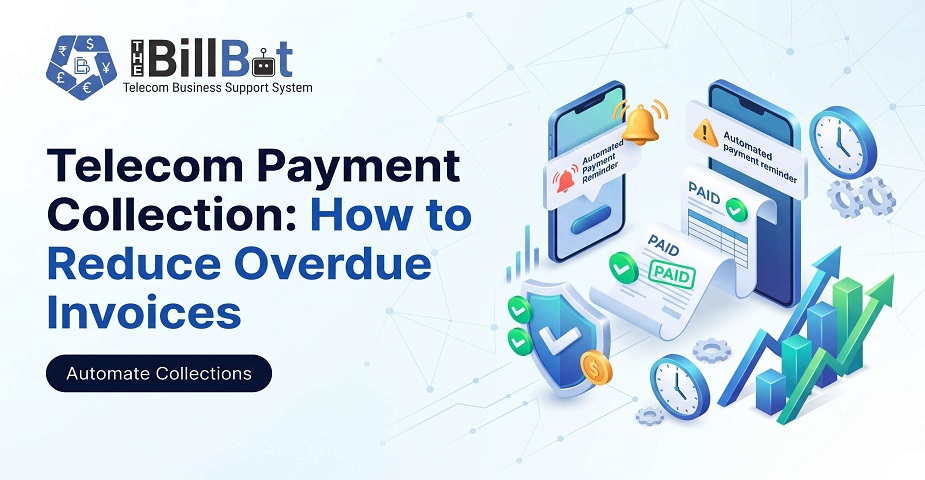
Table of Contents
- What Is Telecom Payment Collection?
- Why Do Telecom Businesses Experience Overdue Invoices?
- 1. Manual Billing Processes
- 2. Unclear Invoice Details
- 3. Missed Payment Reminders
- 4. Multiple Payment Methods and Systems
- 5. Limited Visibility into Outstanding Balances
- 8 Ways to Improve Telecom Payment Collection and Reduce Overdue Invoices
- 1. Automate Telecom Invoice Generation
- 2. Implement Automated Payment Reminders
- 3. Make Payment Options Convenient
- 4. Improve Invoice Accuracy and Transparency
- 5. Monitor Overdue Invoices Regularly
- 6. Integrate Billing and Payment Tracking
- 7. Strengthen Accounts Receivable Management
- 8. Use Reports to Improve Collection Performance
- How Telecom Payment Automation Improves Cash Flow
- How to Choose Telecom Payment Collection Software
- How The Bill Bot Can Support Telecom Billing and Collections
- Best Practices for Reducing Overdue Telecom Invoices
- Conclusion
- Frequently Asked Questions (FAQs)
- 1. What is Telecom Payment Collection?
- 2. How can telecom providers reduce overdue invoices?
- 3. What is Telecom Payment Collection Software?
- 4. How does payment reminder automation help telecom businesses?
- 5. What role does telecom billing software play in payment collection?
- 6. What is Overdue Invoice Management?
- 7. Which metrics should telecom providers monitor for payment collection?
- 8. Can automated payment collection eliminate late payments?
Author : Bhargav
Published : 15 Oct 2026
Related Articles
Explore more insights
14 Oct 2026 / Bhargav
How Automated CDR Processing Simplifies Telecom Usage Billing

13 Oct 2026 / Bhargav
How Automated Telecom Billing Reduces Manual Work and Billing Errors

12 Oct 2026 / Bhargav