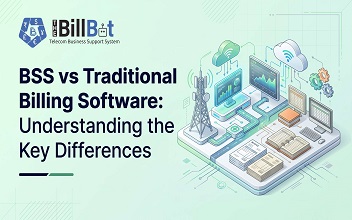
Telecom businesses need more than accurate invoices to manage their daily operations successfully. They must handle customer accounts, service subscriptions, pricing plans, usage records, payments, reporting, and customer communication. As a business grows, managing all these activities through separate systems or manual processes can become increasingly difficult.
This is where the comparison of BSS vs Traditional Billing Software becomes important.
Traditional billing software primarily focuses on calculating charges, generating invoices, and recording payments. A Business Support System (BSS), on the other hand, can connect billing with customer management, product and service management, order processing, and other essential business operations.
Both solutions have their place, but they serve different business needs. Understanding their differences can help telecom providers, Internet Telephony Service Providers (ITSPs), and Managed Service Providers (MSPs) choose a solution that supports their current operations and future growth.
In this blog, we will explore how BSS differs from traditional billing software, the main benefits of each approach, and the factors businesses should consider when choosing the right solution.
What Is Traditional Billing Software?
Traditional Billing Software is designed to manage the financial side of a business. Its primary purpose is to calculate charges, create invoices, track payments, and maintain billing records.
For a small business with a straightforward pricing structure and a limited customer base, this type of software may provide everything needed to manage billing efficiently.
For example, a telecom provider offering a few fixed monthly calling plans may use traditional billing software to generate recurring invoices and record customer payments.
Common features of traditional billing software include:
Invoice generation: Creates invoices based on predefined prices and billing periods.
Payment tracking: Records payments received from customers.
Recurring billing: Generates invoices at regular intervals.
Basic customer records: Stores customer details required for billing.
Tax calculations: Applies relevant taxes to invoices.
Financial reporting: Provides summaries of invoices, outstanding balances, and payments.
These features can help reduce paperwork and improve billing accuracy.
However, traditional billing software may have limitations when a business needs to manage complex telecom pricing, usage-based charges, customer subscriptions, service provisioning, or multiple integrations.
Depending on the product, these additional requirements may need separate tools or custom development.
What Is a Business Support System (BSS)?
A Business Support System (BSS) is a broader software solution that helps telecom businesses manage customer-facing and commercial operations.
Instead of concentrating only on invoices and payments, a BSS can connect different activities across the customer and billing lifecycle.
For example, when a telecom provider signs up a new customer, the business may need to record customer information, select services, assign a pricing plan, configure billing rules, and prepare the account for invoicing.
A well-integrated BSS can help coordinate these activities through a connected platform, reducing the need to maintain the same information across multiple systems.
Depending on its features and configuration, BSS Software for Telecom may include:
Customer management: Maintains customer profiles, account details, and service information.
Product and service management: Organises services, packages, and pricing plans.
Usage-based billing: Calculates charges using call records, data usage, or other billable activities.
Invoice management: Supports invoice creation, adjustments, and billing schedules.
Payment management: Tracks payments, outstanding balances, and payment status.
Automation: Automates recurring billing activities, notifications, and other configured workflows.
Reporting and analytics: Helps businesses monitor revenue, collections, usage, and customer accounts.
System integrations: Connects billing with compatible PBX, CRM, payment, accounting, and other business systems.
Not every BSS includes all these capabilities. The available functions depend on the platform, integrations, and configuration.
For telecom providers managing multiple services and increasingly complex billing requirements, a BSS can offer a more connected approach to business management.
BSS vs Traditional Billing Software: Key Differences
Although both systems can support billing operations, their scope and capabilities can differ significantly.
Let's examine the most important differences.
1. Scope of Functionality
The biggest difference between BSS and traditional billing software is the range of business activities they support.
Traditional billing software primarily handles financial transactions associated with customer services. Its main responsibilities are calculating charges, generating invoices, and recording payments.
A BSS can extend beyond these activities by connecting billing with customer management, product configuration, service information, and operational workflows.
For example, a business using traditional billing software may need separate applications to manage customer enquiries, service packages, and invoices.
A suitable BSS may bring several of these functions together, giving teams a more consistent view of customer accounts and services.
Key difference: Traditional billing software focuses mainly on billing, while a BSS can support a wider range of commercial and customer-related processes.
2. Customer Management
Customer management becomes increasingly important as a telecom provider grows.
Traditional billing software may store customer names, billing addresses, account numbers, and payment details. These records are generally sufficient when the main requirement is to generate invoices.
However, telecom providers may also need to track customer services, subscriptions, pricing agreements, account changes, and billing history.
A BSS can connect customer information with relevant services and billing records, depending on its capabilities.
For instance, when a customer changes their service package, an integrated system can help the business maintain consistent customer and billing information.
This reduces the need for staff to update multiple applications manually.
Key difference: Traditional billing software typically maintains the information needed for invoicing, whereas a BSS can provide a broader view of the customer relationship.
3. Billing Complexity and Flexibility
Not all telecom services follow the same billing model.
Some customers pay a fixed monthly subscription, while others are charged according to call duration, usage volume, destinations, or additional services.
Traditional billing software can handle recurring charges and other billing rules when those capabilities are available. However, more complicated requirements may demand additional configuration, integrations, or custom development.
Telecom Billing Software within a BSS environment may support a wider combination of billing requirements, depending on the platform.
For example, a VoIP provider might need to combine monthly subscriptions with call detail record (CDR) processing, usage-based charges, discounts, and additional service fees.
A flexible billing platform can help apply the appropriate rules to different customers and services.
Key difference: Both systems may support automated billing, but a BSS designed for telecom operations can offer broader options for managing complex services and charging models.
4. Automation of Business Processes
Manual processes can consume significant time when a business manages hundreds or thousands of customer accounts.
Traditional billing software can automate routine activities such as recurring invoice generation and basic payment recording.
A BSS may support a wider range of workflows, including customer onboarding, billing preparation, invoice delivery, payment reminders, and reporting.
For example, an automated workflow could help process usage records, calculate customer charges, generate invoices, and notify customers when invoices are ready.
The extent of automation depends on the available features and how the business configures its processes.
Automation does not eliminate the need for oversight. Businesses still need appropriate checks for incorrect usage records, disputed charges, failed transactions, and exceptional billing cases.
Key difference: Traditional billing software automates billing-related tasks, while a broader BSS can automate connected processes across several business functions.
5. Product and Service Management
Telecom providers often offer multiple services, including VoIP, DID numbers, extensions, broadband, calling plans, and other communication products.
Managing different services can become complicated when pricing information and customer records are maintained in separate systems.
Traditional billing software may support service descriptions and price lists, but advanced product and package management is not always included.
A BSS may allow businesses to manage products, packages, pricing structures, and billing rules within a connected environment.
For example, a provider offering a customer a combination of phone extensions, DID numbers, and a monthly calling package needs to ensure that each service is configured correctly and billed according to its pricing terms.
A suitable BSS can help organise these services and link them to the relevant customer account.
Key difference: Traditional billing software concentrates on charging for products or services, while a BSS can also help manage how those products and services are structured.
6. Integrations With Other Business Systems
Telecom businesses often depend on several applications to manage their operations.
These may include PBX platforms, CRM systems, accounting applications, payment gateways, and communication tools.
Traditional billing software may offer limited integrations or require additional development to connect with other applications.
A BSS can provide broader integration capabilities, depending on the platform and available APIs.
For example, a billing system integrated with a compatible PBX platform may receive call records for processing. A connection with a payment gateway may help update payment information, while an accounting integration may support financial reconciliation.
Well-designed integrations reduce duplicate data entry and help teams work with consistent information.
However, businesses should verify whether their existing systems are supported before selecting a solution.
Key difference: Integration capabilities vary across both categories, but a BSS may provide a more connected environment for managing telecom business processes.
7. Reporting and Business Insights
Billing information can help businesses understand more than how much money they have invoiced.
It can also reveal payment patterns, customer activity, outstanding balances, service usage, and revenue trends.
Traditional billing software generally provides reports related to invoices, payments, and account balances. More advanced products may offer additional analytics.
A BSS can connect billing information with customer and service data to provide broader operational insights.
For example, a telecom provider may want to identify customers with overdue invoices, compare revenue across service categories, or understand which customers generate the highest usage charges.
Access to relevant information can help managers make better decisions about pricing, collections, customer service, and business planning.
Key difference: Traditional billing reports focus primarily on financial transactions, while BSS reporting may offer a broader view of customers, services, and business performance.
8. Scalability and Business Growth
A system that works well for a small business may become difficult to manage as the organisation expands.
An increasing customer base often means more invoices, additional pricing plans, more usage records, and greater demand for accurate reporting.
Traditional billing software can scale effectively when it has sufficient capacity and the required features. However, a basic solution may become restrictive if the business introduces more complex services or workflows.
A suitable BSS can provide a foundation for managing a broader range of operations as the business grows.
For example, a VoIP provider that starts with a small number of customers may eventually serve multiple customer segments with different pricing plans, billing cycles, and service requirements.
The right system should accommodate these changes without creating unnecessary administrative work.
Key difference: Scalability depends on the individual product, but a BSS with flexible billing, integrations, and workflow capabilities may be better suited to businesses with expanding operational requirements.
BSS vs Traditional Billing Software: Comparison Table
The following table summarises the main differences.
Important: These are general differences, not universal rules. Modern billing platforms can include advanced BSS capabilities, while some BSS products may require additional modules or integrations to deliver specific functions.
Benefits of Using BSS Software for Telecom Businesses
For telecom providers, the right Business Support System can improve efficiency by connecting activities that would otherwise be handled separately.
Here are some potential benefits.
1. Reduced Manual Work
A connected platform can reduce repetitive tasks such as entering customer information into multiple systems, preparing invoices manually, and updating payment records.
This allows staff to spend more time resolving customer issues and managing business operations.
2. Improved Billing Accuracy
Automated billing processes can apply configured pricing rules consistently and reduce errors caused by manual calculations or duplicate data entry.
Businesses must still validate usage records and review exceptions to maintain accurate invoices.
3. Better Customer Visibility
When customer information, services, and billing records are connected, staff can access relevant account details more easily.
This can help resolve billing questions and improve communication with customers.
4. More Efficient Payment Collection
Payment tracking, automated reminders, and overdue invoice reporting can help businesses follow up on outstanding balances more consistently.
These features can support better cash flow management, although they cannot guarantee that customers will pay on time.
5. Greater Operational Visibility
Reports covering revenue, usage, invoices, and outstanding balances can help managers understand business performance and identify areas requiring attention.
6. Support for Business Expansion
Flexible pricing, configurable billing rules, and compatible integrations can help a telecom provider introduce new services and manage a growing customer base.
The practical benefits depend on the solution selected and how well it fits the organisation's existing processes.
When Should a Business Choose Traditional Billing Software?
Traditional billing software may be the right choice when a business has straightforward requirements and does not need extensive operational integration.
It may be suitable if:
The business offers a limited number of services.
Most customers follow simple, fixed-price billing arrangements.
Customer management requirements are relatively basic.
The organisation mainly needs invoicing and payment tracking.
Existing business systems already handle customer management and service operations effectively.
A broader platform would introduce unnecessary cost or complexity.
For these businesses, a focused billing solution can be practical, provided it meets current requirements and offers a reasonable path for future growth.
When Should a Business Choose a BSS?
A BSS may be a better fit when billing is closely connected to customer management, service configuration, usage processing, and other operational activities.
Consider a BSS if:
The business manages multiple telecom products or service packages.
Customers have different billing cycles and pricing arrangements.
Usage-based charging and CDR processing are important.
Staff spend considerable time moving data between applications.
The business needs integrated customer and billing information.
Automated workflows could reduce repetitive administrative work.
Management needs reporting across customers, services, invoices, and payments.
The organisation expects its service portfolio or customer base to expand.
Before making a decision, list the features you need, identify the systems that must integrate, and compare the implementation effort and total cost of ownership.
The best solution is the one that meets your operational needs without adding unnecessary complexity.
How The Bill Bot Can Help Telecom Businesses
Telecom providers need billing processes that can accommodate their services, pricing arrangements, and customer requirements.
The Bill Bot offers a business support platform designed for telecom service providers, including VoIP providers, ITSPs, and MSPs.
Its platform focuses on bringing billing and related business operations into a more connected environment.
Depending on the configured solution and enabled features, businesses can use capabilities related to:
Billing management: Organise billing processes and manage customer charges.
CDR processing: Support the processing of call detail records for usage-based billing.
Customer management: Maintain customer account and service information.
Invoice management: Manage invoice generation and related billing activities.
Payment and collection workflows: Support payment tracking and collection processes.
Reporting and analytics: Access information to help monitor billing and business performance.
Integrations: Connect compatible systems to support connected workflows.
For organisations evaluating BSS vs Traditional Billing Software, it is worth considering whether a platform can support both immediate billing requirements and broader operational needs as the business develops.
Explore the platform and its available capabilities on the official website: The Bill Bot.
Frequently Asked Questions (FAQs)
1. What is the main difference between BSS and traditional billing software?
The main difference is their scope. Traditional billing software primarily manages invoices, charges, and payments. A Business Support System (BSS) can also connect billing with customer management, product and service management, and other commercial workflows.
2. Is BSS better than traditional billing software?
Neither option is automatically better for every business. Traditional billing software may be sufficient for organisations with simple billing requirements. A BSS may be more suitable for telecom providers that need integrated customer management, flexible billing, usage processing, and broader automation.
3. Can traditional billing software handle telecom billing?
Yes. Some traditional billing systems support telecom billing requirements, including recurring charges and usage-based billing. However, businesses should verify whether the software supports their specific pricing rules, CDR processing needs, integrations, and reporting requirements.
4. Why do telecom providers need a Business Support System (BSS)?
Telecom providers may need a BSS to coordinate customer accounts, products, billing, payments, and other commercial processes. A suitable platform can reduce manual work, improve visibility, and help manage increasingly complex services.
5. Does BSS software support automated billing?
Many BSS platforms include billing automation capabilities. Depending on the product, these may cover recurring invoices, usage-based charging, invoice delivery, payment reminders, and reporting workflows. Businesses should confirm which features are included in their chosen solution.
6. Can a BSS integrate with CRM and PBX systems?
Some BSS platforms provide integrations with compatible CRM and PBX systems. These connections can help synchronise customer information and process call records for billing. Integration availability depends on the specific platform, third-party system, and configuration.
7. Is BSS software suitable for small telecom businesses?
Yes. A small telecom business may benefit from a BSS if it needs connected billing, customer management, and automation. However, it should compare the solution's cost, implementation requirements, and available features against its actual business needs.
8. What should businesses consider when choosing between BSS and billing software?
Businesses should evaluate billing complexity, customer management, automation, product configuration, integration requirements, reporting, scalability, implementation costs, and ongoing support. A clear list of operational priorities makes it easier to choose a suitable solution.
9. How does telecom billing automation improve business efficiency?
Telecom billing automation can reduce repetitive work by processing usage records, applying configured billing rules, generating invoices, and supporting payment follow-ups. Appropriate validation and exception handling remain essential for maintaining accuracy.
10. Can a BSS replace multiple business applications?
A BSS may consolidate several functions into one platform, depending on its capabilities. However, businesses may still need specialised applications for accounting, communications, service provisioning, or other requirements. Integration is often important when replacing every system is impractical.
Conclusion
Understanding BSS vs Traditional Billing Software helps businesses choose a solution that matches their operational requirements.
Traditional billing software remains a useful option for businesses that primarily need invoice generation, recurring billing, and payment tracking. It can be an efficient choice when billing processes are simple and other business functions are already managed effectively.
A Business Support System offers a broader approach by connecting billing with customer management, service and product information, reporting, and other commercial workflows. For telecom providers managing multiple services, usage-based charges, and growing customer bases, these capabilities can help simplify day-to-day operations.
Before choosing a platform, evaluate your current processes, integration needs, expected growth, and total cost of ownership.
The goal is not simply to select software with more features. It is to find a solution that makes billing more manageable, improves operational visibility, and supports sustainable business growth.
Looking for a more connected way to manage telecom billing and business operations? Explore The Bill Bot to learn more about its business support and billing capabilities.