Telecom businesses handle a large amount of billing information every day. From customer subscriptions and recurring charges to call detail records (CDRs), usage-based pricing, invoices, payments, and adjustments, even a small billing task can involve multiple steps. When these processes rely heavily on spreadsheets and manual data entry, they can consume valuable time and increase the risk of errors. This is where automated telecom billing becomes an important part of modern telecom business operations. By automating repetitive billing activities, service providers can reduce manual workloads, improve billing accuracy, and manage customer accounts more efficiently. For VoIP providers, Internet Telephony Service Providers (ITSPs), and Managed Service Providers (MSPs), billing is not simply about generating invoices. It also involves applying the correct pricing, processing usage data, tracking payments, and maintaining clear financial records. An efficient billing process helps businesses manage these responsibilities without adding unnecessary administrative pressure. In this article, we explore how automated telecom billing reduces manual work, prevents common billing errors, improves customer experiences, and supports long-term business growth. Automated telecom billing is the use of software to manage billing activities with minimal manual intervention. It allows telecom service providers to automate tasks such as customer billing, recurring invoices, usage calculations, CDR processing, payment tracking, and invoice reminders. Traditional billing methods often require employees to collect data from different systems, calculate charges, prepare invoices, and verify the results manually. An automated billing system brings these activities into a more organised workflow, helping businesses process billing information consistently. For example, a VoIP provider may serve hundreds of customers with different call plans, monthly subscriptions, usage rates, and billing cycles. Managing these details manually can become complicated as the customer base grows. Automated telecom billing software helps apply configured pricing rules, process usage records, and generate invoices according to the appropriate billing cycle. The goal is not simply to eliminate manual tasks. It is to make the entire billing process more reliable, consistent, and manageable. Manual billing may seem manageable when a business has only a few customers. However, as services and customer numbers increase, the process can become harder to control. Common challenges include: Time-consuming data entry: Employees may need to enter customer information, service details, usage records, and charges across multiple systems. Calculation mistakes: Incorrect rates, duplicated entries, missed charges, or calculation errors can affect invoice totals. Delayed invoice generation: Manual verification and invoice preparation can slow down billing cycles. Missed payments and follow-ups: Without a structured tracking process, payment reminders may be delayed or overlooked. Difficulty handling complex pricing: Different subscriptions, discounts, taxes, and usage-based charges can make manual calculations more complicated. Limited visibility: Information scattered across spreadsheets and separate tools makes it harder to understand outstanding balances and billing performance. These issues can affect both internal productivity and customer trust. A well-planned telecom billing automation process helps address them by reducing repetitive work and establishing consistent billing procedures. One of the biggest advantages of automated telecom billing is the reduction of repetitive administrative tasks. Instead of relying on employees to complete every billing activity manually, businesses can configure workflows that handle routine operations automatically. Preparing invoices manually requires collecting customer information, checking service details, calculating charges, and formatting the final invoice. When hundreds of invoices need to be generated, these tasks can take a considerable amount of time. Automated telecom billing software can generate invoices using configured billing cycles, customer subscriptions, service charges, and pricing rules. This helps businesses maintain a consistent invoicing process while reducing the effort required from finance and administration teams. Employees can then spend more time reviewing exceptions, supporting customers, and improving financial operations rather than preparing every invoice from scratch. Call Detail Records contain information about calls and other usage events, such as duration, destination, and applicable service details. For telecom providers that charge customers according to usage, processing these records accurately is essential. Manual CDR processing may involve importing files, checking records, calculating charges, and transferring information into billing systems. These steps create opportunities for delays and mistakes. With telecom billing automation, supported usage records can be imported and processed according to configured rating rules. This makes it easier to calculate usage-based charges and prepare customer invoices using the available billing data. Many telecom businesses offer monthly subscriptions, recurring service fees, and customised billing arrangements. Managing these manually can become difficult when customers have different renewal dates, packages, or pricing agreements. An automated billing system can apply configured billing schedules and recurring charges. Once the appropriate rules are established, routine billing activities require less manual intervention. This helps service providers manage recurring revenue more consistently and reduces the risk of overlooking regular billing tasks. Following up with customers about unpaid invoices can take significant time, especially when a business manages many accounts. Automated workflows can send payment reminders according to predefined schedules and invoice statuses. Depending on the system and payment integration, businesses may also be able to track payment updates and support reconciliation processes. This reduces the need for employees to contact every customer individually and helps create a more organised collections process. Billing errors can affect revenue, increase administrative costs, and damage customer confidence. Even small mistakes can lead to invoice disputes, delayed payments, and additional work for the finance team. Automated telecom billing helps reduce these risks by applying consistent rules and reducing unnecessary manual data handling. Telecom providers may offer different plans, discounts, subscription fees, usage rates, and additional services. Calculating each customer's charges manually increases the likelihood of applying the wrong rate or overlooking a pricing condition. Telecom billing software can use configured pricing rules to calculate charges consistently. When these rules are maintained correctly, businesses can reduce calculation mistakes caused by repetitive manual work. However, automation still depends on accurate configuration. Incorrect rates or outdated pricing rules can also produce incorrect invoices, so periodic reviews remain important. Manual data entry can introduce errors such as incorrect customer details, duplicate charges, missing information, or inaccurate amounts. Automated billing workflows can transfer information between connected systems and reuse existing customer or service records, where supported. This reduces the need to enter the same information repeatedly. Validation checks can also help identify missing fields, duplicate records, or unusual billing entries before invoices are finalised. Incorrect usage calculations can create significant billing problems for VoIP providers and ITSPs. For example, a call record may be rated using an incorrect destination rate, or a duplicate record may result in an extra charge. An automated telecom billing system can apply configured rating rules and use supported validation processes to identify potential issues. Businesses can also establish exception-handling procedures for incomplete, duplicate, or unusual usage records. This helps improve billing consistency while making it easier to investigate records that require additional attention. Invoice verification is important even when most billing tasks are automated. Businesses need to identify incorrect charges, investigate customer questions, and maintain reliable financial records. Telecom billing solutions may provide invoice histories, transaction records, usage details, and reporting tools that help employees review billing activity. These records make it easier to trace an issue back to its source and investigate discrepancies. By combining automation with appropriate review procedures, service providers can build a more dependable billing process. Automating billing processes can improve several areas of business operations beyond invoice generation. Time Savings Automated workflows reduce repetitive tasks such as invoice preparation, charge calculations, and payment follow-ups. Teams can use the time saved for higher-value activities. Improved Billing Accuracy Consistent pricing rules and validation checks help reduce common errors associated with manual calculations and repeated data entry. Better Cash Flow Management Timely invoicing, payment tracking, and reminders help businesses manage outstanding balances and follow up on overdue payments more systematically. Improved Customer Experience Clearer invoices, consistent charges, and faster responses to billing queries can help strengthen customer trust and reduce avoidable disputes. Easier Business Growth A well-configured billing process can support increasing customer numbers and service complexity without requiring administrative work to grow at the same rate. Effective telecom billing management requires more than generating invoices. Businesses must coordinate customer records, service packages, usage data, pricing rules, payment information, and financial reporting. A suitable telecom billing software platform can bring these activities into a more connected workflow, depending on its available features and integrations. For example, a provider may use one system to manage customer accounts, another to collect call records, and a separate service to process payments. When these systems are disconnected, employees may need to transfer information manually, increasing the risk of inconsistencies. An integrated telecom billing system can reduce these handoffs by connecting supported business applications and keeping relevant information accessible. Before selecting a platform, businesses should evaluate: Support for recurring and usage-based billing. CDR imports, processing, and rating capabilities. Flexible pricing, discounts, and service packages. Invoice generation and payment tracking. Integration with PBX, CRM, payment, and accounting systems. Reporting, audit trails, and billing exception management. Scalability, access controls, and data security. The right solution depends on the provider's services, customer base, existing technology, and operational requirements. As telecom businesses expand, billing becomes more complicated. A provider may introduce new services, support additional customers, offer different packages, or enter new markets. Each change can add new billing rules and administrative responsibilities. Manual billing processes that once worked for a small customer base may struggle to keep pace with these demands. Automated telecom billing helps businesses establish repeatable processes that can accommodate growth. Once billing rules and workflows are configured appropriately, routine activities can be handled more consistently across a larger number of accounts. Automation also helps managers gain a clearer view of billing activity. Reports on revenue, outstanding invoices, usage, and payment status can support better operational decisions when the underlying data is accurate and up to date. For ITSPs, VoIP providers, and MSPs, this can make it easier to manage multiple service offerings while maintaining a consistent billing experience. However, successful growth requires more than software alone. Businesses must maintain accurate customer information, review pricing changes, monitor exceptions, and train employees to manage the system effectively. To gain the full benefit of telecom billing automation, businesses should introduce it with a clear plan. 1. Review your existing billing process. Identify repetitive tasks, common errors, invoice delays, and areas where employees spend too much time transferring information. 2. Standardise pricing rules. Review subscriptions, usage rates, discounts, taxes, and billing cycles before configuring them in the system. 3. Clean customer and service data. Correct duplicate records, outdated information, and incomplete account details before migrating or connecting data. 4. Test billing scenarios. Test recurring invoices, usage-based charges, discounts, adjustments, and unusual cases before relying on automated processing. 5. Integrate relevant systems. Where supported, connect your billing platform with customer management, PBX, payment processing, and accounting applications. 6. Monitor exceptions and reports. Review failed imports, unusual charges, overdue invoices, and discrepancies instead of assuming that every automated task has completed correctly. 7. Review performance regularly. Track invoice accuracy, billing turnaround time, payment collection, and the volume of billing disputes to identify opportunities for improvement. These practices help make automation more reliable and ensure that the system continues to support the business as its needs evolve. Telecom service providers need a billing process that can handle customer accounts, service packages, usage information, invoices, and payment-related activities without creating unnecessary administrative complexity. The Bill Bot provides a business support system designed for telecom service providers, including VoIP providers, ITSPs, and MSPs. Its billing and business management capabilities can help businesses organise essential operations within a connected platform. With the right billing workflows in place, service providers can reduce repetitive work, manage billing activities more consistently, and gain better visibility into their operations. Businesses evaluating a telecom billing solution should consider how well it supports their existing services, billing requirements, integrations, and future growth plans. Explore The Bill Bot to learn more about its billing and business support capabilities. Automated telecom billing uses software to manage billing activities such as invoice generation, recurring charges, usage calculations, CDR processing, payment tracking, and invoice reminders. It reduces the need for repetitive manual work and helps businesses maintain consistent billing procedures. Automated telecom billing applies configured pricing rules, processes available usage data, and reduces repeated manual data entry. Validation checks and billing reports can also help identify duplicate records, missing information, and unusual charges before they cause further problems. The main benefits include reduced administrative workload, more consistent charge calculations, faster invoice generation, organised payment follow-ups, improved billing visibility, and better support for business growth. Automated telecom billing software can benefit VoIP providers, ITSPs, MSPs, and other telecom businesses that manage recurring subscriptions, usage-based charges, multiple service packages, or a growing number of customer accounts. Many telecom billing platforms support CDR imports and processing. Depending on the software, these records can be rated using configured pricing rules to calculate usage-based charges. Providers should check the platform's supported file formats, integrations, validation features, and rating capabilities. No. Automation can reduce many errors associated with manual work, but it cannot guarantee completely error-free billing. Incorrect pricing configurations, inaccurate source data, failed integrations, and exceptional transactions can still create problems. Regular monitoring and validation remain essential. An automated billing system can support timely invoice generation, payment tracking, and scheduled reminders. These capabilities help businesses follow up on outstanding invoices more consistently, although actual collection results depend on customer payment behaviour and the provider's processes. Businesses should assess recurring and usage-based billing, CDR processing, flexible pricing, invoice management, payment tracking, integrations, reporting, security, and scalability. The best solution should match the provider's current operations and anticipated business needs. Automated telecom billing helps service providers reduce repetitive administrative work, improve billing consistency, and manage invoices and payments more efficiently. By automating routine calculations, recurring charges, supported CDR processing, and payment reminders, businesses can spend less time on manual tasks and more time improving their services. For VoIP providers, ITSPs, and MSPs, the benefits extend beyond saving time. A well-managed billing process can improve customer confidence, support better financial visibility, and make it easier to handle growing operational demands. However, successful automation depends on accurate data, correctly configured pricing rules, suitable integrations, and regular monitoring. Businesses that combine reliable telecom billing software with clear internal processes are better positioned to reduce avoidable errors and build an efficient billing operationWhat Is Automated Telecom Billing?
Why Manual Telecom Billing Creates Challenges
1. How Automated Telecom Billing Reduces Manual Work
Automated Invoice Generation
Automatic Usage and CDR Processing
Recurring Billing and Subscription Management
Automated Payment Reminders
2. How Automated Telecom Billing Helps Reduce Billing Errors
Consistent Pricing and Charge Calculations
Fewer Data Entry Mistakes
More Reliable CDR Rating
Better Invoice Verification and Tracking
3. Key Benefits of Telecom Billing Automation
4. The Role of Telecom Billing Software in Daily Operations
5. How Automated Telecom Billing Supports Business Growth
6. Best Practices for Implementing Telecom Billing Automation
7. Why Choose The Bill Bot for Telecom Billing Management?
Frequently Asked Questions (FAQs)
1. What is automated telecom billing?
2. How does automated telecom billing reduce billing errors?
3. What are the main benefits of telecom billing automation?
4. Who needs automated telecom billing software?
5. Can automated telecom billing handle CDR processing?
6. Does telecom billing automation eliminate all billing errors?
7. How does an automated billing system improve cash flow?
8. What should businesses look for in telecom billing software?
Conclusion
 Book a Demo
How Automated Telecom Billing Reduces Manual Work and Billing Errors
Bhargav
Oct 13, 2026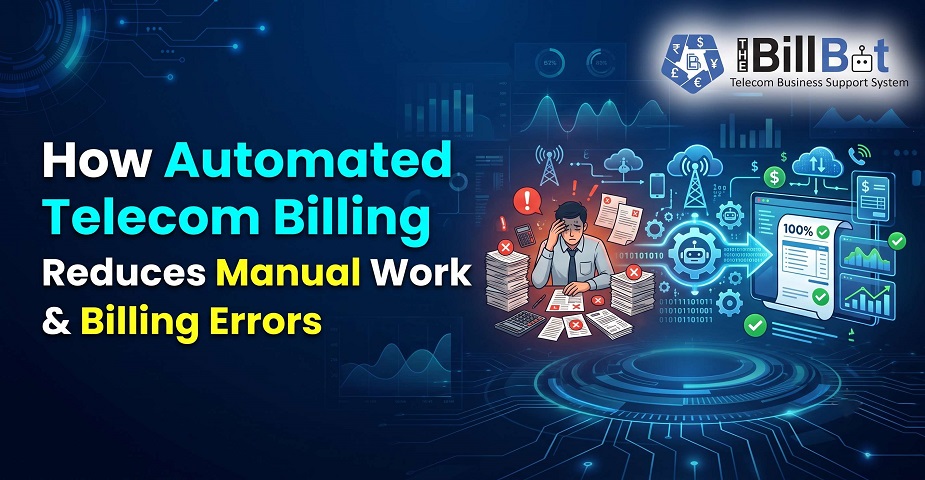
Table of Contents
- What Is Automated Telecom Billing?
- Why Manual Telecom Billing Creates Challenges
- 1. How Automated Telecom Billing Reduces Manual Work
- Automated Invoice Generation
- Automatic Usage and CDR Processing
- Recurring Billing and Subscription Management
- Automated Payment Reminders
- 2. How Automated Telecom Billing Helps Reduce Billing Errors
- Consistent Pricing and Charge Calculations
- Fewer Data Entry Mistakes
- More Reliable CDR Rating
- Better Invoice Verification and Tracking
- 3. Key Benefits of Telecom Billing Automation
- 4. The Role of Telecom Billing Software in Daily Operations
- 5. How Automated Telecom Billing Supports Business Growth
- 6. Best Practices for Implementing Telecom Billing Automation
- 7. Why Choose The Bill Bot for Telecom Billing Management?
- Frequently Asked Questions (FAQs)
- 1. What is automated telecom billing?
- 2. How does automated telecom billing reduce billing errors?
- 3. What are the main benefits of telecom billing automation?
- 4. Who needs automated telecom billing software?
- 5. Can automated telecom billing handle CDR processing?
- 6. Does telecom billing automation eliminate all billing errors?
- 7. How does an automated billing system improve cash flow?
- 8. What should businesses look for in telecom billing software?
- Conclusion
Author : Bhargav
Published : 13 Oct 2026
Related Articles
Explore more insights
12 Oct 2026 / Bhargav
Contract Management Best Practices for ITSPs and MSPs
10 Oct 2026 / Bhargav
Telecom Product Bundling: How Packages Can Simplify Service Management
09 Oct 2026 / Bhargav