Telecom providers handle large volumes of call records and usage data every day. For businesses offering VoIP, broadband, DID numbers, call plans, and other communication services, managing this information accurately is essential for smooth billing operations. Even a small mistake in usage calculations can lead to incorrect invoices, customer complaints, and revenue loss. This is where Automated CDR Processing becomes valuable. By automating the collection, validation, processing, and rating of call detail records, telecom providers can simplify billing operations and reduce the need for repetitive manual work. Instead of relying on spreadsheets and time-consuming manual checks, service providers can use automated systems to process usage records and prepare accurate billing information. This improves operational efficiency, supports better revenue management, and creates a smoother billing experience for customers. In this article, we explore how automated CDR processing works, why it matters for telecom businesses, and how it simplifies telecom usage billing. Call Detail Records (CDRs) contain information about communication activities. Depending on the service and source system, a CDR may include details such as call duration, call destination, start time, end time, usage volume, service type, and other relevant billing information. Telecom providers use these records to calculate charges for calls and other usage-based services. Automated CDR Processing is the process of collecting, validating, organising, and preparing call detail records for billing with minimal manual intervention. An automated system can import records from supported sources, check their validity, apply processing rules, and pass the resulting usage data to the billing system. For example, a VoIP provider handling thousands of calls daily needs to calculate charges according to customer-specific rates and pricing plans. An automated CDR processing system can help manage these records consistently, making it easier to calculate usage charges and generate invoices. The result is a more organised, reliable, and scalable billing workflow. Telecom usage billing depends on accurate and timely usage information. Before a provider can charge customers correctly, it must ensure that usage records are available, complete, and processed according to the appropriate pricing rules. Manual processing can become difficult as call volumes and customer numbers increase. Employees may need to import files, check records, identify errors, calculate charges, and transfer information between systems. These tasks take time and can introduce inconsistencies. Automated CDR processing helps address these challenges by improving the flow of usage data from the source system to billing. Its importance can be understood through several key benefits: Accurate billing calculations: Consistent processing helps reduce errors caused by manual data handling. Faster billing cycles: Large volumes of usage records can be processed more efficiently. Better visibility: Processed usage data can help teams understand consumption and billing activity. Reduced administrative work: Employees can spend less time on repetitive processing tasks. Improved scalability: Automated workflows can support growing customer bases and increasing usage volumes. These benefits help telecom providers build a more dependable billing process. The first step in billing is obtaining usage records from the relevant systems. Depending on the telecom environment, these records may come from PBX platforms, softswitches, VoIP systems, carrier platforms, or other supported sources. Collecting records manually can become complicated when several systems are involved. Different file formats, processing schedules, and data sources may require additional effort from the billing team. CDR Processing Software can automate the import of records from supported sources. Depending on the system's capabilities, providers can configure scheduled imports and recurring processing workflows. This reduces repetitive administrative work and helps ensure that usage data enters the billing process more consistently. Not every incoming record is necessarily ready for billing. Some records may contain missing information, invalid values, duplicate entries, or unexpected formats. If these issues remain undetected, they can affect usage calculations and invoice accuracy. An Automated CDR Processing System can apply validation rules to identify records that do not meet defined requirements. Depending on the software, it may also detect duplicates, flag incomplete data, and separate problematic records for further investigation. This allows billing teams to resolve exceptions before charges are calculated. Validation is particularly important for providers managing high call volumes, where checking every record manually would require significant time and effort. Different customers may have different rates, destinations, billing plans, discounts, or charging rules. Applying the correct pricing information to each usage record is therefore a central part of telecom billing. Telecom usage rating determines the applicable charge for a particular service or usage event according to configured pricing rules. For example, a VoIP provider may charge customers different rates depending on the destination, call duration, service package, or contractual agreement. A suitable CDR billing system can apply the relevant rating rules to eligible usage records. Automating this process helps reduce calculation inconsistencies and supports more reliable billing. The exact rating capabilities depend on the software, its configuration, and the pricing information available. Manual data entry and calculations can create several problems, including incorrect usage totals, missed records, duplicated entries, and the application of outdated rates. These mistakes can affect both customer satisfaction and revenue collection. Telecom Billing Automation reduces dependence on repetitive manual tasks by standardising how usage records are processed and rated. Once the correct rules are configured, the system can apply them consistently across eligible records. Automation does not eliminate every possible error. Incorrect source data, unsuitable rating rules, and integration problems can still affect results. Regular reconciliation, exception monitoring, and configuration reviews remain important. However, a well-managed automated workflow makes many common billing issues easier to prevent or identify. Telecom providers often need to process usage data before they can generate invoices. When CDR processing is slow, the entire billing cycle can be delayed. Automated processing helps prepare usage information more efficiently, allowing billing systems to use processed records during scheduled billing runs. Once the usage data has been rated and checked, it can be included in invoice calculations according to the provider's billing rules. This can help businesses issue invoices on time, reduce processing backlogs, and maintain a more predictable billing schedule. For providers with recurring monthly charges and usage-based fees, a consistent workflow makes it easier to coordinate different billing activities. Accurate revenue tracking requires a clear relationship between recorded usage, applicable rates, calculated charges, and customer invoices. If usage records are missing or charges are calculated incorrectly, providers may underbill customers or spend additional time investigating discrepancies. A CDR Management System can help organise usage records and support the review of processing results. When connected to billing and reporting tools, it can provide a clearer view of rated usage and the charges associated with it. Providers can use these records to investigate exceptions, compare usage totals, and identify potential differences between source data and billed amounts. Effective reconciliation remains essential because automated processing is only as reliable as the data, rules, and checks supporting it. As telecom businesses grow, their customer requirements often become more complex. One customer may use a fixed monthly package, while another may pay according to call duration, destinations, or agreed usage rates. Managing these differences manually can make billing increasingly difficult. Automated CDR Processing helps providers handle usage records through repeatable workflows, while an integrated billing platform can apply customer-specific pricing and billing configurations. This is especially useful for VoIP providers, ITSPs, and MSPs serving businesses with different service requirements. With suitable software and configuration, providers can manage increasing volumes of usage data without relying entirely on additional manual processing. Processed CDR data can reveal useful information about how customers use communication services. For example, providers may want to understand call volumes, usage patterns, destination trends, or changes in consumption over time. This information can help billing teams investigate unusual activity and support commercial teams when reviewing customer requirements. When integrated with reporting and analytics tools, automated processing can make usage data easier to analyse. These insights can help businesses improve internal monitoring, understand customer behaviour, and make better-informed decisions about service packages and pricing. The value of these insights depends on the quality of the underlying records and the reporting capabilities available. Choosing appropriate CDR Processing Software is important for building an efficient telecom billing workflow. Providers should evaluate whether a solution supports their existing systems, data formats, pricing structure, and operational requirements. Important capabilities to consider include: Automated data import: Supports the collection of records from relevant systems and sources. Record validation: Identifies incomplete, invalid, or duplicate records where supported. Flexible usage rating: Applies configurable pricing and charging rules. Exception management: Helps teams investigate records that cannot be processed normally. Billing integration: Transfers processed usage information to the billing system. Reporting and reconciliation: Supports checks on processed records, usage totals, and calculated charges. Scalability: Handles increasing data volumes as the business grows. Monitoring and audit trails: Helps teams track processing activity and investigate discrepancies. Providers should also review integration requirements, access controls, data retention policies, and available technical support before selecting a solution. Efficient billing operations become increasingly important as a telecom business expands. More customers, more services, and more usage records create additional demands on billing teams. Without a structured process, growth can lead to longer processing times, more administrative work, and greater difficulty investigating billing discrepancies. Automated Telecom Billing helps create repeatable workflows that support these changing requirements. By reducing manual processing and organising usage data more effectively, businesses can devote more attention to customer service, product development, and operational improvement. Automation can also support more consistent billing schedules and make it easier to introduce new usage-based services when the underlying platform supports the required pricing and integration capabilities. For VoIP providers, ITSPs, and MSPs, this creates a practical foundation for managing billing complexity while maintaining service quality. Telecom businesses need a reliable way to manage customer information, services, usage charges, and invoicing without creating unnecessary administrative complexity. The Bill Bot provides a business support system designed for telecom and IT service providers. Its billing-focused approach can help businesses organise billing operations and manage relevant processes through a central platform. When evaluating a billing platform, providers should consider how CDR processing connects with their existing PBX or carrier systems, customer records, pricing rules, invoice generation, and reporting requirements. A suitable combination of automated CDR processing and billing management can help reduce repetitive work, improve visibility, and establish a more consistent approach to usage billing. To learn more about The Bill Bot and its capabilities, visit The Bill Bot. To get the most value from automation, telecom providers should establish a clear and well-maintained processing workflow. 1. Review your existing data sources. Identify where CDRs originate, which formats are used, and how often records become available. 2. Define validation rules. Establish checks for missing fields, duplicate records, invalid values, and other common data issues. 3. Maintain accurate rating information. Review tariffs, destinations, customer-specific prices, and charging rules regularly. 4. Test before going live. Compare automated processing results against verified sample records and existing billing calculations. 5. Monitor failed records. Set up a clear process for investigating exceptions and correcting underlying problems. 6. Reconcile usage and invoices. Compare source records, processed data, rated usage, and billed charges to identify discrepancies. 7. Review performance regularly. Monitor processing delays, failed imports, recurring errors, and changes in data volume. These practices help ensure that automation remains dependable as services and business requirements evolve. Automated CDR Processing plays an important role in simplifying telecom usage billing. By streamlining record collection, validating incoming data, applying rating rules, and preparing usage information for invoicing, it helps telecom providers manage billing operations more efficiently. It can reduce repetitive manual work, improve consistency, support reconciliation, and make it easier to manage growing volumes of call records. However, effective automation still requires accurate source data, well-configured pricing rules, appropriate integrations, and regular monitoring. For VoIP providers, ITSPs, and MSPs, combining reliable CDR processing with suitable telecom billing software can create a more organised and scalable billing workflow. With the right processes and tools in place, businesses can spend less time handling usage data manually and more time improving customer experience and supporting sustainable growth. Automated CDR Processing is the process of collecting, validating, organising, and preparing call detail records for billing with minimal manual intervention. It helps telecom providers manage usage data more efficiently. It streamlines record imports, applies validation rules, supports usage rating, and prepares processed data for invoicing. This can reduce manual work, improve consistency, and help shorten billing cycles. CDR Processing Software is a tool used to manage call detail records. Depending on its capabilities, it can import usage data, validate records, identify exceptions, apply processing rules, and integrate with billing systems. CDR processing prepares usage records for further use by validating and organising them. CDR rating applies the relevant pricing rules to determine the charges associated with those records. Yes. Automation can reduce errors caused by repetitive manual data entry and calculations. However, incorrect source data, configuration problems, and integration issues can still cause discrepancies, so monitoring and reconciliation remain necessary. Yes. It can be useful for VoIP providers managing high volumes of calls and different pricing plans. The chosen solution should support the provider's CDR formats, rating requirements, and billing integrations. It helps providers organise usage records, apply configured rating rules, and review processed charges. When combined with reconciliation and reporting, it can help identify discrepancies and support more accurate billing. Businesses should assess data source compatibility, validation capabilities, rating flexibility, exception handling, integration options, reporting, security, scalability, and technical support. Not necessarily. CDR processing focuses on handling usage records, while a full billing system may also manage customer accounts, recurring charges, invoices, payments, and reporting. Integration between these systems helps create a complete billing workflow. Start by reviewing current data sources and manual billing tasks. Then define validation and rating rules, assess compatible software, test sample records, and establish reconciliation and monitoring procedures before expanding automation.What Is Automated CDR Processing?
Why Is CDR Processing Important for Telecom Usage Billing?
How Automated CDR Processing Simplifies Telecom Usage Billing
1. Automates CDR Collection and Import
2. Validates Records Before Billing
3. Calculates Usage Charges More Consistently
4. Reduces Manual Billing Errors
5. Speeds Up Invoice Generation
6. Improves Revenue Tracking and Reconciliation
7. Supports Multiple Customers and Pricing Plans
8. Provides Better Usage Insights
Key Features to Look for in CDR Processing Software
How Automated CDR Processing Supports Telecom Business Growth
How The Bill Bot Can Help Simplify Telecom Billing
Best Practices for Implementing Automated CDR Processing
Conclusion
Frequently Asked Questions (FAQs)
1. What is Automated CDR Processing?
2. How does CDR processing improve telecom usage billing?
3. What is CDR Processing Software?
4. What is the difference between CDR processing and CDR rating?
5. Can automated CDR processing reduce billing errors?
6. Is automated CDR processing suitable for VoIP providers?
7. How does automated CDR processing support revenue management?
8. What should businesses consider when choosing a CDR Management System?
9. Does automated CDR processing replace the entire billing system?
10. How can telecom providers get started with CDR processing automation?
 Book a Demo
How Automated CDR Processing Simplifies Telecom Usage Billing
Bhargav
Oct 14, 2026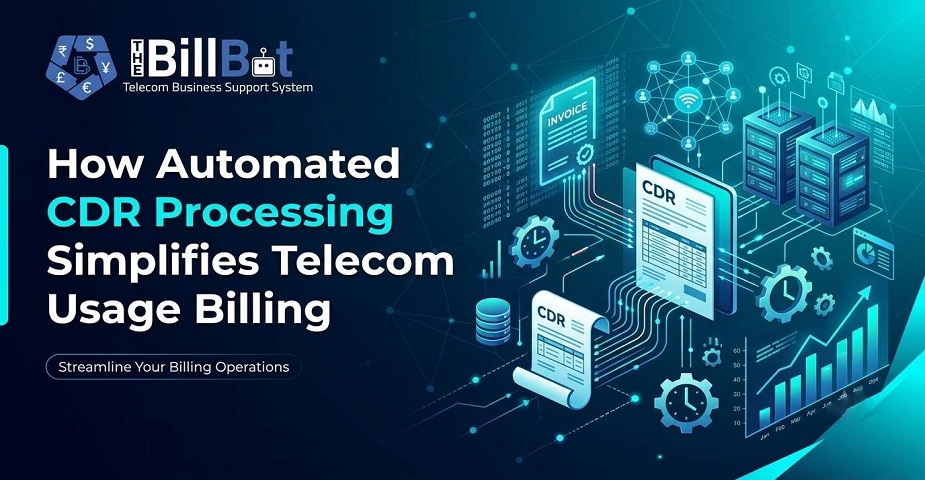
Table of Contents
- What Is Automated CDR Processing?
- Why Is CDR Processing Important for Telecom Usage Billing?
- How Automated CDR Processing Simplifies Telecom Usage Billing
- 1. Automates CDR Collection and Import
- 2. Validates Records Before Billing
- 3. Calculates Usage Charges More Consistently
- 4. Reduces Manual Billing Errors
- 5. Speeds Up Invoice Generation
- 6. Improves Revenue Tracking and Reconciliation
- 7. Supports Multiple Customers and Pricing Plans
- 8. Provides Better Usage Insights
- Key Features to Look for in CDR Processing Software
- How Automated CDR Processing Supports Telecom Business Growth
- How The Bill Bot Can Help Simplify Telecom Billing
- Best Practices for Implementing Automated CDR Processing
- Conclusion
- Frequently Asked Questions (FAQs)
- 1. What is Automated CDR Processing?
- 2. How does CDR processing improve telecom usage billing?
- 3. What is CDR Processing Software?
- 4. What is the difference between CDR processing and CDR rating?
- 5. Can automated CDR processing reduce billing errors?
- 6. Is automated CDR processing suitable for VoIP providers?
- 7. How does automated CDR processing support revenue management?
- 8. What should businesses consider when choosing a CDR Management System?
- 9. Does automated CDR processing replace the entire billing system?
- 10. How can telecom providers get started with CDR processing automation?
Author : Bhargav
Published : 14 Oct 2026
Related Articles
Explore more insights

13 Oct 2026 / Bhargav
How Automated Telecom Billing Reduces Manual Work and Billing Errors

12 Oct 2026 / Bhargav
Contract Management Best Practices for ITSPs and MSPs
10 Oct 2026 / Bhargav