
Telecom businesses manage a wide range of daily operations, from handling customer accounts and processing call records to generating invoices, tracking payments and managing financial information. These activities often involve different software platforms. When these systems operate independently, teams may need to enter the same information multiple times, switch between applications and manually transfer data to complete routine tasks. Over time, disconnected systems can create unnecessary administrative work, increase the risk of errors and make it difficult to maintain accurate business information. This is where Telecom Integration Software becomes valuable. By connecting PBX platforms, CRM systems and accounting applications, telecom providers can create a more organised and connected business environment. Information can move between systems more efficiently, helping teams manage customer relationships, billing operations and financial activities from a coordinated workflow. For VoIP providers, Internet Telephony Service Providers (ITSPs) and Managed Service Providers (MSPs), integrating essential business systems is an important step towards improving operational efficiency and supporting long-term growth. Telecom Integration Software connects different business applications and telecom systems so they can exchange relevant information and work together more effectively. Instead of managing PBX, CRM, billing and accounting platforms separately, businesses can establish connections that allow data to flow between these applications. For example, when a customer makes a call through a PBX system, call information can be collected and processed for billing purposes. The relevant customer details can be associated with the CRM account, while invoice and payment information can be shared with the accounting system. This connected approach reduces the need for repetitive manual tasks and helps teams maintain more consistent information across their business operations. Common systems that can be connected include: PBX and VoIP platforms Customer Relationship Management (CRM) systems Telecom billing and Business Support Systems (BSS) Accounting and financial applications Payment gateways Customer portals Reporting and analytics platforms The main objective is to create a connected technology environment where different systems support the same business processes. As telecom businesses expand, managing separate applications becomes increasingly complicated. A provider may have hundreds or thousands of customers, multiple service plans, different billing cycles and large volumes of call detail records (CDRs). When business systems are not connected, employees often spend valuable time transferring information between platforms. Some common challenges include: Customer details, service information and billing records may need to be entered into multiple systems. This increases administrative effort and creates opportunities for mistakes. When PBX usage information is not connected to billing software, teams may need to export and process CDR files manually before invoices can be generated. Customer details stored in separate applications may become outdated or inconsistent, making it harder for support and finance teams to work with accurate records. Without proper accounting integration, businesses may struggle to maintain an up-to-date picture of invoices, outstanding payments and revenue. Gathering information from different platforms can make business reporting slower and more difficult. A connected environment addresses these challenges by improving communication between essential business applications. PBX systems are an important part of telecom operations. They manage voice communication, extensions, call routing and other telephony activities. However, call management is only one part of running a telecom business. Providers also need to monitor usage, calculate charges and generate accurate customer invoices. This is where PBX Integration becomes important. By connecting PBX platforms with telecom billing software, providers can transfer call-related information into their billing workflows. A typical PBX integration workflow includes: The PBX system processes incoming and outgoing calls. Call Detail Records (CDRs) capture relevant call information. CDR data is transferred to the connected billing platform. The billing system processes usage records and applies the relevant pricing rules. Charges are calculated according to customer plans and service agreements. Processed usage information is included in the customer's billing cycle. This approach reduces manual CDR handling and supports more consistent usage-based billing. Automates the transfer of call records. Reduces manual CDR processing. Supports accurate usage-based charging. Improves billing efficiency. Helps providers manage large volumes of call activity. Provides better visibility into customer usage. For businesses offering VoIP services, reliable PBX connectivity is an important foundation for efficient billing operations. Customer information is central to telecom business operations. Providers need to manage customer profiles, contact details, service subscriptions, contracts, support activities and account history. A CRM system helps organise this information, but its value increases when it connects with billing and telecom platforms. CRM Integration for Telecom allows customer information to move between connected applications, helping different departments work with consistent account details. Consider a telecom provider onboarding a new customer. The customer registers for a service, and the business creates an account with the required contact and billing information. Through CRM and billing integration, relevant customer details can be shared with the billing platform without unnecessary duplicate entry. The connected workflow can support: Customer account creation. Contact and company information management. Service and subscription tracking. Customer plan and package information. Invoice and payment visibility. Contract and renewal management. Customer support and account history. Better Customer Data Management: Teams can access more consistent customer information across connected applications. Improved Customer Onboarding: Customer details can move through the onboarding process with fewer manual steps. More Efficient Customer Support: Support teams can access relevant account and service information more easily. Better Departmental Coordination: Sales, customer service and finance teams can work with shared information. Improved Customer Visibility: Businesses can develop a clearer understanding of customer relationships and service activity. A well-planned PBX CRM Integration strategy can also connect customer records with relevant telephony information, helping businesses manage communication activities alongside customer accounts. Accounting is another important part of telecom operations. Providers need to manage invoices, payments, outstanding balances, taxes, revenue and financial records. When accounting applications operate separately from billing platforms, finance teams may need to export invoice information, update payment records and reconcile transactions manually. Accounting Software Integration helps reduce this administrative effort by connecting billing information with financial applications. A connected accounting workflow may include: Customer invoice information is generated by the billing platform. Relevant invoice data is transferred to the accounting application. Payment information is updated as transactions are received. Outstanding balances can be monitored. Financial records can be reviewed alongside other accounting information. Finance teams can use the available information for reconciliation and reporting. The exact workflow depends on the accounting application and the integration capabilities available. Reduced Manual Work: Finance teams spend less time copying invoice and payment information between platforms. Improved Financial Accuracy: Automated data transfer can reduce errors caused by repetitive manual entry. Better Payment Tracking: Teams can maintain clearer records of received and outstanding payments. Simplified Reconciliation: Connected financial information makes it easier to compare billing and payment records. Improved Financial Reporting: Businesses can use organised financial data to support reporting and decision-making. For telecom providers managing recurring subscriptions and usage-based charges, accounting integration can make financial administration more manageable. PBX, CRM and accounting integrations become even more valuable when they are connected through a central billing platform. Telecom Billing Integration helps bring customer information, service details, usage records, pricing rules and payment activities into a coordinated process. A connected billing platform can support different telecom services, including: VoIP services. DID numbers. SIP trunks. Extensions. Broadband services. Call plans. Recurring subscriptions. Usage-based services. Instead of managing billing activities across multiple disconnected applications, providers can coordinate important billing processes through an integrated platform. Integrated Telecom Billing Software helps businesses manage essential billing activities, including: Customer account management. Product and service configuration. Flexible pricing and packages. Recurring and usage-based billing. CDR processing. Invoice generation. Payment tracking. Automated payment reminders. Revenue and usage reporting. The benefit is not simply having multiple applications connected. It is creating a structured workflow where information from different systems supports the complete customer billing journey. Not every telecom business uses the same software. Some providers rely on established PBX platforms, while others use customised CRM applications, third-party accounting tools or specialised payment systems. Telecom API Integration provides a way for different applications to exchange information through defined interfaces. APIs allow software platforms to communicate without requiring employees to transfer every piece of information manually. Depending on the available API capabilities, integrations may support: PBX and telephony platforms. CRM and customer management applications. Billing and invoicing systems. Accounting software. Payment gateways. Customer self-service portals. External reporting tools. API-based connectivity offers flexibility when businesses need to connect existing systems or introduce new applications. It can help providers: Reduce repetitive data handling. Exchange information between applications. Support customised business workflows. Connect third-party services. Extend existing software capabilities. Adapt their technology environment as business requirements change. However, successful integration requires proper API documentation, authentication, data mapping, error handling and ongoing maintenance. Building a connected telecom environment requires more than simply linking applications. Businesses need to understand how information moves between systems and how each integration supports daily operations. Here are six practical steps. Start by reviewing the applications currently used for PBX management, CRM, billing, accounting and payments. Understand what each system does and identify where information is duplicated or manually transferred. Document the complete workflow, from customer onboarding to service activation, usage processing, invoice generation and payment collection. This helps identify which systems need to exchange information and when that information should be transferred. Depending on the available technology, integrations may use APIs, webhooks, scheduled data transfers or other supported connection methods. Choose an approach that meets your operational requirements and works reliably with the existing applications. Consistent data is essential for successful Telecom System Integration. Customer IDs, service references, product details, billing information and transaction records should follow clearly defined formats. This helps prevent duplicate accounts and mismatched information. Before implementing integrations across the business, test important processes such as customer creation, CDR processing, invoice generation, payment updates and accounting transfers. Testing helps identify missing information, incorrect data mapping and communication errors. Integration is an ongoing process. Businesses should monitor data transfers, API performance, failed transactions and system updates. Regular reviews help ensure that connected systems continue to support changing business requirements. When PBX, CRM and accounting systems work together, businesses can automate several routine activities. This is the foundation of effective Telecom Workflow Automation. For example, a connected workflow could look like this: A new customer is created in the CRM. Customer and service information is shared with the billing platform. The customer receives the selected telecom service. PBX systems generate call records. CDR information is processed by the billing platform. Applicable charges are calculated. An invoice is generated according to the billing cycle. Invoice information is shared with the accounting system. Payment updates are recorded. Business reports provide visibility into billing and revenue activity. The precise level of automation depends on the systems involved and their integration capabilities. Less manual administrative work. More consistent billing processes. Improved customer account management. Better coordination between departments. Faster access to business information. Reduced repetitive data entry. More organised financial operations. Better support for business expansion. For growing VoIP providers, ITSPs and MSPs, these improvements can make daily operations easier to manage. Although connected systems offer several advantages, integration projects can present challenges. Understanding these challenges early helps businesses plan more effectively. Data Compatibility: Different applications may use different formats for customer, service and transaction information. Proper data mapping is essential. API Limitations: Some platforms provide limited API access or may not support every required operation. Security and Access Control: Integrations must use appropriate authentication, permissions and secure data transfer methods. Legacy Systems: Older applications may require additional development or middleware to communicate with modern platforms. Integration Maintenance: Software updates, API changes and changing business processes may require ongoing adjustments. Testing and Reliability: Businesses should verify that information is transferred correctly and that failed transactions can be identified and resolved. Choosing compatible systems and planning integrations carefully can help reduce these challenges. For telecom providers, managing customers, services, billing and business information through disconnected systems can create unnecessary complexity. The Bill Bot is designed to support telecom billing and business management requirements for VoIP providers, ITSPs and MSPs. With capabilities covering customer management, product and price plan management, billing automation, CDR processing, invoicing, payment management and reporting, The Bill Bot helps providers organise important business operations through a connected platform. Its integration capabilities can help businesses connect their telecom environment with relevant external systems, depending on the supported integrations and configuration requirements. By bringing essential billing and business processes together, providers can work towards a more organised operational structure. Whether a business is managing recurring subscriptions, usage-based charges, customer accounts or payment collection, having a coordinated billing environment can make everyday processes easier to manage. Looking to simplify your telecom billing operations? Explore The Bill Bot and discover how its billing and business support capabilities can help your telecom business operate more efficiently. Connecting PBX, CRM and accounting applications is an important step towards building a more efficient telecom business. PBX integration helps transfer call activity into billing workflows. CRM integration improves customer information management, while accounting integration supports organised financial operations. When these systems work together through reliable Telecom Integration Software, businesses can reduce manual work and improve the flow of information across departments. With the right integration strategy, telecom providers can create connected workflows that support accurate billing, better customer management and more efficient business operations. For VoIP providers, ITSPs and MSPs planning to grow, investing in a connected telecom environment can provide a stronger foundation for future business requirements. Telecom Integration Software connects different telecom and business applications, such as PBX systems, CRM platforms, billing software and accounting applications, allowing them to exchange information and support connected workflows. PBX Integration connects telephony systems with other business applications. It helps transfer call records, supports CDR processing and enables providers to use call activity for usage-based billing. CRM Integration for Telecom helps businesses manage customer information more consistently, improve onboarding, coordinate customer support and connect account details with billing and service information. Accounting Software Integration connects billing and financial applications, helping businesses manage invoice records, payment information, outstanding balances and financial reporting with less manual data entry. Yes. With suitable integration capabilities, PBX, CRM and accounting systems can exchange relevant information through APIs, webhooks or other supported connection methods. This helps create a coordinated telecom workflow. Telecom API Integration allows different software applications to communicate and exchange information through application programming interfaces (APIs). It helps connect telecom platforms with billing, CRM, accounting and third-party services. Telecom Billing Integration connects customer information, service details, usage records and payment processes. It helps automate billing activities, reduce repetitive tasks and improve billing consistency. Yes. Small and growing VoIP providers can benefit from connected systems by reducing manual administration and creating more organised workflows. The integration approach should match their current requirements and future growth plans. Businesses should evaluate API compatibility, data formats, security requirements, integration costs, system reliability, scalability and ongoing maintenance before implementing a connected environment. Telecom Workflow Automation reduces repetitive manual activities by connecting processes such as customer onboarding, CDR processing, invoice generation, payment updates and reporting. This allows teams to focus more on customer service and business development.What Is Telecom Integration Software?
Why Telecom Businesses Need Connected Systems
1. Repetitive Data Entry
2. Delayed Billing Processes
3. Inconsistent Customer Information
4. Limited Financial Visibility
5. Complicated Reporting
1. PBX Integration: Connecting Call Activity with Billing Operations
How PBX Integration Works
Benefits of PBX Integration
2. CRM Integration for Telecom: Creating a Connected Customer Experience
How CRM Integration Works
Benefits of CRM Integration
3. Accounting Software Integration: Simplifying Financial Management
How Accounting Integration Works
Benefits of Accounting Software Integration
4. Telecom Billing Integration: Bringing Business Operations Together
The Role of Integrated Telecom Billing Software
5. Telecom API Integration: Making Different Systems Communicate
What Can Telecom APIs Connect?
Why API Integration Matters
6. How to Build a Connected Telecom Workflow
Step 1: Identify Existing Business Systems
Step 2: Map Your Business Processes
Step 3: Select the Right Integration Approach
Step 4: Standardise Customer and Service Data
Step 5: Test the Complete Workflow
Step 6: Monitor and Improve Integrations
7. How Telecom Workflow Automation Supports Business Growth
Business Benefits of Telecom Workflow Automation
8. Common Challenges in Telecom System Integration
9. How The Bill Bot Supports Connected Telecom Operations
Conclusion
Frequently Asked Questions (FAQs)
1. What is Telecom Integration Software?
2. Why is PBX Integration important for telecom providers?
3. What are the benefits of CRM Integration for Telecom?
4. How does Accounting Software Integration help telecom businesses?
5. Can PBX, CRM and accounting systems work together?
6. What is Telecom API Integration?
7. How does Telecom Billing Integration improve billing operations?
8. Is Telecom Integration Software suitable for small and growing VoIP providers?
9. What should businesses consider before integrating telecom systems?
10. How does telecom workflow automation improve business efficiency?
PBX, CRM and Accounting Integrations: Building a Connected Telecom Workflow
Bhargav
Nov 03, 2026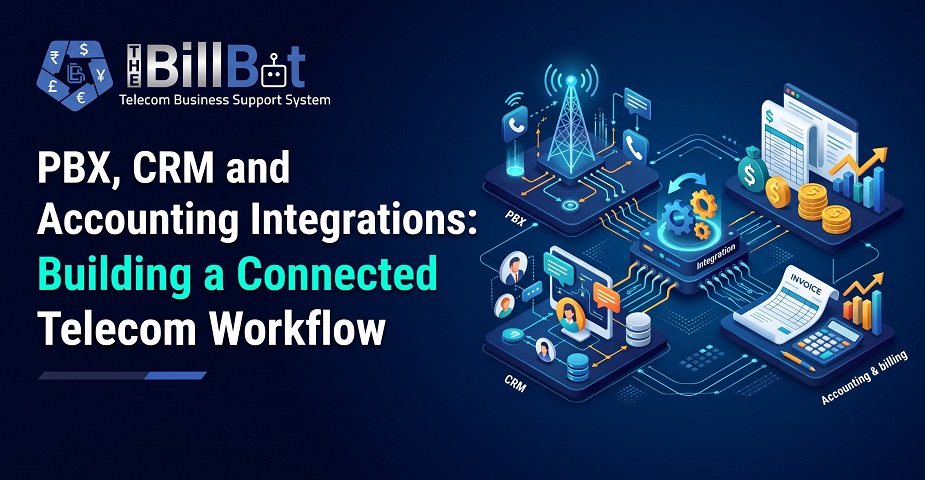
Table of Contents
- What Is Telecom Integration Software?
- Why Telecom Businesses Need Connected Systems
- 1. Repetitive Data Entry
- 2. Delayed Billing Processes
- 3. Inconsistent Customer Information
- 4. Limited Financial Visibility
- 5. Complicated Reporting
- 1. PBX Integration: Connecting Call Activity with Billing Operations
- How PBX Integration Works
- Benefits of PBX Integration
- 2. CRM Integration for Telecom: Creating a Connected Customer Experience
- How CRM Integration Works
- Benefits of CRM Integration
- 3. Accounting Software Integration: Simplifying Financial Management
- How Accounting Integration Works
- Benefits of Accounting Software Integration
- 4. Telecom Billing Integration: Bringing Business Operations Together
- The Role of Integrated Telecom Billing Software
- 5. Telecom API Integration: Making Different Systems Communicate
- What Can Telecom APIs Connect?
- Why API Integration Matters
- 6. How to Build a Connected Telecom Workflow
- Step 1: Identify Existing Business Systems
- Step 2: Map Your Business Processes
- Step 3: Select the Right Integration Approach
- Step 4: Standardise Customer and Service Data
- Step 5: Test the Complete Workflow
- Step 6: Monitor and Improve Integrations
- 7. How Telecom Workflow Automation Supports Business Growth
- Business Benefits of Telecom Workflow Automation
- 8. Common Challenges in Telecom System Integration
- 9. How The Bill Bot Supports Connected Telecom Operations
- Conclusion
- Frequently Asked Questions (FAQs)
- 1. What is Telecom Integration Software?
- 2. Why is PBX Integration important for telecom providers?
- 3. What are the benefits of CRM Integration for Telecom?
- 4. How does Accounting Software Integration help telecom businesses?
- 5. Can PBX, CRM and accounting systems work together?
- 6. What is Telecom API Integration?
- 7. How does Telecom Billing Integration improve billing operations?
- 8. Is Telecom Integration Software suitable for small and growing VoIP providers?
- 9. What should businesses consider before integrating telecom systems?
- 10. How does telecom workflow automation improve business efficiency?
Author : Bhargav
Published : 03 Nov 2026
Related Articles
Explore more insights
02 Nov 2026 / Bhargav
Revenue and Usage Reporting for VoIP Providers: A Practical Guide
31 Oct 2026 / Bhargav
How to Automate Invoice Generation and Payment Reminders
30 Oct 2026 / Bhargav