
Telecom providers work with multiple suppliers to deliver reliable communication services to their customers. These suppliers may provide voice termination, DID numbers, connectivity, broadband, international calling routes and other telecom services. Each supplier can have different pricing structures, billing conditions and rate update schedules. Keeping track of all these changes can become difficult, particularly for IT Service Providers (ITSPs), VoIP providers and Managed Service Providers (MSPs) managing large customer bases. This is where Supplier Rate Management becomes important. It helps telecom businesses organise supplier pricing information, monitor rate changes and ensure that the latest costs are reflected in their pricing and billing processes. Instead of relying on spreadsheets, emails and manual updates, businesses can establish a more structured approach to managing supplier rates. In this article, we explore why supplier rate management matters, the challenges telecom providers face and how businesses can keep their supplier pricing accurate and up to date. Supplier Rate Management is the process of maintaining, organising and updating the prices charged by suppliers for telecom services. Telecom businesses purchase services from different providers and use these services to deliver solutions to their customers. For example, a VoIP provider may purchase call termination services from multiple wholesale carriers. Each carrier can offer different rates depending on the destination, call type, volume and commercial agreement. Managing these prices requires accurate records and a clear understanding of supplier pricing conditions. Effective Telecom Supplier Rate Management allows businesses to: Maintain supplier pricing information in one organised system. Track changes in wholesale rates. Compare prices across different suppliers. Update rate sheets when suppliers introduce new charges. Monitor supplier costs and protect profit margins. Maintain accurate customer pricing and billing. Review historical pricing information when required. The objective is not simply to store supplier prices. It is to make sure the business always works with reliable cost information when managing services, calculating charges and making commercial decisions. Supplier pricing directly affects the operating costs and profitability of telecom businesses. Even a small change in wholesale rates can make a noticeable difference when a provider processes thousands of calls or manages a large number of services. Without a structured process, outdated supplier rates may remain in use, leading to incorrect cost calculations and unexpected financial losses. Here are some important reasons why telecom providers need effective supplier rate management. Telecom suppliers regularly revise their prices based on market conditions, destination charges, network costs and commercial agreements. If a provider continues using an old rate sheet, its cost calculations may no longer reflect the actual supplier charges. Regular Supplier Rate Updates help businesses maintain accurate wholesale pricing and reduce the risk of working with outdated information. Profitability depends on the difference between the cost of purchasing telecom services and the revenue generated from customers. When supplier costs increase but customer prices remain unchanged, profit margins can decrease. By maintaining accurate supplier pricing, businesses can review their costs, identify changes and decide whether customer price adjustments are necessary. This makes Telecom Cost Management more effective and supports better financial planning. Many telecom businesses initially manage supplier prices through spreadsheets and email attachments. As the number of suppliers increases, maintaining these records becomes time-consuming. Employees may need to compare multiple files, identify changed destinations and manually update pricing information. A structured rate management process reduces repetitive work and makes it easier to maintain consistent supplier records. Having access to accurate supplier prices helps businesses make better commercial decisions. For example, a provider may discover that one supplier offers more competitive rates for certain international destinations, while another provides better pricing for other routes. Comparing these costs helps businesses evaluate supplier relationships and improve their overall pricing strategy. Although supplier pricing is essential to telecom operations, managing it efficiently can be challenging. Suppliers may introduce new prices regularly. Some changes affect specific destinations, while others apply to entire service categories. When updates arrive through different communication channels, employees may struggle to identify which rates have changed. Missing an important update can result in incorrect cost calculations. Telecom providers often receive rate sheets from several suppliers. Each supplier may use a different file format, naming convention, currency or pricing structure. Comparing these documents manually can create confusion and increase the possibility of errors. Effective Rate Sheet Management helps businesses organise these documents and maintain a consistent pricing structure. Using outdated pricing information can affect billing accuracy and profitability. For instance, if a supplier increases its international call termination rates but the telecom provider does not update its internal records, the business may continue calculating service costs using the previous prices. These differences can create unexpected financial discrepancies. When supplier pricing is maintained across separate spreadsheets, it becomes difficult to understand the overall cost structure. Managers may struggle to identify which suppliers offer competitive rates, where costs are increasing and which services are affecting profitability. Better Supplier Pricing Management provides a clearer picture of supplier expenses. Receiving a new supplier rate sheet does not automatically mean that the latest prices are being used. Employees still need to review the information, check for errors, identify changes and update the relevant records. If this process takes several days, the business may continue operating with outdated rates. Maintaining accurate supplier pricing requires a consistent process. Telecom businesses should establish clear procedures for receiving, reviewing and applying rate changes. Here are some practical ways to improve supplier rate management. The first step is to maintain supplier pricing information in one organised location. Instead of keeping different rate sheets across individual computers and email accounts, businesses should use a centralised system where authorised employees can access the latest supplier records. This makes it easier to: View supplier pricing information. Identify the latest available rate sheets. Compare prices across suppliers. Reduce duplicate records. Maintain consistent pricing information. Centralised Telecom Rate Management also improves coordination between finance, billing and operations teams. Telecom providers should create a routine for reviewing supplier prices. Some suppliers may send updates frequently, while others may revise their rates only occasionally. Businesses should monitor supplier communications and review new pricing documents as soon as they arrive. A regular review process helps identify changes before they affect billing and cost calculations. It is also useful to assign responsibility to specific employees or departments so that important updates are not overlooked. Before applying a supplier update, businesses should compare the new rate sheet with the previous version. This helps identify: Increased or decreased rates. Newly added destinations. Removed destinations. Changes in minimum charges. Updated connection fees. Differences in billing conditions. Comparing old and new prices provides better visibility and helps employees understand how each update may affect operating costs. Keeping historical supplier pricing records is an important part of effective Rate Sheet Management. Businesses should retain previous versions instead of replacing them without maintaining a record. Historical information helps managers understand how supplier costs have changed over time and investigate discrepancies when they arise. It also provides a useful reference when reviewing supplier agreements or evaluating pricing decisions. Not every supplier rate sheet should be applied immediately. Incorrect formats, missing destinations, duplicate entries and unexpected pricing values can create problems if they are imported without checking. A validation process helps ensure that the information is complete and consistent. Businesses should review important changes and confirm unusual pricing values with the supplier before using them in operational calculations. As telecom businesses grow, manually managing every supplier rate becomes increasingly difficult. Supplier Rate Automation can help reduce repetitive tasks involved in importing, reviewing and maintaining pricing information. Depending on the available system capabilities, automation can support: Importing supplier rate sheets. Processing pricing information. Identifying changes between rate versions. Updating approved supplier rates. Maintaining historical records. Reducing manual data entry. Automation does not remove the need for proper review. Instead, it helps employees spend less time on repetitive administration and more time on pricing accuracy and business decisions. Businesses can streamline supplier pricing processes by creating Custom Telecom Billing Workflows that connect pricing updates, usage processing, billing activities and operational tasks. Supplier rates and customer billing are closely connected. Telecom providers need accurate supplier costs to understand how much it costs to deliver each service. These costs can then be considered when developing customer price plans and calculating business profitability. For example, consider a VoIP provider purchasing international call termination from a wholesale carrier. The supplier charges a specific rate for calls to each destination. The VoIP provider then applies its own customer pricing structure to generate revenue. If the supplier changes its rates, the provider needs to review the impact on its costs and commercial pricing. Without accurate Supplier Rate Management, the business may face several issues: Incorrect cost calculations. Reduced profit margins. Inconsistent pricing decisions. Difficulties reconciling supplier invoices. Limited visibility into service profitability. Connecting supplier pricing information with the wider billing process helps telecom providers maintain better control over their financial operations. Telecom Pricing Management involves more than deciding how much customers should pay. Businesses must consider supplier costs, operating expenses, service requirements, market conditions and their desired profit margins. When supplier pricing information is accurate and accessible, providers can make more informed decisions about their products and services. For example, an ITSP offering different international calling packages may need to review supplier costs regularly to ensure that its customer pricing remains commercially sustainable. Similarly, an MSP managing connectivity and communication services may need to evaluate changes in supplier charges before renewing customer agreements. Effective Wholesale Rate Management supports these decisions by giving businesses a clearer understanding of their underlying service costs. It also helps providers evaluate alternative suppliers, negotiate better commercial terms and identify opportunities to improve profitability. As telecom businesses expand, managing supplier information alongside customers, products, pricing and billing can become increasingly complex. The Bill Bot provides a Business Support System (BSS) designed to help VoIP providers, ITSPs and MSPs manage important business operations through one platform. With a connected business management approach, telecom providers can streamline processes such as: Product and Package Management: Organise telecom products, services and packages. Flexible Price Plans: Manage customer pricing structures according to business requirements. Smart Billing and Invoicing: Simplify billing operations and invoice management. CDR Processing: Process call detail records for usage-based billing. Reports and Analytics: Access business information to support operational decisions. Integrations: Connect relevant business systems to create more efficient workflows. By bringing essential business operations together, The Bill Bot helps telecom providers reduce administrative complexity and improve operational visibility. For businesses looking to improve their overall pricing and billing processes, having a connected BSS platform can make day-to-day management more organised and efficient. A reliable supplier rate management process should be consistent, transparent and easy to maintain. Consider the following best practices: Keep supplier records organised: Maintain accurate supplier details and associated pricing information. Review rate changes regularly: Monitor supplier communications to avoid missing important updates. Compare every new rate sheet: Identify pricing differences before applying changes. Maintain historical records: Keep previous rate versions for reference and auditing. Validate pricing information: Check for missing, duplicate or unusual rate entries. Use automation where possible: Reduce repetitive manual work and improve consistency. Review supplier performance: Evaluate pricing competitiveness and commercial reliability. Monitor business costs: Understand how supplier changes affect service profitability. Following these practices helps telecom providers maintain better control over supplier costs while supporting accurate billing and sustainable business growth. Supplier Rate Management is an essential part of running an efficient and profitable telecom business. As providers work with multiple suppliers and manage changing wholesale prices, keeping pricing information accurate becomes increasingly important. A structured approach helps businesses monitor supplier changes, maintain updated rate sheets, reduce manual errors and make better pricing decisions. By combining centralised records, regular reviews, validation processes and automation, telecom providers can improve their control over supplier costs and maintain more reliable billing operations. For ITSPs, VoIP providers and MSPs, investing in better supplier pricing processes is not just an administrative improvement. It is an important step towards building a more organised, efficient and scalable telecom business. Supplier Rate Management is the process of maintaining, reviewing and updating the prices charged by telecom suppliers. It helps providers manage wholesale costs, monitor pricing changes and maintain accurate service cost information. It helps telecom providers control operating costs, protect profit margins, maintain accurate pricing information and reduce billing discrepancies caused by outdated supplier rates. Supplier rates should be updated whenever a supplier introduces a pricing change. Businesses should regularly monitor supplier communications and review new rate sheets promptly to ensure their records remain accurate. Rate Sheet Management involves organising, reviewing, comparing and maintaining supplier pricing documents. It helps telecom businesses manage different supplier rates and keep pricing records consistent. Supplier rate automation reduces repetitive manual tasks involved in processing and maintaining supplier pricing information. Depending on the system, it can help import rate sheets, identify pricing changes and maintain updated records. Supplier rates represent the costs a telecom provider pays to purchase services from another provider. Customer rates are the prices charged to end customers. The difference between these rates contributes to the business's gross margin, before other operating costs. Providers can compare wholesale rates across suppliers, review pricing agreements, monitor rate changes, evaluate alternative suppliers and analyse service costs to identify opportunities for savings. Supplier pricing determines the cost of delivering telecom services. If supplier rates change but internal cost information is not updated, businesses may experience inaccurate cost calculations, reduced margins and financial discrepancies. Businesses should check pricing changes, destination coverage, currencies, connection charges, billing increments, effective dates and missing or duplicate entries before applying a new rate sheet. A Business Support System can bring important telecom operations, including product management, customer pricing, billing, CDR processing and reporting, into a connected environment. This helps providers manage their business processes more efficiently.What Is Supplier Rate Management?
Why Is Supplier Rate Management Important for Telecom Providers?
1. Maintain Accurate Wholesale Pricing
2. Protect Business Profit Margins
3. Reduce Manual Work
4. Improve Pricing Decisions
Common Challenges in Managing Telecom Supplier Rates
1. Frequent Supplier Price Changes
2. Managing Multiple Rate Sheets
3. Incorrect or Outdated Rate Information
4. Limited Supplier Cost Visibility
5. Delays Between Receiving and Applying Updates
How Telecom Providers Can Keep Supplier Rates Updated
1. Centralise Supplier Pricing Information
2. Establish a Regular Rate Review Process
3. Compare New and Existing Rates
4. Maintain Rate Sheet History
5. Validate Supplier Pricing Before Applying Changes
6. Use Supplier Rate Automation
How Supplier Rate Management Supports Telecom Billing
The Role of Telecom Pricing Management in Business Growth
How The Bill Bot Can Help Telecom Providers Manage Their Operations
Best Practices for Effective Supplier Rate Management
Conclusion
Frequently Asked Questions (FAQs)
1. What is Supplier Rate Management in telecom?
2. Why is supplier rate management important for telecom providers?
3. How often should telecom suppliers' rates be updated?
4. What is Rate Sheet Management?
5. How does supplier rate automation help telecom businesses?
6. What is the difference between supplier rates and customer rates?
7. How can telecom providers reduce supplier costs?
8. How does supplier pricing affect telecom billing?
9. What should businesses check before accepting a new supplier rate sheet?
10. Can a BSS platform help with supplier and pricing management?
Supplier Rate Management: How Telecom Providers Keep Rates Updated
Bhargav
Nov 21, 2026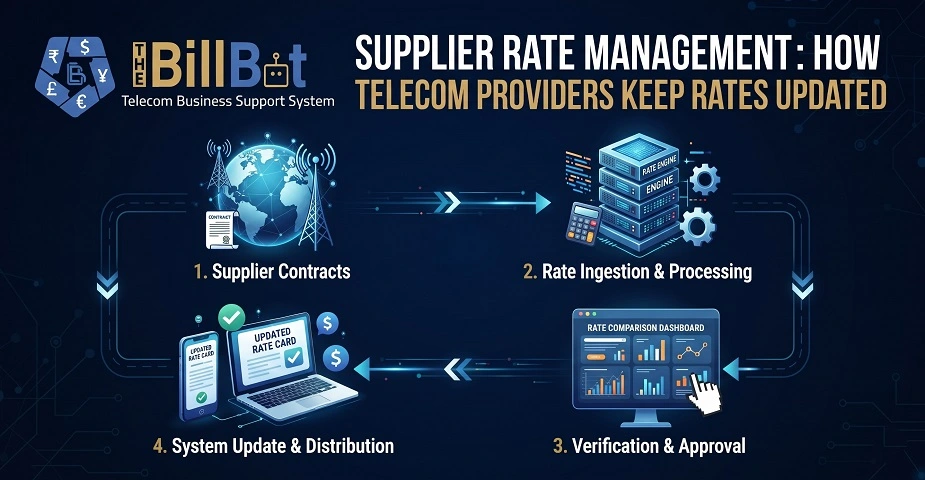
Table of Contents
- What Is Supplier Rate Management?
- Why Is Supplier Rate Management Important for Telecom Providers?
- 1. Maintain Accurate Wholesale Pricing
- 2. Protect Business Profit Margins
- 3. Reduce Manual Work
- 4. Improve Pricing Decisions
- Common Challenges in Managing Telecom Supplier Rates
- 1. Frequent Supplier Price Changes
- 2. Managing Multiple Rate Sheets
- 3. Incorrect or Outdated Rate Information
- 4. Limited Supplier Cost Visibility
- 5. Delays Between Receiving and Applying Updates
- How Telecom Providers Can Keep Supplier Rates Updated
- 1. Centralise Supplier Pricing Information
- 2. Establish a Regular Rate Review Process
- 3. Compare New and Existing Rates
- 4. Maintain Rate Sheet History
- 5. Validate Supplier Pricing Before Applying Changes
- 6. Use Supplier Rate Automation
- How Supplier Rate Management Supports Telecom Billing
- The Role of Telecom Pricing Management in Business Growth
- How The Bill Bot Can Help Telecom Providers Manage Their Operations
- Best Practices for Effective Supplier Rate Management
- Conclusion
- Frequently Asked Questions (FAQs)
- 1. What is Supplier Rate Management in telecom?
- 2. Why is supplier rate management important for telecom providers?
- 3. How often should telecom suppliers' rates be updated?
- 4. What is Rate Sheet Management?
- 5. How does supplier rate automation help telecom businesses?
- 6. What is the difference between supplier rates and customer rates?
- 7. How can telecom providers reduce supplier costs?
- 8. How does supplier pricing affect telecom billing?
- 9. What should businesses check before accepting a new supplier rate sheet?
- 10. Can a BSS platform help with supplier and pricing management?
Author : Bhargav
Published : 21 Nov 2026
Related Articles
Explore more insights
20 Nov 2026 / Bhargav
How Customer Self-Care Helps Customers Manage Invoices and Call Records
19 Nov 2026 / Bhargav
How Digital Signatures Simplify Telecom Customer Onboarding
18 Nov 2026 / Bhargav