
The telecommunications industry is constantly evolving. Customers expect faster connections, flexible service plans and a smooth experience when signing up for new services. Whether they are subscribing to broadband, VoIP, business communication services or mobile connectivity, they want the onboarding process to be simple and convenient. However, many telecom providers still depend on traditional paperwork, printed agreements, manual approvals and physical signatures. These activities can slow down customer registration, increase administrative work and create unnecessary delays before services become active. This is where a Digital Signature for Telecom becomes valuable. It allows telecom businesses to manage agreements electronically, collect customer signatures remotely and organise important documents without depending on paper-based processes. By adopting digital signatures, telecom providers can improve the customer experience, reduce manual tasks and make their onboarding workflows more efficient. Let's explore how digital signatures simplify telecom customer onboarding and why they are becoming an important part of modern telecom business operations. A digital signature for telecom is an electronic method of signing customer agreements, service contracts, consent forms and other business documents during the customer registration process. Instead of printing documents, collecting handwritten signatures and scanning completed agreements, telecom providers can send documents electronically. Customers can review the information and complete the signing process using a computer, tablet or smartphone. Depending on the solution and applicable legal requirements, digital signing workflows may include identity verification, authentication, timestamps, document integrity checks and electronic records. For telecom businesses, this makes it easier to manage customer agreements while maintaining organised documentation. Common documents that can be signed digitally include: New customer subscription agreements VoIP and broadband service contracts Business communication agreements Service activation forms Customer consent documents Plan upgrade and renewal agreements Terms and conditions Service modification requests Digital signatures help bring these activities into a more connected and manageable onboarding process. Customer onboarding involves more than simply collecting customer details. Telecom providers must gather information, prepare agreements, obtain approvals, verify relevant details and coordinate service activation. When these activities depend on physical documents, several challenges can arise. Traditional onboarding often requires staff to prepare agreements, print documents, arrange signatures and scan completed paperwork. Each additional step increases the time required to complete customer registration. Customers may not always be available to visit an office or meet a sales representative. Waiting for physical signatures can delay contract approval and service activation. Managing hundreds or thousands of customer agreements manually can become complicated. Documents may be misplaced, stored in different locations or difficult to retrieve when needed. Sales and support teams spend valuable time following up on unsigned agreements, checking paperwork and updating customer records. Modern customers expect digital experiences. Asking them to print, sign, scan and email documents creates unnecessary friction during registration. These challenges highlight why telecom businesses should consider more efficient digital onboarding solutions. Digital signatures can improve several stages of the customer journey. Here are seven important ways they help telecom providers streamline their operations. Speed is an important factor in customer acquisition. When customers decide to purchase a telecom service, they generally want the registration and activation process completed without unnecessary waiting. With electronic signature software, providers can prepare agreements and send them directly to customers through email or other supported digital channels. Customers can review and sign the documents remotely without visiting an office or handling physical paperwork. This helps reduce delays between the initial customer enquiry and agreement completion. For VoIP providers, IT service providers and broadband businesses, faster registration can create a smoother onboarding experience and help sales teams manage new customers more efficiently. Paper-based onboarding creates additional work for telecom businesses. Printing, scanning, storing and organising documents requires time and resources. Digital signatures support paperless customer onboarding by allowing agreements and approvals to be completed electronically. Businesses can reduce their dependence on printed documents and maintain digital records in a more organised way. Some important advantages include: Reduced printing and stationery expenses Less physical document storage Easier document sharing Better accessibility to signed agreements More organised customer records A paperless approach also makes it easier for employees to manage customer documentation across different departments and locations. Telecom providers often work with customers across different cities, regions and countries. Requiring every customer to visit an office for contract signing can create unnecessary difficulties. E-signature for telecom providers makes remote agreement signing possible. For example, a business customer purchasing a VoIP communication package can receive a service agreement electronically. The customer can review the contract, complete the signing process and return the signed document without arranging an in-person meeting. This is particularly useful for: Business telecom subscriptions Remote broadband installations VoIP service registrations Corporate communication solutions Multi-location customer accounts Remote signing gives customers greater flexibility while helping telecom businesses manage onboarding across wider geographical areas. Incorrect customer information can create problems throughout the onboarding process. Errors in company names, billing addresses, selected service packages or contract terms may require documents to be corrected and signed again. Digital signing workflows can be connected with customer management systems to populate agreement templates using existing customer information. This reduces repetitive manual data entry and helps maintain consistency between customer records and agreements. Maintaining accurate customer details, service records, contact information and billing preferences is essential for effective Telecom Customer Management and a smoother onboarding experience. Before sending a document for signature, employees can review important information such as: Customer or company name Contact information Billing address Selected products and services Pricing and payment terms Contract duration Applicable service conditions Some electronic signature solutions also provide document templates and required-field validation. Although digital signing does not eliminate every possibility of human error, a well-designed workflow can significantly improve document accuracy. Customer agreements contain important business and personal information. Telecom providers need appropriate processes to protect these documents and maintain reliable records. Modern digital signature software can offer security features such as signer authentication, encryption, timestamps, access controls and audit trails. These features help businesses track important signing activities and maintain evidence of document handling. For example, an authorised employee may be able to check whether an agreement has been: Created and prepared Sent to the customer Opened for review Signed by the customer Completed by all required parties The exact features depend on the selected platform. Telecom providers should also ensure that their signing solution follows applicable data protection requirements, document retention policies and electronic signature regulations. Managing customer agreements manually becomes increasingly difficult as a telecom business grows. Sales teams may need to prepare multiple contracts every day, follow up with customers and coordinate approvals between different departments. Customer agreement automation helps streamline these activities. With an integrated digital signing workflow, businesses can automate several administrative steps, including: Generating agreements using predefined templates Sending documents to the correct signatories Assigning signing responsibilities Sending reminders for pending signatures Updating document status Storing completed agreements Notifying relevant employees when signing is complete This reduces repetitive work and gives employees more time to focus on customer communication and business development. For ITSPs and MSPs managing multiple service agreements, automated document workflows can make daily operations considerably easier. Customer onboarding usually involves several departments. The sales team collects customer information and discusses service requirements. The operations team prepares the required services, while the billing department needs accurate information to configure customer accounts and payment arrangements. When agreements are managed through separate manual processes, important information can be delayed or overlooked. Digital signatures can help create a more connected workflow. Once a customer signs an agreement, the completed document and relevant information can be made available to authorised departments through integrated systems. This helps sales, operations and billing teams work with consistent customer information. The result is a more organised onboarding process with fewer manual handovers. Digital signatures become even more useful when they are included as part of a structured customer onboarding workflow. Here is an example of how the process can work. Step 1: Customer Registration The customer submits their details through a website, customer portal or sales representative. Step 2: Customer Information Verification The telecom provider checks the submitted information and completes any required identity verification or compliance checks. Step 3: Agreement Preparation The system prepares a customer agreement containing the selected service package, pricing, contract terms and other relevant details. Step 4: Digital Document Signing The agreement is sent to the customer through an approved electronic signing platform. Step 5: Signature Confirmation The customer reviews the document and completes the required signing and authentication steps. Step 6: Document Storage The completed agreement is stored electronically with the appropriate signing evidence and customer records. Step 7: Service Activation and Billing Setup After all required approvals and checks are complete, the telecom provider can proceed with service provisioning and billing configuration. This workflow reduces unnecessary paperwork and creates a more consistent experience for both customers and employees. Digital signatures are not limited to large telecommunications operators. They can also benefit smaller service providers and growing telecom businesses. VoIP businesses regularly manage new subscriptions, service agreements, number allocations and plan changes. Digital signatures help simplify the process of obtaining customer approval for these services. ITSPs often manage multiple business customers with different pricing structures and service requirements. Electronic signing helps them manage customer agreements more efficiently. MSPs may need signed agreements for managed IT services, support packages, maintenance contracts and recurring service subscriptions. Digital signing can reduce administrative delays and improve contract management. Broadband providers can use digital agreements for new connections, package changes, installation approvals and subscription renewals. Across these business models, digital signatures help create a more organised approach to customer documentation. Selecting the right digital signature software is important for maintaining an efficient and reliable onboarding process. Telecom businesses should evaluate the following factors before choosing a solution. 1. Ease of Use: Customers should be able to understand and complete the signing process without unnecessary technical steps. 2. Security Features: Look for suitable authentication, encryption, document protection and audit trail capabilities. 3. Integration Options: The software should support integration with existing CRM, billing, customer management and document management systems where required. 4. Document Management: Businesses should be able to organise, retrieve and manage signed agreements easily. 5. Automated Notifications: Automatic reminders and signing status updates can help reduce manual follow-ups. 6. Scalability: The solution should support increasing document volumes as the business grows. 7. Legal and Regulatory Compliance: Confirm that the signing method meets the applicable electronic signature requirements in the countries where the business operates. Choosing a suitable platform can help telecom providers build a more efficient digital onboarding experience. Digital signatures help improve the agreement and approval stages of customer onboarding. However, a smooth customer journey also depends on how well the remaining business processes are managed. This is where an integrated Business Support System (BSS) becomes valuable. The Bill Bot helps telecom businesses, VoIP providers, ITSPs and MSPs manage important business activities through a connected platform. From lead and customer management to product management, contract management, billing, invoicing and payment collection, businesses can manage essential operational activities in one place. By connecting customer information with other business processes, telecom providers can reduce disconnected workflows and improve operational visibility. When digital signing capabilities are incorporated into the wider business workflow through suitable integrations, providers can create a more organised journey from customer registration to service activation and billing. One Platform. Unlimited Possibilities. Explore how The Bill Bot can help your business simplify telecom operations and manage its billing and business processes more efficiently. Customer onboarding plays an important role in the success of every telecom business. Complicated paperwork, delayed contract approvals and manual document management can create unnecessary challenges for both customers and employees. A digital signature for telecom provides a practical way to modernise this process. It allows customers to sign agreements remotely, supports paperless documentation, improves document tracking and reduces repetitive administrative work. For VoIP providers, ITSPs, MSPs and broadband businesses, adopting digital signing workflows can make customer registration more convenient and business operations more organised. However, the real value comes when digital signatures work alongside customer management, contract management, billing and other operational systems. By combining digital documentation with an integrated business support system, telecom providers can build a smoother onboarding experience and prepare their operations for future growth. A digital signature for telecom is an electronic signing method used to approve customer agreements, service contracts, consent forms and other telecom-related documents. It allows customers to sign documents remotely without depending on printed paperwork. Digital signatures simplify onboarding by reducing physical paperwork, speeding up contract approvals, enabling remote signing and improving document organisation. They also help businesses track signing progress more efficiently. Yes. VoIP providers can use electronic signature software to manage subscription agreements, service contracts, customer approvals and plan changes. It helps reduce manual documentation and simplify customer registration. Electronic signatures can be legally recognised in many jurisdictions. However, their validity depends on the applicable laws, signature type, document category and required authentication standards. Telecom providers should confirm local legal and regulatory requirements before implementation. An electronic signature is a broad term covering electronic methods of indicating agreement or approval. A cryptographic digital signature is a specific type that uses cryptographic technology to help verify the signer's identity and detect document changes. Yes. They can reduce expenses associated with printing, scanning, courier services, physical document storage and manual administration. Actual savings depend on the number of agreements and the implementation cost. Yes. Many digital signing platforms offer APIs and integration capabilities that connect with CRM, billing and document management systems. These integrations can help transfer customer information and signed agreements between business applications. ITSPs and MSPs manage customer contracts, service agreements, support subscriptions and renewals. Digital document signing helps simplify approvals, reduce paperwork and maintain organised customer documentation. No. A signature and identity verification serve different purposes. Some signing platforms offer authentication features, but telecom providers must still complete the identity verification and KYC checks required by applicable regulations and their internal policies. Telecom businesses can begin by identifying documents that require customer signatures, selecting an appropriate electronic signing platform, creating standard agreement templates and integrating the signing process with their existing customer management workflows.What Is a Digital Signature for Telecom?
Why Traditional Telecom Customer Onboarding Needs Improvement
1. Lengthy Documentation Process
2. Delays in Contract Approval
3. Document Management Difficulties
4. Increased Administrative Work
5. Limited Customer Convenience
7 Ways Digital Signatures Simplify Telecom Customer Onboarding
1. Faster Customer Registration
2. Paperless Customer Onboarding
3. Convenient Remote Contract Signing
4. Improved Document Accuracy
5. Better Security and Document Tracking
6. Automated Customer Agreement Management
7. Faster Coordination Between Sales and Operations Teams
How Digital Signatures Fit into the Telecom Onboarding Process
The Role of Digital Signatures in VoIP, ITSP and MSP Businesses
VoIP Providers
ITSPs (Internet Telephony Service Providers)
MSPs (Managed Service Providers)
Broadband and Connectivity Providers
What to Consider When Choosing Digital Signature Software
How The Bill Bot Supports a More Connected Telecom Business
Conclusion
Frequently Asked Questions (FAQs)
1. What is a digital signature for telecom?
2. How do digital signatures improve telecom customer onboarding?
3. Is electronic signature software suitable for VoIP providers?
4. Are digital signatures legally valid for telecom contracts?
5. What is the difference between an electronic signature and a digital signature?
6. Can digital signatures reduce telecom onboarding costs?
7. Can digital signatures integrate with telecom CRM and billing systems?
8. Why should ITSPs and MSPs consider digital document signing?
9. Does digital signing eliminate the need for customer identity verification?
10. How can telecom businesses get started with paperless customer onboarding?
How Digital Signatures Simplify Telecom Customer Onboarding
Bhargav
Nov 19, 2026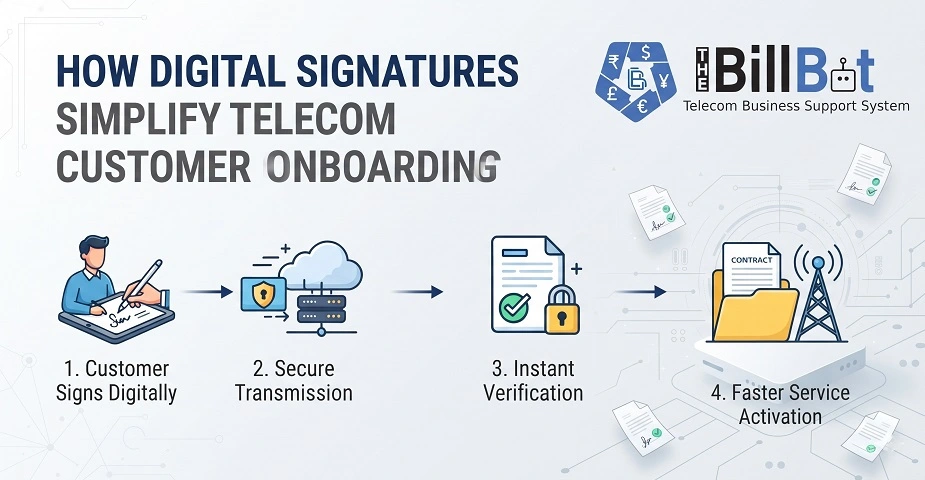
Table of Contents
- What Is a Digital Signature for Telecom?
- Why Traditional Telecom Customer Onboarding Needs Improvement
- 1. Lengthy Documentation Process
- 2. Delays in Contract Approval
- 3. Document Management Difficulties
- 4. Increased Administrative Work
- 5. Limited Customer Convenience
- 7 Ways Digital Signatures Simplify Telecom Customer Onboarding
- 1. Faster Customer Registration
- 2. Paperless Customer Onboarding
- 3. Convenient Remote Contract Signing
- 4. Improved Document Accuracy
- 5. Better Security and Document Tracking
- 6. Automated Customer Agreement Management
- 7. Faster Coordination Between Sales and Operations Teams
- How Digital Signatures Fit into the Telecom Onboarding Process
- The Role of Digital Signatures in VoIP, ITSP and MSP Businesses
- VoIP Providers
- ITSPs (Internet Telephony Service Providers)
- MSPs (Managed Service Providers)
- Broadband and Connectivity Providers
- What to Consider When Choosing Digital Signature Software
- How The Bill Bot Supports a More Connected Telecom Business
- Conclusion
- Frequently Asked Questions (FAQs)
- 1. What is a digital signature for telecom?
- 2. How do digital signatures improve telecom customer onboarding?
- 3. Is electronic signature software suitable for VoIP providers?
- 4. Are digital signatures legally valid for telecom contracts?
- 5. What is the difference between an electronic signature and a digital signature?
- 6. Can digital signatures reduce telecom onboarding costs?
- 7. Can digital signatures integrate with telecom CRM and billing systems?
- 8. Why should ITSPs and MSPs consider digital document signing?
- 9. Does digital signing eliminate the need for customer identity verification?
- 10. How can telecom businesses get started with paperless customer onboarding?
Author : Bhargav
Published : 19 Nov 2026
Related Articles
Explore more insights
18 Nov 2026 / Bhargav
Telecom Ticketing Systems: Managing Customer Support Requests Efficiently

17 Nov 2026 / Bhargav
Role-Based Access Control in Telecom Billing: A Practical Guide

16 Nov 2026 / Bhargav