Billing is one of the most important operational processes for a telecom business. It connects the services a provider delivers with the revenue it collects from customers. As telecom businesses grow, billing can become increasingly complicated due to recurring subscriptions, usage-based charges, call detail records (CDRs), multiple pricing plans, discounts, taxes, payments, renewals, and customer-specific billing rules. This is where Managed Billing for Telecom Providers can make a significant difference. Managed billing combines billing technology, automation, processes, and ongoing operational support to simplify the billing lifecycle. Instead of managing every billing task manually, telecom providers can use a managed approach to automate repetitive activities, improve billing accuracy, monitor payments, and maintain better visibility into revenue. Modern telecom billing platforms can support activities such as usage processing, rating, invoice generation, payment management, reporting, and revenue tracking. In this guide, we will explain what managed billing means, how it works, its key benefits, and what telecom providers should consider when choosing a managed billing solution. Managed Billing for Telecom Providers refers to an approach where billing technology, processes, or day-to-day billing activities are managed with the help of specialised software, automation, and professional support. Depending on the provider and service model, managed billing can cover different parts of the billing lifecycle. These may include: Customer account management Usage and CDR processing Recurring billing Usage-based billing Rating and charging Invoice generation Payment processing Payment reminders Collections management Revenue reporting Account reconciliation Billing system administration The goal is to create a structured billing environment where telecom providers can spend less time on repetitive administrative work and more time focusing on customers, services, and business growth. Telecom billing itself typically involves collecting consumption data, calculating charges, generating invoices, processing payments, and managing collections. The exact process can vary depending on the telecom business and its technology stack, but a typical Telecom Managed Billing workflow follows several key stages. The billing process starts with customer and service information. A provider may configure: Customer accounts Products and services Packages Pricing plans Billing cycles Discounts Taxes Payment terms Contract details A flexible billing environment allows these rules to be configured according to the provider's business model. Telecom services generate large amounts of usage information. For voice providers, this may include call detail records. Other providers may need to process data usage, subscriptions, recurring services, or other consumption records. A managed billing environment can help collect and process this information before charges are calculated. Once usage data has been collected, the applicable pricing rules are applied. For example, a telecom provider may charge customers according to: Minutes used Destination Call type Data consumption Subscription plan Service package Usage tiers One-time charges Discounts Modern Telecom Billing Software can automate these calculations and support both recurring and usage-based billing models. After charges are calculated, invoices can be generated according to the customer's billing cycle. Automated invoicing helps reduce repetitive manual work and can provide consistent invoice formatting across customers. Managed billing can also support payment processing and collections. Depending on the solution, providers may manage: Online payments Recurring payments Payment reminders Outstanding balances Customer statements Reconciliation Collection activities This creates a more connected billing-to-payment workflow. The final stage is understanding what is happening across the billing operation. Reports can help providers monitor: Revenue Collections Outstanding invoices Customer balances Usage Billing activity Product performance Payment trends This gives management better visibility into the financial side of telecom operations. Managed Billing Services can be configured around the specific requirements of a telecom provider. Common services may include: Customer accounts, billing profiles, plans, pricing, and payment information can be managed from a central system. For voice and VoIP businesses, CDR processing is an important part of the billing process. Usage records can be imported, processed, rated, and included in customer billing. Recurring charges can be automatically generated based on predefined billing cycles. This is useful for subscriptions, monthly services, packages, and recurring plans. Providers can charge customers according to actual service consumption. This is particularly useful for voice, data, and other usage-driven telecom services. Invoices can be generated and delivered automatically based on configured billing rules and schedules. A managed billing environment can connect invoices with payment processes, making it easier to track paid and unpaid accounts. Billing data can be transformed into reports that help providers understand revenue, usage, collections, and customer activity. Traditional billing processes often depend heavily on spreadsheets, manual calculations, disconnected systems, and repetitive administrative tasks. This can create problems as the customer base grows. For example, a provider may need to manually collect usage data, check pricing, calculate charges, prepare invoices, send payment reminders, and reconcile payments. With Managed Telecom Billing, many of these activities can be connected and automated. The purpose is not simply to replace manual work with software. A well-designed managed billing process connects the different stages of the billing lifecycle. One of the biggest benefits is automation. Instead of manually repeating the same billing activities every month, providers can automate processes such as billing runs, invoice generation, reminders, and reports. Manual calculations and data entry can introduce errors. Automated billing applies predefined rules consistently, helping reduce avoidable billing mistakes. Telecom providers often offer multiple services, packages, discounts, and pricing structures. A flexible Managed Billing Solution can support different charging models without requiring teams to calculate everything manually. When invoices, payments, and outstanding balances are managed within a connected system, finance teams can get a clearer view of collections and receivables. A billing process that works for 100 customers may become difficult to manage with thousands of customers. Automation and scalable Telecom Billing Management help providers handle increasing transaction volumes without increasing manual effort at the same rate. Accurate and timely invoices contribute to a smoother customer experience. Customers can receive invoices on schedule, view their charges clearly, and access payment options without unnecessary delays. Billing data contains valuable information about customers, services, usage, and revenue. With appropriate reporting, telecom providers can identify trends and use billing data to support operational and commercial decisions. Telecom Billing Software provides the technology layer needed to manage complex billing processes. Modern platforms can support usage rating, recurring billing, invoicing, payment management, customer accounts, reporting, and integrations. For example, telecom billing platforms may integrate with CRM systems, accounting platforms, payment gateways, PBXs, network systems, and other business applications. This reduces the need to move information manually between multiple systems. For growing telecom providers, integration is particularly important because billing rarely operates in isolation. Automated Telecom Billing is an important part of a managed billing strategy. Automation can be applied to many stages of the billing lifecycle, including: Importing usage records Processing CDRs Applying pricing rules Running billing cycles Generating invoices Sending invoices Sending payment reminders Processing payments Creating reports Monitoring outstanding balances The objective is to create a repeatable billing workflow that operates consistently with minimal manual intervention. Billing Services for Telecom Providers can be useful for a wide range of businesses, including: VoIP providers ITSPs MSPs offering telecom services Broadband providers Internet service providers Hosted communications providers Telecom resellers Wholesale voice providers Managed communications businesses The specific requirements will differ between businesses. A VoIP provider processing CDRs may have different requirements from an ISP managing recurring broadband subscriptions. That is why flexibility is an important consideration when selecting a billing system. Before choosing a managed billing platform or service, telecom providers should evaluate several areas. The system should support the billing models relevant to the business, including recurring, usage-based, subscription, and custom charges. Look for automation across billing runs, invoices, reminders, payments, and reporting. The solution should integrate with the systems already used by the business, such as CRM, accounting, PBX, payment, and network platforms. Strong reporting capabilities can provide visibility into revenue, customers, usage, invoices, and collections. The billing environment should be capable of supporting business growth and increasing customer or usage volumes. Billing systems manage sensitive customer and financial information, so security, access control, backups, and system reliability are important considerations. If billing operations are being managed externally or through a managed service model, responsive technical and operational support is an important factor. Billing is more than simply creating an invoice. It involves connecting customer information, services, usage, pricing, payments, and financial reporting. For telecom providers, this complexity can increase significantly as the business adds customers, services, pricing models, and integrations. Managed Billing for Telecom Providers provides a structured approach to handling this complexity through a combination of billing software, automation, processes, and support. Instead of relying on disconnected tools and manual processes, providers can build a more consistent billing workflow that supports accurate invoicing, better payment management, operational efficiency, and business visibility. As telecom operations become more complex, billing needs to be accurate, flexible, and efficient. Manual billing processes can become difficult to maintain as customer numbers, services, usage, and pricing models increase. Managed Billing for Telecom Providers offers a practical approach by combining technology, automation, structured workflows, and billing support. From usage processing and rating to invoicing, payments, collections, and reporting, managed billing can help create a more connected billing operation. For telecom providers looking to reduce repetitive work, improve billing visibility, and build scalable billing processes, a flexible managed billing approach can become an important part of their overall business operations. Managed Billing for Telecom Providers is an approach where telecom billing technology, processes, or selected billing activities are managed through specialised software, automation, and operational support. It can cover usage processing, rating, invoicing, payments, collections, and reporting. Managed Billing Services help telecom businesses manage some or all of their billing operations. Depending on the provider, services can include customer billing, usage processing, invoice generation, payment management, reconciliation, reporting, and billing system administration. Telecom Managed Billing is a structured approach to managing telecom billing processes using technology, automation, and defined workflows. It can help providers manage recurring and usage-based charges more efficiently. Not necessarily. Telecom Billing Software is the technology used to manage billing activities, while managed billing can include the software plus operational management, support, configuration, and other services. Yes. Managed billing can support usage-based models where customers are charged according to their actual consumption. For telecom providers, this may involve processing CDRs or other usage records before applying pricing and generating charges. It can automate billing cycles, invoice generation, delivery, payment reminders, and reporting. This can reduce repetitive manual tasks and create a more consistent invoicing process. It can be particularly useful when billing complexity increases with customer numbers, services, usage volumes, or pricing models. Scalable billing systems are designed to handle larger operational requirements as a business grows. Providers should consider billing flexibility, automation, integrations, usage and CDR processing, invoicing, payment management, reporting, scalability, security, and ongoing support.What Is Managed Billing for Telecom Providers?
How Does Telecom Managed Billing Work?
1. Customer and Service Setup
2. Usage Data Collection
3. Rating and Charging
4. Invoice Generation
5. Payment and Collections
6. Reporting and Revenue Monitoring
What Services Can Managed Billing Include?
Customer Billing Management
Usage and CDR Processing
Recurring Billing
Usage-Based Billing
Invoice Management
Payment Management
Reporting and Analytics
Managed Billing vs. Traditional Manual Billing
Key Benefits of Managed Billing for Telecom Providers
1. Reduce Manual Work
2. Improve Billing Accuracy
3. Handle Complex Pricing Models
4. Improve Cash Flow Visibility
5. Scale With Business Growth
6. Better Customer Experience
7. Better Business Insights
Why Telecom Billing Software Is Important
Managed Billing and Telecom Billing Automation
Who Can Benefit From Managed Billing?
What to Look for in a Managed Billing Solution
Flexible Billing Models
Automation
Integrations
Reporting
Scalability
Security and Reliability
Support
Managed Billing Can Simplify Telecom Operations
Conclusion
Frequently Asked Questions
What is Managed Billing for Telecom Providers?
What are Managed Billing Services?
What is Telecom Managed Billing?
Is Telecom Billing Software the same as managed billing?
Can managed billing support usage-based billing?
How does managed billing improve invoice management?
Is managed billing suitable for growing telecom providers?
What should telecom providers consider when choosing a managed billing solution?
 Book a Demo
What Is Managed Billing for Telecom Providers?
Bhargav
Oct 09, 2026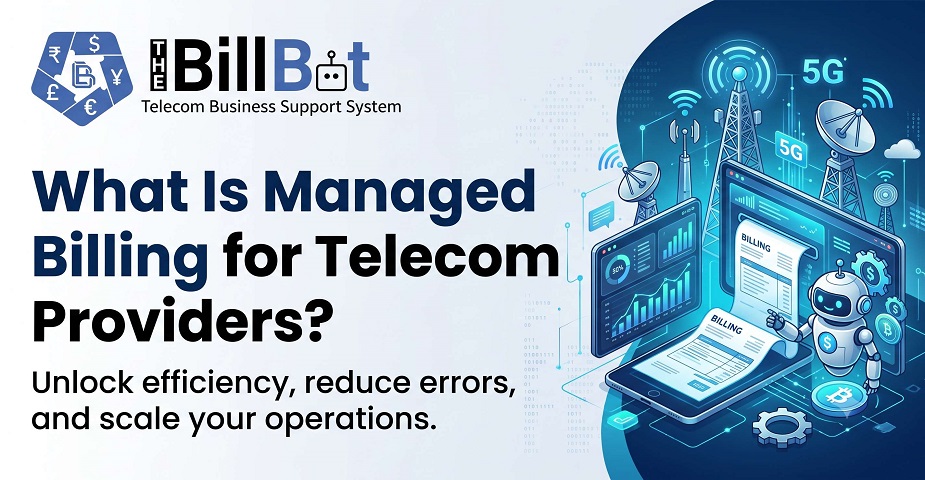
Table of Contents
- What Is Managed Billing for Telecom Providers?
- How Does Telecom Managed Billing Work?
- 1. Customer and Service Setup
- 2. Usage Data Collection
- 3. Rating and Charging
- 4. Invoice Generation
- 5. Payment and Collections
- 6. Reporting and Revenue Monitoring
- What Services Can Managed Billing Include?
- Customer Billing Management
- Usage and CDR Processing
- Recurring Billing
- Usage-Based Billing
- Invoice Management
- Payment Management
- Reporting and Analytics
- Managed Billing vs. Traditional Manual Billing
- Key Benefits of Managed Billing for Telecom Providers
- 1. Reduce Manual Work
- 2. Improve Billing Accuracy
- 3. Handle Complex Pricing Models
- 4. Improve Cash Flow Visibility
- 5. Scale With Business Growth
- 6. Better Customer Experience
- 7. Better Business Insights
- Why Telecom Billing Software Is Important
- Managed Billing and Telecom Billing Automation
- Who Can Benefit From Managed Billing?
- What to Look for in a Managed Billing Solution
- Flexible Billing Models
- Automation
- Integrations
- Reporting
- Scalability
- Security and Reliability
- Support
- Managed Billing Can Simplify Telecom Operations
- Conclusion
- Frequently Asked Questions
- What is Managed Billing for Telecom Providers?
- What are Managed Billing Services?
- What is Telecom Managed Billing?
- Is Telecom Billing Software the same as managed billing?
- Can managed billing support usage-based billing?
- How does managed billing improve invoice management?
- Is managed billing suitable for growing telecom providers?
- What should telecom providers consider when choosing a managed billing solution?
Author : Bhargav
Published : 09 Oct 2026
Related Articles
Explore more insights
08 Oct 2026 / Bhargav
Why Telecom Providers Need Customisable Billing Software
07 Oct 2026 / Bhargav
Why Telecom Billing Integrations Matter for Growing ITSPs
06 Oct 2026 / Bhargav