For VoIP providers, accurate billing is one of the most important parts of running a reliable and profitable telecom business. Every call can generate valuable usage information, including the caller, destination, call duration, call type, and associated charges. Managing this information manually becomes increasingly difficult as call volumes and customer accounts grow.
This is where CDR Billing becomes essential.
CDR Billing uses Call Detail Records (CDRs) generated by telecom and VoIP systems to calculate customer charges based on actual usage. Instead of manually reviewing call records and preparing invoices, providers can use automated billing systems to process call data, apply pricing rules, calculate charges, and generate accurate invoices.
For VoIP providers, CDR Billing can help simplify complex billing operations while providing greater visibility into customer usage and revenue.
In this guide, we will explain what CDR Billing is, how it works, its key benefits, and what providers should look for when choosing a CDR Billing System.
What Is CDR Billing?
CDR Billing is the process of using Call Detail Records to calculate and manage charges for telecommunications and VoIP services.
A Call Detail Record contains information about a call or communication session. Depending on the telecom platform or PBX system, a CDR can include details such as:
Caller number
Destination number
Call start time
Call end time
Call duration
Call type
Call status
Destination or country
Trunk or route information
Account or customer information
Usage-related data
A billing system takes this information and applies predefined pricing rules. The resulting charges can then be included in customer invoices.
For example, if a customer makes an international call for 10 minutes and the applicable rate is £0.05 per minute, the billing system can calculate the charge automatically based on the CDR.
This makes Call Detail Record Billing an important part of automated telecom billing.
What Are Call Detail Records (CDR)?
Call Detail Records (CDR) are data records generated by telecom systems, VoIP platforms, switches, PBXs, and other communication systems.
A CDR is not necessarily an invoice. Instead, it provides the usage information required to calculate a charge.
A typical CDR may contain:
Customer: Customer or account associated with the call
Source: Number or endpoint that initiated the call
Destination: Number or endpoint receiving the call
Duration: Length of the call
Timestamp: Date and time of the call
Call Type: Local, national, international, mobile, or other categories
Status: Answered, failed, busy, or unavailable
Route: Network or carrier route used for the call
The billing platform processes this information and determines how much the customer should be charged.
How Does CDR Billing Work?
The CDR Billing process generally involves several stages.
1. CDR Data Collection
The first step is collecting CDR data from the provider's VoIP infrastructure, PBX, softswitch, SBC, carrier, or other telecom systems.
The billing platform needs reliable access to call records before it can calculate usage charges.
2. CDR Processing
Once the records are received, the system processes and normalises the data.
Different telecom platforms may produce CDRs in different formats. A capable CDR Billing Platform can process these records and convert them into a consistent structure.
3. CDR Validation
Before billing, records should be checked for errors, duplicates, missing information, or invalid data.
This step is important because incorrect usage data can lead to incorrect customer charges.
4. Rate Application
The billing system applies the appropriate pricing rules to each call.
Rates can vary depending on:
Destination
Call type
Duration
Customer plan
Time of day
Carrier
Product
Package
Contract
Special pricing rules
5. Charge Calculation
After the correct rate is identified, the system calculates the charge associated with each usage record.
For example:
Call duration: 20 minutes
Rate: £0.04 per minute
Calculated charge: £0.80
The system can repeat this process across thousands or millions of records.
6. Invoice Generation
Once usage charges have been calculated, they can be combined with other recurring or one-time charges to generate customer invoices.
This creates a more complete billing process for VoIP providers.
7. Reporting and Reconciliation
Processed CDR data can also be used for usage reports, revenue analysis, customer statements, and billing reconciliation.
This allows providers to compare usage, charges, payments, and revenue more effectively.
Why Is CDR Billing Important for VoIP Providers?
For providers handling a large volume of calls, manually processing usage information is inefficient and difficult to scale.
CDR Billing for VoIP Providers helps automate this process.
Instead of manually reviewing individual calls, providers can use a CDR Billing System to process usage records automatically.
This can help providers:
Reduce manual billing work
Improve billing accuracy
Process high volumes of call records
Apply complex pricing rules
Generate invoices faster
Monitor customer usage
Improve billing transparency
Identify unusual usage patterns
Simplify billing operations
The result is a more structured approach to usage-based billing.
Key Benefits of CDR Billing
1. Automated Billing
One of the biggest advantages of CDR Billing is automation.
A CDR Billing Software solution can automatically import records, process usage, apply rates, calculate charges, and prepare billing information.
This reduces repetitive administrative work.
2. Improved Billing Accuracy
Manual calculations can introduce errors, especially when providers handle thousands of call records.
Automated VoIP CDR Billing helps apply predefined pricing rules consistently across customer usage.
3. Faster Invoice Processing
Processing CDRs automatically can significantly reduce the time required to prepare usage-based invoices.
This can help providers maintain a more consistent billing cycle.
4. Better Customer Transparency
Customers often want to understand what they are being charged for.
Detailed usage information can help providers explain charges and provide more transparent invoices.
5. Scalable Billing Operations
As a VoIP business grows, call volumes and customer accounts can increase rapidly.
A scalable CDR Billing Platform can process large volumes of records without requiring the same increase in manual effort.
6. Better Usage Visibility
CDRs provide detailed information about customer calling activity.
Providers can use this data to understand usage trends, identify high-usage accounts, and monitor service activity.
7. Simplified Billing Management
A centralised VoIP Billing Management solution can bring usage processing, rating, invoicing, payments, and reporting into a more connected workflow.
This can make day-to-day billing administration easier to manage.
CDR Billing vs Traditional Manual Billing
Traditional billing processes may rely heavily on spreadsheets, manual calculations, and separate systems.
This approach can become difficult when a provider has:
Many customers
Multiple pricing plans
Different destinations
Multiple carriers
Large CDR volumes
Complex discounts
Recurring services
Usage-based services
A modern CDR Billing System can automate many of these tasks.
The right approach depends on the provider's business model, infrastructure, customer volume, and billing complexity.
What Is CDR Billing Software?
CDR Billing Software is a solution designed to process Call Detail Records and convert telecom usage data into billable charges.
Depending on the platform, features may include:
CDR import
CDR processing
Rate management
Usage rating
Customer management
Product and package management
Invoice generation
Payment management
Usage reporting
Revenue reporting
Customer statements
Billing reconciliation
Automated notifications
For VoIP providers, integrating CDR processing with broader VoIP Billing Software can create a more connected billing workflow.
What Should You Look for in a CDR Billing Platform?
Choosing the right CDR Billing Platform requires more than checking whether it can process call records.
Providers should consider several factors.
CDR Integration
The platform should be able to receive CDR data from the relevant telecom or VoIP systems used by the business.
Flexible Rating
Different customers may have different pricing structures. The billing platform should support flexible rating and charging rules.
Automation
Look for automation across CDR processing, rating, invoicing, payment reminders, and reporting.
Scalability
The system should be able to handle growing customer numbers and increasing CDR volumes.
Reporting
Detailed reports can help providers understand usage, revenue, collections, and customer activity.
Integration Capabilities
A CDR billing solution should ideally integrate with relevant CRM, payment, accounting, PBX, carrier, and telecom systems.
Security and Reliability
Billing information is business-critical. Providers should consider data security, access controls, system reliability, backups, and audit capabilities.
How CDR Billing Supports Telecom Billing
Telecom CDR Billing is not limited to traditional voice providers. It can support different telecom and communication businesses where services are charged according to usage.
The same fundamental concept applies:
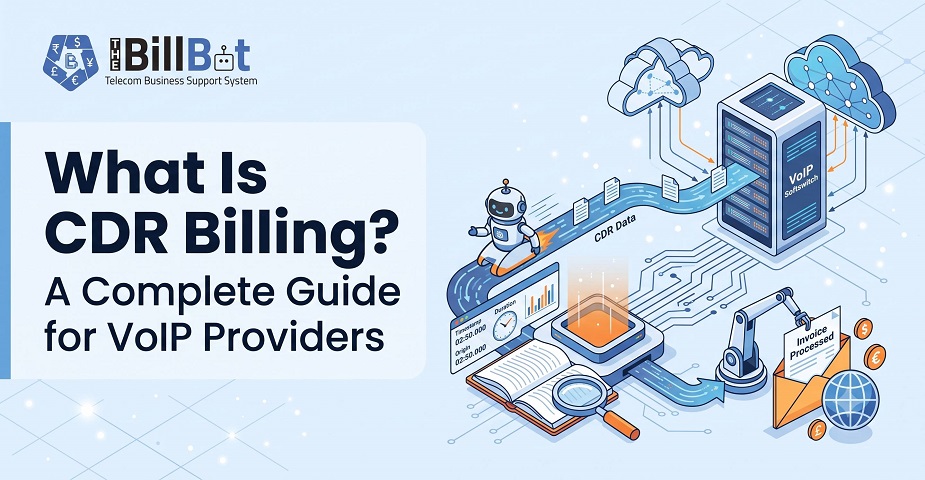
Usage Data → CDR Processing → Rating → Charge Calculation → Invoice
By connecting CDR processing with a broader telecom billing workflow, providers can manage usage-based charges alongside recurring services, products, packages, and other billing items.
Common Challenges Without Automated CDR Billing
Without an automated billing process, VoIP providers may encounter several challenges.
Manual Data Entry
Moving usage information between systems manually consumes time and can introduce errors.
Complex Pricing
Different rates and customer plans can make manual billing difficult to maintain.
Duplicate or Missing Records
Large datasets can contain duplicate or incomplete records that need to be identified before billing.
Delayed Invoicing
Manual processing can delay invoice generation and affect the overall billing cycle.
Limited Visibility
Without centralised reporting, providers may struggle to understand customer usage and revenue performance.
Difficult Scaling
A process that works for a small customer base may become inefficient as the business grows.
Automated CDR Billing helps address these challenges by creating a structured and repeatable billing workflow.
CDR Billing and the Future of VoIP Billing
The telecom industry continues to move toward greater automation and integrated business systems.
For VoIP providers, billing is increasingly connected with customer management, product management, payments, reporting, and service operations.
This means modern VoIP Billing Software is becoming more than a tool for generating invoices. It can become part of a broader business support environment where usage data flows through the business automatically.
CDR Billing plays an important role in that process because accurate usage data is the foundation of usage-based charging.
Final Thoughts
CDR Billing provides VoIP providers with a structured way to convert call usage data into accurate and manageable customer charges.
By collecting Call Detail Records, validating usage, applying rates, calculating charges, and connecting the results with invoicing, providers can reduce manual billing work and improve operational efficiency.
A modern CDR Billing System can also support scalability, reporting, customer transparency, and more efficient VoIP Billing Management.
For providers looking to automate usage-based billing, choosing a reliable CDR Billing Software solution can be an important step toward building a more efficient and scalable billing operation.
Frequently Asked Questions About CDR Billing
1. What is CDR Billing?
CDR Billing is the process of using Call Detail Records to calculate charges for telecom and VoIP usage. The system processes call information, applies pricing rules, calculates charges, and can generate invoices.
2. What are Call Detail Records?
Call Detail Records, or CDRs, are records containing information about communication sessions such as caller, destination, call duration, timestamp, call type, and call status.
3. Why do VoIP providers need CDR Billing?
VoIP providers use CDR Billing to automate usage-based charging, process large volumes of call records, apply pricing rules, improve billing accuracy, and simplify invoice generation.
4. What is CDR Billing Software?
CDR Billing Software is a system that processes Call Detail Records and converts usage information into billable charges. It can also support rating, invoicing, reporting, and payment workflows.
5. How does VoIP CDR Billing work?
VoIP CDR Billing typically collects CDRs from a VoIP or telecom system, validates the records, applies appropriate rates, calculates charges, and sends the results to the billing and invoicing process.
6. Can CDR Billing handle different pricing plans?
Yes. A capable CDR Billing Platform can support different rates and pricing structures based on factors such as destination, call type, duration, customer, product, package, or contract.
7. Is CDR Billing useful for small VoIP providers?
Yes. While the complexity of billing depends on the provider's business model, automation can help small providers reduce repetitive manual work and establish scalable billing processes from an early stage.
8. What is the difference between CDR Billing and VoIP Billing Software?
CDR Billing focuses specifically on processing usage records and calculating charges from CDR data. VoIP Billing Software can cover a broader range of functions, including customer management, products, invoices, payments, reporting, and CDR-based billing.
9. Can CDR Billing improve invoice accuracy?
Automated CDR Billing can reduce manual calculation and data-entry errors by consistently applying predefined billing and rating rules. However, the quality of the final result also depends on accurate source data and correctly configured pricing rules.
10. What should VoIP providers consider when choosing CDR Billing Software?
Providers should consider CDR compatibility, rating flexibility, automation, scalability, integrations, reporting, security, reliability, and how easily the platform can adapt to their billing model.