Telecom providers manage a wide range of services, from VoIP calling and broadband connectivity to DID numbers, extensions and business communication packages. Each service may have a different pricing structure, which makes choosing the right billing approach an important business decision.
Some customers prefer a fixed monthly fee because it makes budgeting easier. Others want to pay according to their actual usage, particularly when their call volumes or data consumption change from month to month.
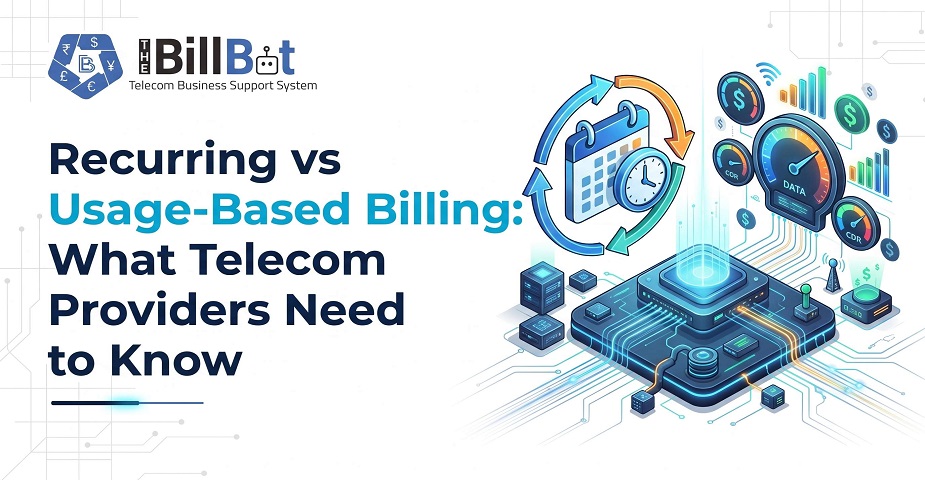
This is where Recurring vs Usage-Based Billing becomes an important consideration for telecom providers. Both models offer practical benefits, but the right choice depends on the services you deliver, your customers' expectations and your revenue goals.
Understanding how these billing models work can help you improve billing accuracy, reduce manual administration and create pricing plans that support business growth.
What Is Recurring Billing?
Recurring billing is a pricing model in which customers are charged at regular intervals, such as monthly, quarterly or annually. The amount is generally agreed in advance and remains consistent unless the subscription, service package or pricing terms change.
For telecom providers, recurring billing is commonly used for services that customers need continuously.
Examples include:
Monthly VoIP subscriptions.
Business telephone extensions.
Broadband packages.
DID number rentals.
Managed communication services.
Monthly support and maintenance plans.
Benefits of Recurring Billing for Telecom Providers
1. Predictable revenue
Recurring billing gives providers a clearer view of expected income. When customers have active subscriptions, businesses can forecast revenue more effectively and plan their operating costs.
2. Easier customer budgeting
Customers know how much they are expected to pay each billing cycle. This predictability is particularly useful for businesses managing multiple communication services.
3. Simplified invoicing
Once subscription charges and billing dates are configured, invoices can be generated automatically. This reduces repetitive administrative work and helps teams manage large customer accounts more efficiently.
4. Better customer retention opportunities
Subscription plans support ongoing customer relationships. Providers can review usage, identify changing requirements and recommend suitable upgrades or additional services.
However, recurring billing alone may not cover every charge. Customers may also incur call charges, additional data costs or other variable fees. Providers need a billing approach that can accommodate these differences.
What Is Usage-Based Billing?
Usage-based billing charges customers according to how much of a service they consume during a particular period. Instead of paying only a fixed subscription fee, customers are charged based on measurable activity.
This model is useful when consumption varies considerably between customers or billing periods.
For example, a VoIP provider might charge customers according to their outgoing call minutes. Another provider might calculate charges based on international calls, message volumes or additional data usage.
Common examples of usage-based telecom billing include:
Outgoing call minutes.
International calling charges.
Pay-as-you-go communication services.
Data consumption beyond an agreed allowance.
Chargeable messages or transactions.
Additional usage outside a customer's package.
Benefits of Usage-Based Billing
1. Charges reflect actual consumption
Customers pay according to the services they use. This can be attractive to businesses with fluctuating communication requirements.
2. Flexible pricing options
Providers can offer different rates for local calls, international calls, destinations, service types or usage volumes.
3. Opportunities to increase revenue
When customers increase their consumption, usage-based charges can increase revenue without requiring every customer to move to a different subscription.
4. Suitable for different customer segments
Small businesses, large enterprises and customers with seasonal demand may have very different usage patterns. Flexible pricing helps providers accommodate those differences.
Nevertheless, usage-based billing requires accurate usage records, clearly defined rates and reliable calculations. Without appropriate systems, managing these charges manually can become time-consuming and lead to invoice disputes.
Recurring vs Usage-Based Billing: Key Differences
Both approaches help telecom providers charge for their services, but they work differently.
The main difference is that recurring billing charges customers for continued access to a service, while usage-based billing calculates charges from actual consumption.
Neither approach is universally better. The most appropriate model depends on the service, customer expectations and commercial objectives.
Which Telecom Billing Model Is Right for Your Business?
Choosing between different Telecom Billing Models requires an understanding of how your services are delivered and consumed.
Choose Recurring Billing for Predictable Services
Recurring billing is a practical choice when customers receive an ongoing service for an agreed fee.
For example, a business purchasing ten telephone extensions might pay a fixed monthly amount for those extensions. The provider can generate invoices according to the agreed billing cycle.
This model is particularly suitable when:
Services are provided continuously.
Customers prefer predictable monthly costs.
Subscription charges form a significant part of revenue.
The service does not require every charge to be calculated from individual usage records.
Providers should still account for changes such as new extensions, cancellations, upgrades and mid-cycle adjustments.
Choose Usage-Based Billing for Variable Consumption
Usage-based billing works well when charges depend on how much a customer uses a service.
Consider a business whose employees make a different number of outgoing calls each month. A usage-based pricing structure allows the provider to calculate charges from the recorded call activity.
This approach may be appropriate when:
Call volumes change frequently.
Customers use services at different levels.
Additional consumption needs to be charged separately.
Providers offer pay-as-you-go or metered services.
Accurate call detail record processing, rate configuration and usage validation are essential to ensure customers are charged correctly.
Consider Hybrid Billing Models for Greater Flexibility
Many telecom providers do not need to choose just one approach. They can combine recurring and usage-based billing within the same customer account.
For example, a customer could pay a fixed monthly subscription for a VoIP package that includes a defined number of call minutes. Additional chargeable calls are then billed according to the applicable rates.
This structure combines predictable subscription revenue with charges that reflect additional consumption.
Hybrid Billing Models can be useful for:
VoIP providers offering monthly calling packages.
Broadband providers charging for usage beyond a plan allowance.
ITSPs combining subscriptions with chargeable services.
MSPs providing fixed monthly support alongside additional billable work.
A hybrid approach can offer a balance between customer affordability, revenue predictability and flexible service pricing.
How Telecom Billing Software Supports Both Models
Managing subscriptions and usage charges manually becomes increasingly difficult as the number of customers, services and pricing rules grows.
Reliable Telecom Billing Software helps providers bring different billing activities together and apply the correct charges consistently.
Here are several capabilities worth considering.
1. Automated Subscription Management
Software should support recurring billing schedules, subscription changes and regular invoice generation. This reduces repetitive work and helps ensure that ongoing services are billed according to their agreed terms.
2. Accurate CDR Processing
Call Detail Records (CDRs) contain information about telephone calls, including details needed to calculate applicable charges. Billing systems can process these records, apply configured rates and prepare usage charges for invoicing.
Accurate CDR processing is particularly important for providers managing large call volumes or multiple destinations.
3. Flexible Pricing Configuration
Different customers may require different rates, packages, discounts and service allowances.
A suitable billing platform should allow providers to configure pricing rules according to their commercial agreements without creating unnecessary manual processes.
4. Combined Invoicing
When customers use multiple services, separate invoices can make billing harder to understand.
A system that combines recurring subscriptions and usage-based charges can help providers present a clearer breakdown of costs on a single invoice where appropriate.
5. Reporting and Revenue Visibility
Billing reports help providers understand recurring revenue, usage patterns, outstanding invoices and customer activity.
These insights can support better pricing decisions, help identify unusual consumption and highlight opportunities to improve collections.
6. Payment Tracking and Reconciliation
Automated billing is more effective when it connects with payment management. Providers can track outstanding balances, monitor payment status and reduce manual reconciliation work.
Together, these capabilities help businesses implement Automated Telecom Billing processes that support both recurring and variable charges.
Common Challenges and How to Overcome Them
Although different pricing models offer flexibility, providers should consider several practical challenges.
Inaccurate usage records: Missing, duplicated or incorrectly processed usage data can lead to billing errors. Implement validation checks and investigate discrepancies before invoices are finalised.
Complex pricing rules: Different tariffs, discounts and package allowances can make charge calculations difficult. Maintain clear pricing rules and test them whenever changes are introduced.
Customer confusion: Variable charges can surprise customers who are accustomed to fixed monthly fees. Explain pricing terms clearly and provide itemised invoices.
Manual administration: Handling subscription changes, usage records and invoice preparation separately can increase workloads. Automate repetitive processes where possible.
Revenue uncertainty: Usage-based charges fluctuate with customer activity. Monitor historical consumption and use it alongside subscription revenue when forecasting income.
Addressing these challenges early helps providers maintain customer trust while improving operational efficiency.
How The Bill Bot Can Help Telecom Providers
Telecom businesses need billing processes that can accommodate their services, pricing structures and customer requirements.
The Bill Bot provides a business support system designed for telecom providers, ITSPs and MSPs. Its billing and business management capabilities can help businesses streamline billing-related operations and manage different aspects of their service delivery.
For providers evaluating recurring, usage-based or hybrid pricing, the important consideration is having a system that supports their commercial requirements without creating unnecessary manual work.
By bringing billing processes, customer information and reporting into a more organised workflow, providers can work towards greater operational efficiency and a clearer view of their business performance.
Explore The Bill Bot to learn more about its billing and business support capabilities.
Conclusion
Understanding Recurring vs Usage-Based Billing helps telecom providers choose pricing structures that suit their services and customers.
Recurring billing offers predictable charges and simplifies budgeting, making it suitable for ongoing subscriptions. Usage-based billing links charges to actual consumption, giving providers flexibility when delivering services with variable demand.
For many telecom businesses, combining both approaches through hybrid billing models provides a practical way to balance predictable revenue with additional usage charges.
The right Telecom Billing Solutions should support accurate calculations, flexible pricing, automated invoicing and clear reporting. With the right processes and technology in place, providers can reduce administrative effort, improve billing accuracy and build stronger customer relationships.
Frequently Asked Questions (FAQs)
1. What is the difference between recurring and usage-based billing?
Recurring billing charges customers at regular intervals, usually at a fixed price. Usage-based billing calculates charges according to the amount of a service consumed during a billing period.
2. Which billing model is best for telecom providers?
It depends on the service. Recurring billing suits subscriptions and ongoing services, while usage-based billing is useful for services such as chargeable call minutes and additional consumption. Many providers use a combination of both.
3. Can telecom providers use recurring and usage-based billing together?
Yes. Hybrid Billing Models allow providers to charge a fixed subscription fee while billing additional usage separately. For example, a VoIP package may include a monthly allowance with extra charges for calls outside that allowance.
4. How does telecom billing software help manage different billing models?
Telecom Billing Software can automate subscription invoicing, process usage records, apply pricing rules, calculate charges and generate invoices. The capabilities available depend on the particular platform.
5. Is usage-based billing suitable for VoIP providers?
Yes. Usage-Based Telecom Billing is suitable for VoIP providers that charge according to call duration, destinations or other measurable consumption. Accurate call records and rate configuration are essential.
6. What are the main challenges of usage-based billing?
Common challenges include inaccurate usage records, complex pricing structures, unpredictable charges and customer disputes. Automated processing, validation checks and clear invoices can help address these issues.
7. What are the benefits of recurring billing for telecom providers?
Recurring Billing for Telecom Providers can make revenue easier to forecast, simplify customer budgeting and reduce repetitive invoicing tasks through automation.
8. How can providers choose the right telecom pricing model?
Providers should consider their services, customer usage patterns, revenue goals and customers' budgeting preferences. Comparing these factors helps determine whether recurring, usage-based or hybrid pricing is most appropriate.