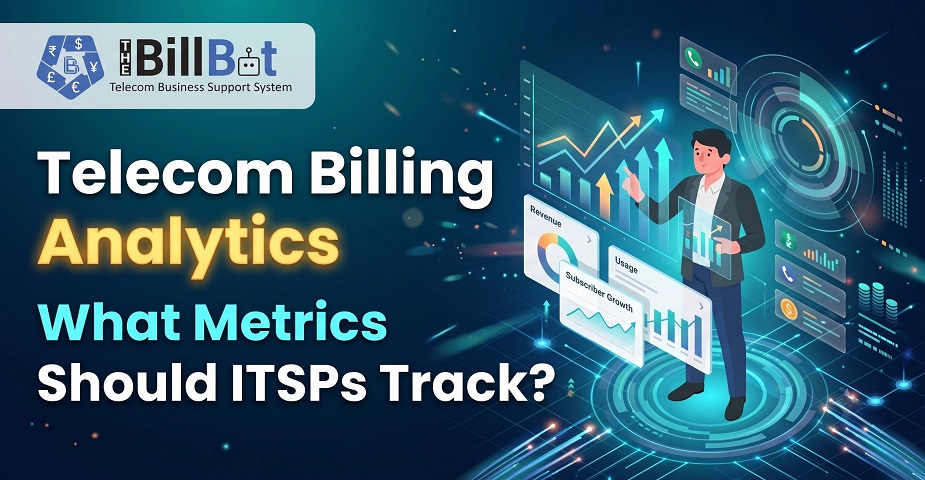
For ITSPs, billing is much more than generating invoices and collecting payments. Every billing cycle produces valuable information about customers, usage, revenue, services, payments, and operational performance. When this information is analyzed effectively, it can help service providers identify problems earlier, understand business trends, and make more informed decisions.
This is where Telecom Billing Analytics becomes important.
Modern ITSPs manage multiple services, pricing models, customer accounts, usage records, recurring charges, one-time fees, discounts, taxes, and payment transactions. Without the right analytics, it can be difficult to understand whether billing operations are performing efficiently or where revenue opportunities may be getting lost.
By tracking the right Telecom Billing Metrics, ITSPs can gain a clearer picture of financial performance while improving billing accuracy, customer experience, and operational efficiency.
What Is Telecom Billing Analytics?
Telecom Billing Analytics is the process of collecting, analyzing, and interpreting billing-related data to understand how a telecom or ITSP business is performing.
This data can include invoices, customer accounts, recurring charges, usage records, payments, outstanding balances, discounts, taxes, credits, adjustments, and service-level revenue.
Instead of looking at billing as a back-office process, analytics turns billing data into actionable business information.
For example, an ITSP can use billing analytics to determine:
How much revenue was generated during a specific period
Which services generate the most revenue
How much customers are actually paying
Which invoices remain unpaid
Where billing discrepancies are occurring
Which customers generate the highest revenue
How usage affects billing
Whether revenue is increasing or declining
Where potential revenue leakage may exist
Industry KPI frameworks commonly group telecom metrics into areas such as revenue, subscriber/customer performance, and operational efficiency.
For ITSPs, the most useful approach is to connect these metrics directly to the billing lifecycle.
Why Billing Analytics Matters for ITSPs
ITSPs often operate with complex billing structures. A single customer may have multiple services, different pricing plans, recurring subscriptions, usage-based charges, add-ons, and discounts.
As customer numbers increase, manually reviewing this information becomes increasingly difficult.
Telecom Billing Analytics for ITSPs helps turn large volumes of billing information into understandable business insights.
With effective ITSP Billing Analytics, providers can:
Improve billing accuracy
Monitor revenue trends
Identify unusual billing activity
Track customer payment behavior
Understand service profitability
Reduce manual reporting
Detect potential revenue leakage
Improve collection performance
Monitor customer account activity
Make data-driven pricing decisions
Billing analytics is particularly useful when usage records must flow through multiple stages before appearing on an invoice. Missing or incorrectly rated usage records can result in inaccurate billing or lost revenue.
Key Telecom Billing Metrics ITSPs Should Track
Not every metric needs to be monitored with the same frequency. The objective should be to create a focused set of Telecom Billing KPIs that provides visibility into revenue, billing accuracy, collections, customer behavior, and operational efficiency.
Here are some of the most important metrics ITSPs should consider.
1. Total Billing Revenue
Total billing revenue is one of the most fundamental metrics for an ITSP.
It represents the amount billed to customers during a particular period and provides a starting point for understanding financial performance.
ITSPs can compare billing revenue across:
Month-over-month periods
Quarters
Customer segments
Products
Services
Pricing plans
Geographic markets
Revenue trends become more useful when combined with other metrics. For example, rising revenue with declining customer numbers may indicate that existing customers are spending more, while increasing customers with flat revenue may indicate lower average revenue per account.
2. Average Revenue Per Customer
Average revenue per customer helps ITSPs understand how much revenue each customer generates on average.
A simplified calculation is:
Average Revenue Per Customer = Total Customer Revenue ÷ Average Number of Customers
The metric can be calculated for different customer groups, products, or service categories.
Traditional telecom reporting commonly uses ARPU—average revenue per user—as a customer economics metric.
For ITSPs, tracking customer-level or account-level revenue can provide similar insight, particularly where one account may contain multiple users or services.
3. Monthly Recurring Revenue
Monthly Recurring Revenue (MRR) is particularly useful for ITSPs that sell subscription-based services.
MRR shows the recurring revenue expected from active subscriptions during a month.
Tracking MRR can help providers understand:
Recurring revenue growth
New customer revenue
Expansion revenue
Downgrades
Cancellations
Revenue trends by service
MRR should be separated from one-time charges where possible so management can distinguish predictable recurring revenue from temporary billing activity.
4. Billing Accuracy Rate
Billing accuracy is a critical Telecom Billing KPI because errors can affect both revenue and customer trust.
Billing accuracy can be measured as the percentage of invoices generated without billing-related errors.
ITSPs can monitor issues involving:
Incorrect usage charges
Incorrect pricing
Missing services
Duplicate charges
Incorrect discounts
Tax calculation issues
Contract or plan mismatches
Revenue assurance frameworks commonly include billing accuracy and revenue leakage among the metrics used to monitor billing performance.
A useful billing dashboard should not only show the accuracy percentage but also identify the most common sources of errors.
5. Revenue Leakage
Revenue leakage occurs when the amount a provider should earn differs from the amount actually billed or collected.
For example, leakage may occur because:
Usage records are missing
Services are active but not billed
Pricing rules are incorrect
Discounts are applied incorrectly
Products are provisioned without corresponding billing
Rating errors occur
Carrier or supplier charges do not match expectations
Comparing expected charges with actual billed amounts can help ITSPs identify discrepancies earlier. Revenue assurance approaches increasingly emphasize reconciliation between usage, rating, and billing data.
6. Invoice Volume
Invoice volume measures the number of invoices generated during a particular period.
Although it may seem like a basic metric, invoice volume becomes useful when compared with:
Customer growth
Billing errors
Processing time
Payment volume
Dispute volume
Automation levels
If invoice volume increases significantly while manual processing remains high, an ITSP may need to improve automation and workflow management.
7. Outstanding Accounts Receivable
Accounts receivable shows the money customers owe the business.
ITSPs should monitor:
Total outstanding balance
Current receivables
Overdue receivables
Receivables by customer
Receivables by aging period
An aging report can divide unpaid invoices into categories such as 0–30 days, 31–60 days, 61–90 days, and more than 90 days.
This helps finance teams prioritize collection activities.
8. Collection Rate
The collection rate measures how effectively billed revenue is converted into actual payments.
A simple calculation is:
Collection Rate = Amount Collected ÷ Amount Due × 100
A declining collection rate can indicate payment issues, ineffective reminders, disputes, or customer credit problems.
By monitoring this metric alongside overdue balances, ITSPs can identify changes in customer payment behavior.
9. Payment Success Rate
For providers offering online payment options, payment success rate is another important billing metric.
ITSPs can track:
Successful payments
Failed payments
Declined transactions
Retry success
Payment method performance
This can reveal whether customers are experiencing problems during the payment process.
A high payment failure rate may require investigation into payment methods, transaction workflows, customer notifications, or payment gateway configuration.
10. Invoice Dispute Rate
Invoice disputes can consume significant time for billing and customer service teams.
The dispute rate measures the percentage of invoices that result in customer disputes.
Common causes include:
Incorrect usage
Unexpected charges
Contract differences
Pricing misunderstandings
Missing credits
Tax discrepancies
Telecom Billing Reports should ideally identify not only the number of disputes but also their reasons, value, and resolution time.
11. Usage-to-Billing Variance
For usage-based services, ITSPs should compare recorded usage with billed usage.
This is especially important for voice, messaging, data, and other consumption-based services.
The objective is to identify differences between:
Actual Usage → Rated Usage → Billed Usage
A variance can indicate missing records, rating issues, integration problems, or other billing inconsistencies.
CDRs and other usage events form an important part of the telecom billing pipeline, so monitoring their movement through collection, mediation, rating, and billing can improve billing visibility.
12. Revenue by Product or Service
Not every service contributes equally to business revenue.
ITSPs should analyze revenue by:
Voice services
Broadband
SIP services
DID numbers
Calling plans
Hosted services
Add-ons
Other recurring services
This form of Telecom Revenue Analytics helps management understand which services contribute most to overall revenue.
It can also support pricing, packaging, and product strategy decisions.
13. Customer Churn and Revenue Churn
Billing analytics can also provide valuable customer-retention insights.
Customer churn measures the percentage of customers who leave during a specific period.
Revenue churn focuses on the revenue lost from cancellations or downgrades.
Looking at both metrics provides more context than customer count alone.
For example, losing several low-value accounts and losing a few high-value accounts may have very different financial effects.
Telecom KPI frameworks commonly track churn alongside revenue and subscriber metrics because customer changes directly affect revenue performance.
14. Customer Lifetime Value
Customer Lifetime Value (CLV) estimates the revenue or value a customer may generate over the relationship.
ITSPs can analyze CLV by customer segment, service, plan, or acquisition channel.
Combining CLV with billing information can help identify high-value accounts and understand which services contribute to long-term customer value.
15. Billing Processing Time
Billing analytics should not focus exclusively on revenue.
Operational metrics are equally important.
Billing processing time measures how long it takes to complete a billing cycle from usage collection through invoice generation.
Tracking this metric can reveal:
Manual bottlenecks
Integration delays
Processing issues
Data validation problems
Approval delays
As customer and transaction volumes grow, reducing unnecessary processing time can improve operational efficiency.
16. Credit Notes and Billing Adjustments
ITSPs should also monitor credit notes, refunds, adjustments, and manual billing changes.
A sudden increase in adjustments may indicate:
Pricing errors
Incorrect configuration
Customer disputes
Contract changes
Manual processing problems
This makes adjustment volume an important part of Billing Data Analytics.
How to Build an Effective Telecom Billing Analytics Dashboard
A useful dashboard should make important information easy to understand.
Instead of displaying dozens of unrelated numbers, ITSPs can organize their dashboard into several categories.
Revenue Dashboard
Track:
Total revenue
MRR
Revenue by service
Revenue growth
Average revenue per customer
Billing Performance Dashboard
Track:
Billing accuracy
Invoice volume
Invoice processing time
Billing errors
Usage-to-billing variance
Collections Dashboard
Track:
Amount collected
Collection rate
Outstanding balance
Aging receivables
Payment success rate
Customer Dashboard
Track:
Active customers
New customers
Churn
Revenue churn
Customer lifetime value
Revenue Assurance Dashboard
Track:
Revenue leakage
Active-but-unbilled services
Rating discrepancies
Missing usage records
Billing exceptions
This structure makes ITSP Billing Metrics easier to interpret and connect to specific business decisions.
How ITSPs Can Use Billing Analytics for Better Decisions
Collecting data is only the first step. The real value comes from using the information to make operational improvements.
For example, if billing analytics shows an increase in invoice disputes, the business can investigate pricing configuration or invoice presentation.
If revenue from a particular service is declining, management can analyze customer usage, pricing, cancellations, and plan changes.
If outstanding receivables are increasing, finance teams can review payment behavior and collection workflows.
If usage-to-billing differences are increasing, technical teams can investigate the CDR and rating pipeline.
This is why Telecom Billing Performance should be evaluated as a connected system rather than through a single metric.
Common Mistakes When Tracking Billing Metrics
ITSPs can make their analytics less useful by focusing on too much data without defining clear objectives.
Common mistakes include:
Tracking Too Many Metrics
More metrics do not automatically mean better analytics. A focused set of KPIs is usually easier to understand and act upon.
Ignoring Data Quality
If billing data is incomplete or inconsistent, reports can produce misleading results.
Looking Only at Revenue
Revenue is important, but it should be analyzed alongside billing accuracy, collections, usage, customer behavior, and operational performance.
Relying Entirely on Manual Reports
Manual spreadsheets can make it difficult to maintain consistent reporting as billing volumes increase.
Not Connecting Usage and Billing Data
For usage-based services, separating usage information from billing information can hide important discrepancies.
The Role of Automation in Billing Analytics
Automation can make Billing Analytics for ITSPs more practical by reducing manual data collection and reporting.
An automated billing environment can bring together customer data, products, pricing, usage, invoices, payments, and reporting information.
This gives teams a more consistent view of the billing lifecycle.
Automation can also support:
Scheduled billing reports
Automated invoice generation
Payment reminders
Revenue reporting
Exception identification
Customer account analysis
Usage reporting
Collection monitoring
The goal is not simply to automate reporting. It is to create a reliable flow of billing information that allows teams to identify issues and opportunities sooner.
Final Thoughts
Telecom Billing Analytics gives ITSPs a clearer understanding of what is happening across their billing and revenue operations.
The most valuable metrics are not necessarily the ones that produce the biggest numbers. They are the metrics that help teams understand billing accuracy, revenue performance, customer behavior, collections, usage, and potential leakage.
By tracking metrics such as total revenue, MRR, average revenue per customer, billing accuracy, revenue leakage, collection rate, payment success rate, invoice disputes, usage-to-billing variance, churn, and service-level revenue, ITSPs can build a more complete view of their business.
The key is to connect these Telecom Billing Metrics into a single reporting framework rather than analyzing each number in isolation.
When billing data becomes easier to understand, ITSPs can move from simply processing invoices to using billing information as a source of actionable business insight.
Frequently Asked Questions
1. What is Telecom Billing Analytics?
Telecom Billing Analytics is the process of analyzing billing, usage, customer, payment, and revenue data to understand billing performance and identify business opportunities or problems.
2. Which Telecom Billing Metrics should ITSPs track?
Important metrics include total revenue, MRR, average revenue per customer, billing accuracy, revenue leakage, invoice volume, collection rate, outstanding receivables, payment success rate, invoice disputes, usage-to-billing variance, churn, and revenue by service.
3. Why is billing accuracy important for ITSPs?
Billing accuracy helps ensure customers are charged correctly and that the provider receives the revenue it has earned. Tracking billing accuracy can also help identify recurring errors and reduce billing disputes.
4. How can Telecom Billing Analytics reduce revenue leakage?
Analytics can compare expected charges with actual billed amounts and identify discrepancies such as missing usage, incorrect ratings, active services that are not being billed, or pricing inconsistencies.
5. What are Telecom Billing KPIs?
Telecom Billing KPIs are measurable indicators used to evaluate billing, revenue, collections, customer, and operational performance. Examples include billing accuracy, revenue leakage, collection rate, MRR, and invoice dispute rate.
6. How often should ITSPs review billing analytics?
Critical metrics such as revenue, billing exceptions, payment failures, and outstanding balances can be monitored regularly or in near real time. Broader performance reports can be reviewed weekly or monthly depending on business requirements.
7. What are Telecom Billing Reports?
Telecom Billing Reports provide structured information about invoices, usage, revenue, payments, customers, outstanding balances, billing errors, and other billing activities.
8. Can billing analytics help improve customer retention?
Yes. Billing analytics can identify patterns involving disputes, payment problems, declining usage, cancellations, and revenue changes. These insights can help teams investigate customer issues earlier.
9. What is ITSP Billing Analytics?
ITSP Billing Analytics applies billing-data analysis specifically to Internet Telephony Service Providers and similar service providers. It helps them understand revenue, usage, invoices, payments, customers, and billing performance.
10. How does billing analytics support business growth?
Billing analytics helps ITSPs understand which services generate revenue, where money may be leaking, how customers behave, and where operational improvements are needed. These insights can support better pricing, service management, collections, and revenue decisions.