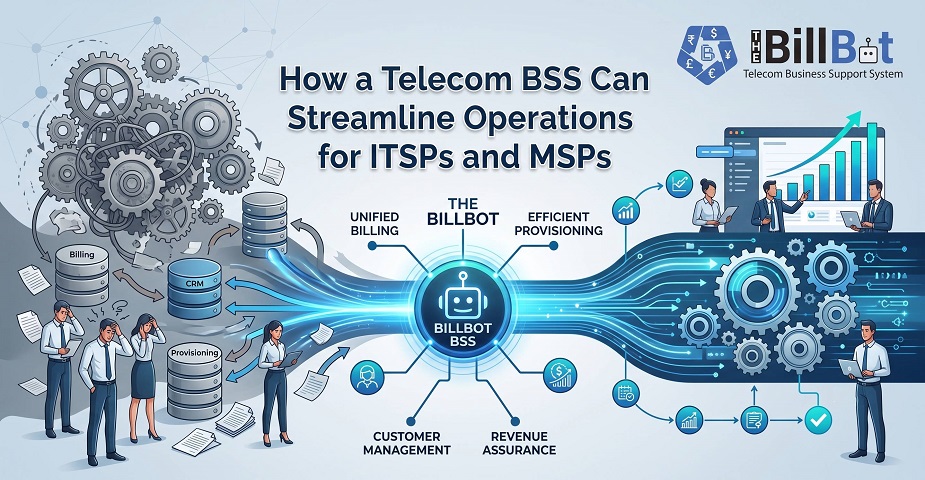
Running an IT service or telecom business involves much more than delivering reliable connectivity and technical support. IT Service Providers (ITSPs) and Managed Service Providers (MSPs) also need to manage customers, subscriptions, usage, billing, invoices, payments, reporting, and day-to-day business processes.
As the number of customers and services grows, managing these activities manually can become increasingly difficult. Disconnected systems, repetitive administrative tasks, billing errors, delayed reports, and limited visibility into customer accounts can all create unnecessary operational challenges.
This is where a Telecom BSS can make a significant difference.
A modern Telecom BSS brings important business processes together in one connected environment. It can help ITSPs and MSPs manage customers, services, usage, billing, invoicing, payments, and reporting while reducing repetitive manual work.
According to TM Forum, modern BSS platforms support important business functions such as customer service, billing, and order management, while modern BSS architectures increasingly focus on modularity, integration, and automation.
What Is a Telecom BSS?
A Telecom BSS, or Telecom Business Support System, is a collection of software capabilities designed to manage the business side of telecom and service-provider operations.
While network systems focus on technical infrastructure and service delivery, BSS focuses on the commercial and customer-facing side of the business.
A Telecom Business Support System can typically support processes such as:
Customer management
Product and service management
Account management
Usage and CDR management
Rating and charging
Billing and invoicing
Payment management
Notifications and reminders
Reporting and analytics
Service and order management
System integrations
For ITSPs and MSPs, this can provide a more connected way to manage the complete customer and billing lifecycle.
Instead of using separate tools for customer information, usage data, invoices, payments, and reports, businesses can connect these processes through a centralized BSS environment.
Why ITSPs and MSPs Need Better Business Operations
ITSPs and MSPs often manage multiple services for different customers. These may include voice services, broadband, cloud services, managed IT services, hosted solutions, communication services, and other recurring offerings.
As service portfolios grow, business operations can become complicated.
For example, a provider may need to:
Create a customer account.
Add one or more services.
Collect usage information.
Calculate charges.
Generate an invoice.
Send the invoice to the customer.
Track payments.
Send reminders for outstanding balances.
Generate business reports.
When these activities are performed manually or across disconnected applications, employees may spend significant time moving information from one system to another.
A centralized Telecom BSS can connect these processes and create a more structured operational workflow.
How Telecom BSS Streamlines ITSP and MSP Operations
1. Centralized Customer Management
Customer information is one of the most important assets for an ITSP or MSP.
Without a centralized system, customer details can become scattered across spreadsheets, CRM platforms, billing applications, emails, and other tools.
A BSS for ITSPs can provide a centralized customer view where businesses can manage account information, services, billing details, usage, invoices, and payment history.
This makes it easier for teams to find relevant customer information without switching between multiple systems.
A unified customer view can also support more consistent customer service because employees have access to the information they need when handling customer requests.
2. Automated Billing and Invoicing
Billing is one of the areas where automation can have a major operational impact.
ITSPs and MSPs may need to bill customers based on recurring subscriptions, service plans, usage, call records, additional services, discounts, or other pricing rules.
Manually preparing invoices can increase the risk of errors and consume valuable employee time.
A Telecom BSS can automate important billing processes by collecting usage data, applying configured pricing rules, calculating charges, and generating invoices.
This creates a more consistent billing workflow and reduces repetitive administrative work.
For providers handling a large number of customers, automated invoicing can make monthly billing cycles easier to manage.
3. Better Usage and CDR Management
For communication service providers, usage data is often directly connected to billing.
Call Detail Records (CDRs), for example, can contain information about calls and usage that needs to be processed before customers can be accurately charged.
A Telecom BSS can integrate with relevant systems to collect and process usage information.
Instead of manually downloading and preparing usage data, providers can create automated workflows that move usage information into the billing process.
This can help reduce manual intervention and create a more repeatable billing operation.
4. Automated Payment Management
Getting invoices generated is only one part of the billing cycle. Providers also need to track payments and outstanding balances.
A modern BSS can connect billing and payment processes so businesses can monitor invoice status and payment activity from a centralized environment.
Automated payment notifications and reminders can also help businesses follow up on overdue invoices without requiring employees to manually monitor every customer account.
This creates a more structured accounts-receivable workflow.
5. Streamlined Service and Account Management
ITSPs and MSPs frequently add, modify, upgrade, or remove services for customers.
Without connected systems, every service change may require several manual updates.
For example, when a customer purchases a new service, employees may need to update the customer account, service records, billing information, and other systems separately.
A Telecom BSS for ITSPs can connect these processes and help automate service-related workflows.
This can make account changes more consistent while reducing repetitive administrative tasks.
6. Improved Reporting and Business Visibility
Business decisions require reliable information.
ITSPs and MSPs need visibility into areas such as:
Revenue
Customer accounts
Outstanding invoices
Payment activity
Service usage
Billing performance
Customer activity
Operational performance
A BSS software for telecom businesses can bring data from different business processes into reports and dashboards.
This allows management teams to monitor operations and identify trends without relying entirely on manually prepared spreadsheets.
Modern BSS environments increasingly emphasize integrated data and business processes because disconnected systems can make it harder to obtain a complete view of operations.
7. Reduced Manual Work Through Automation
One of the biggest advantages of BSS is workflow automation.
Consider a typical monthly billing process:
Usage Data → Rating → Invoice Generation → Invoice Delivery → Payment Tracking → Payment Reminder → Reporting
Without automation, employees may need to perform several of these steps manually.
With a Telecom BSS, these processes can be connected into an automated workflow.
The goal is not simply to automate one task. The bigger opportunity is to automate the complete business process from one stage to the next.
This can allow teams to spend less time on repetitive administrative activities and more time on customer service, sales, and business growth.
Telecom BSS for ITSPs vs. BSS for MSPs
Although ITSPs and MSPs have different business models, both can benefit from centralized business support capabilities.
BSS for ITSPs
ITSPs often need to manage communication-related services, usage-based billing, recurring plans, customer accounts, and telecom integrations.
A Telecom BSS for ITSPs can help connect customer management, service provisioning workflows, usage processing, billing, invoicing, payments, and reporting.
This is particularly useful when providers manage multiple customers and service types.
BSS for MSPs
MSPs often manage recurring services, subscriptions, customer contracts, support services, and managed technology solutions.
A BSS for MSPs can help organize customers, services, billing cycles, invoices, payments, and reporting in a centralized system.
As MSPs expand their service portfolios, having connected business processes can make it easier to manage recurring revenue and customer operations.
Integration Is Key to a Modern Telecom BSS
A BSS does not have to operate as an isolated platform.
Integration is an important part of modern BSS architecture. Providers may need their BSS to communicate with systems such as:
PBX platforms
CRM systems
Payment gateways
Accounting platforms
Customer portals
Service platforms
Network systems
Usage and CDR sources
Email systems
Reporting tools
TM Forum's work on modern BSS architectures highlights API-driven, modular approaches designed to simplify integration and support more flexible business operations.
For ITSPs and MSPs, integration can help create a connected workflow instead of forcing employees to manually transfer information between applications.
Scalability for Growing ITSPs and MSPs
A business process that works for 50 customers may become difficult to manage when the customer base reaches hundreds or thousands.
Growth can increase the volume of:
Customer accounts
Service subscriptions
Usage records
Invoices
Payments
Support activities
Reports
A scalable Telecom BSS can help businesses handle increasing operational complexity without relying entirely on additional manual processes.
This is especially important for service providers that want to grow while maintaining consistent billing and customer management processes.
Improving the Customer Experience
Operational efficiency also affects customers.
Customers expect accurate invoices, timely notifications, convenient payment options, and quick access to account information.
When internal systems are disconnected, delays and errors can affect the customer experience.
By connecting customer management, billing, payments, and service information, a Telecom BSS can help create more consistent customer interactions.
For example, automated billing and notifications can reduce delays, while centralized account information can help support teams respond to customer questions more efficiently.
Industry examples also show how automation across BSS environments can affect customer-facing operations. TM Forum has reported an Airtel case involving automated operations across existing BSS, with reported reductions in call-center volumes and order fallout.
What to Look for in BSS Software for Telecom
When selecting BSS software for telecom, ITSPs and MSPs should consider their current operational requirements and future growth plans.
Important capabilities may include:
Customer and account management
Automated billing
Invoice generation
Usage and CDR processing
Payment management
Automated reminders
Product and service management
Reporting and analytics
API integrations
Workflow automation
Customer portals
Role-based access
Customizable business rules
Scalability
The right solution should fit the provider's business processes rather than forcing the provider to maintain unnecessary manual workarounds.
How The Bill Bot Can Support ITSP and MSP Operations
For ITSPs and MSPs, managing billing and business processes efficiently is an important part of scaling operations.
The Bill Bot is designed around business support capabilities that can help service providers manage areas such as billing, invoicing, payments, usage, automation, and reporting.
By bringing these functions into a connected workflow, businesses can reduce repetitive administrative tasks and gain better visibility into their day-to-day operations.
For providers looking to modernize their billing and business processes, a Telecom BSS can provide a foundation for creating more organized, automated, and scalable operations.
Conclusion
ITSPs and MSPs operate in an environment where customer expectations, service portfolios, and operational complexity continue to grow.
Managing customers, services, usage, billing, invoices, payments, and reports through disconnected tools can make everyday operations more difficult.
A Telecom BSS provides a way to connect these business processes and automate repetitive workflows.
From centralized customer management and automated invoicing to usage processing, payment tracking, reporting, and system integration, a modern Telecom Business Support System can help ITSPs and MSPs create a more structured operational environment.
The key is to choose a BSS platform that supports the organization's current requirements while providing the flexibility and scalability needed for future growth.
Frequently Asked Questions
1. What is a Telecom BSS?
A Telecom BSS is a Business Support System designed to manage the commercial and customer-facing operations of telecom and service providers. It can support customer management, billing, invoicing, payments, usage, reporting, and other business processes.
2. How does Telecom BSS help ITSPs?
A Telecom BSS can help ITSPs centralize customer information, automate billing and invoicing, process usage data, manage payments, generate reports, and connect different business systems.
3. What is BSS for MSPs?
BSS for MSPs refers to business support software that helps managed service providers manage customers, recurring services, billing, invoices, payments, reporting, and operational workflows from a connected platform.
4. Can Telecom BSS automate billing?
Yes. A Telecom BSS can automate several parts of the billing lifecycle, including usage processing, rating, invoice generation, invoice delivery, payment tracking, and payment reminders, depending on the platform's capabilities.
5. Why is BSS software important for telecom businesses?
BSS software for telecom can connect important business processes and reduce reliance on manual tasks. It can provide better visibility into customers, services, billing, payments, and business performance.
6. Can Telecom BSS integrate with other systems?
Yes. Modern BSS platforms can be designed to integrate with CRM systems, PBX platforms, payment gateways, accounting applications, customer portals, usage systems, and other business or operational platforms.
7. Is Telecom BSS suitable for growing ITSPs and MSPs?
Yes. A scalable BSS can help growing service providers manage increasing numbers of customers, services, usage records, invoices, and payments while maintaining more consistent business processes.
8. What are the main benefits of Telecom BSS?
Key benefits can include centralized customer management, automated billing, streamlined invoicing, usage processing, payment tracking, reporting, system integration, workflow automation, and improved operational visibility.