
Customer relationships are at the heart of every successful VoIP and telecom business. While competitive pricing and reliable connectivity help attract customers, providing a consistent experience is what encourages them to stay. From onboarding new customers to managing subscriptions, answering enquiries, processing invoices and resolving service issues, every interaction influences customer satisfaction. For VoIP providers, IT service providers and telecom businesses, managing these activities becomes increasingly challenging as the customer base grows. Information may be spread across different systems, billing tasks may require manual effort, and support teams may struggle to access accurate customer records quickly. This is where customer management for VoIP providers becomes essential. A structured approach helps businesses organise customer information, simplify daily operations, improve communication and build long-term relationships. In this guide, we explore practical customer management best practices for VoIP and telecom providers, including how the right processes and software can improve efficiency, strengthen customer relationships and support business growth. Customer management for VoIP providers involves organising and maintaining every aspect of the customer relationship throughout its lifecycle. This includes lead enquiries, customer onboarding, account information, service subscriptions, billing, payments, support requests and ongoing communication. Unlike businesses that manage only basic customer contact details, VoIP and telecom providers often need to connect customer records with technical services and billing information. For example, a single business customer might have multiple extensions, telephone numbers, call plans and broadband services. Keeping all this information organised helps the provider understand what the customer uses, how much they should be charged and whether they need additional support. Effective customer management typically involves: Maintaining accurate customer and account records. Organising services, subscriptions and pricing plans. Managing invoices, payments and outstanding balances. Tracking customer enquiries and support requests. Monitoring customer activity and service history. Improving communication across the customer lifecycle. A well-organised process makes it easier for teams to deliver reliable service without creating unnecessary administrative work. As telecom businesses grow, customer information and daily responsibilities become more complex. Managing everything through spreadsheets, emails and disconnected applications can lead to delays and inconsistent information. Effective telecom customer management helps address these challenges in several ways. When customer details are stored in a centralised system, teams can access relevant information without searching through multiple applications. Account details, subscribed services, billing history and previous interactions can be easier to review. This visibility allows staff to understand customer requirements and respond with greater accuracy. Customers are more likely to remain with a provider when they receive reliable support, clear invoices and timely communication. A structured management process helps identify recurring problems and gives teams opportunities to resolve them before customers consider switching providers. Manual data entry, repeated invoice preparation and disconnected customer records consume valuable time. Automating suitable tasks allows employees to focus on customer service, sales and business development. Customers expect timely responses to enquiries, billing questions and service changes. A consistent communication process helps teams follow up appropriately and avoid missed requests. Accurate customer records can reveal additional service requirements, changing usage patterns and opportunities to offer suitable upgrades. This helps telecom providers grow existing accounts while maintaining stronger relationships. One of the most important customer management best practices is to keep customer information organised in a central location. When contact details, service records and billing information are spread across separate spreadsheets or applications, employees may work with outdated or incomplete data. This can cause confusion during customer interactions. A centralised customer management system should ideally maintain: Customer names, contact details and company information. Account numbers and billing preferences. Active subscriptions, services and pricing plans. Invoice and payment history. Communication records and support requests. Contract information and renewal dates. For example, if a customer contacts the support team about an unexpected invoice, the employee should be able to review the customer's services and billing history without requesting the same information repeatedly. Accurate records improve internal coordination and create a smoother customer experience. The onboarding experience often establishes the tone for the entire customer relationship. A complicated setup process can create frustration before customers have fully started using a service. VoIP and telecom providers should establish a clear onboarding workflow covering account creation, service configuration, pricing confirmation, billing details and customer communication. A practical onboarding process may include: Collecting the required customer information. Confirming selected products and service plans. Configuring accounts and associated services. Setting up billing preferences and payment details. Providing service instructions and support contacts. Confirming that the customer is ready to use the service. Where possible, automate repetitive administrative tasks and use standard onboarding checklists. A consistent approach reduces errors, improves efficiency and helps customers understand what to expect from the beginning. Billing accuracy is particularly important in telecom businesses because invoices may depend on several services, usage records, pricing rules and billing cycles. If customer information is disconnected from the billing process, providers may encounter incorrect charges, duplicated records or delays in invoice generation. Effective VoIP customer management should connect account information with relevant billing details, including: Recurring service charges. Usage-based charges and call records. Discounts and agreed pricing. Billing cycles and invoice dates. Payments, adjustments and outstanding balances. Automated billing workflows can reduce repetitive tasks and help employees identify discrepancies earlier. For instance, when a customer's service plan changes, the updated information should be reflected in the relevant billing process. This helps reduce the risk of charging customers according to outdated pricing. Connecting customer management with billing also makes it easier for support teams to investigate invoice queries and provide accurate explanations. As the number of customers increases, manual processes become harder to maintain. Customer management software for telecom businesses can help centralise information and coordinate activities across sales, billing and customer support. When evaluating software, providers should consider their actual operational requirements rather than selecting a platform based solely on its feature list. Useful capabilities may include: Centralised customer and account management. Service and subscription tracking. Payment tracking and automated reminders. Customer communication history. Reporting and operational insights. Integration with existing business applications. The right platform should make everyday tasks easier for employees while giving managers a clearer understanding of customer activity. It is also important to consider usability, data security, integration options and the ability to support future business growth. Even when services operate reliably, customers may occasionally need help with invoices, account changes, technical problems or service configuration. A good support process ensures that enquiries are recorded, assigned and followed up rather than being lost in individual email inboxes. VoIP and telecom providers can improve support by: Establishing clear channels for customer enquiries. Recording the details of each request. Assigning responsibility to the appropriate team. Tracking outstanding issues and follow-up dates. Reviewing previous interactions before responding. Analysing recurring problems to identify improvements. Access to customer history is particularly valuable. If an issue has already been reported, employees can review earlier conversations instead of asking the customer to explain everything again. Providers should also monitor useful service indicators, such as response times, resolution times and customer feedback. These measurements can help identify bottlenecks and improve the overall support process. Regular communication helps customers stay informed about their accounts, invoices and services. However, manually sending every notification can become difficult as a business grows. VoIP customer management processes can benefit from automation for routine communications such as: Welcome and onboarding messages. Invoice notifications. Payment confirmations. Upcoming payment reminders. Service renewal notifications. Account updates and relevant follow-ups. Automation should be carefully configured to ensure that messages are accurate, timely and appropriate to the customer's situation. For example, an automated payment reminder can notify a customer about an outstanding invoice without requiring an employee to check every account manually. Personalised communication is still important. Automated messages should be clear and helpful, with appropriate contact details so customers can ask questions when necessary. Customer satisfaction should not be measured only when a complaint arrives. Providers benefit from regularly reviewing customer feedback and identifying signs that an account may need attention. Useful indicators include customer complaints, unresolved support requests, payment difficulties, contract renewal dates and changes in service usage. A telecom customer management system can help bring these details together so teams can recognise patterns and take appropriate action. For example, repeated billing disputes may indicate a pricing configuration problem, while recurring support requests may point to an onboarding or service communication issue. Businesses can also collect feedback through short surveys, account reviews and follow-up conversations. The objective is to understand customer concerns, resolve problems early and make practical improvements based on evidence rather than assumptions. Customer Relationship Management for telecom businesses goes beyond storing contact details. It helps teams understand the customer journey, manage opportunities and maintain meaningful communication over time. Telecom CRM software can support sales and account management activities such as: Tracking new enquiries and sales opportunities. Recording customer interactions. Managing follow-up tasks. Monitoring contract renewals. Identifying opportunities for suitable additional services. Coordinating information between sales and support teams. For example, a business customer may initially subscribe to a small number of VoIP services and later need additional extensions or locations. A well-maintained customer record helps the account manager understand the existing arrangement and discuss relevant options. Any recommendation should be based on the customer's actual needs rather than simply encouraging additional purchases. When customer information is accessible to the appropriate teams, the business can provide more consistent service throughout the relationship. Customer management becomes more effective when decisions are supported by accurate information. Regular reporting can help telecom providers understand account activity, service demand, billing performance and customer retention. Useful metrics may include: Number of active customers. Customer acquisition and retention rates. Outstanding invoices and payment trends. Average support response and resolution times. Contract renewals and cancellations. Revenue by customer or service category. These indicators help management identify areas that require attention. For instance, an increase in overdue invoices may suggest that payment reminders need improvement or that customers are experiencing difficulties with the payment process. A rise in cancellations may justify reviewing service quality, pricing or customer feedback. Reports should focus on information that supports clear business decisions. Collecting large amounts of data is less valuable if teams cannot use it to improve their operations. As customer numbers increase, providers need processes that can accommodate additional accounts and services without requiring a proportional increase in administrative work. VoIP customer management software can help by bringing customer records, service information and relevant operational workflows into a more organised environment. For example, an integrated platform may help a provider manage account details, recurring billing, usage-based charges, invoices, payment tracking and customer reports. These capabilities can reduce duplicated work and improve visibility across departments. Employees spend less time locating information, while managers can make decisions using more consistent records. However, software alone cannot solve every customer management challenge. Businesses still need clear procedures, accurate data, trained employees and appropriate access controls. The best results come when technology supports a well-defined process rather than replacing the need for good customer service. Even experienced telecom providers can encounter customer management problems when processes do not keep pace with business growth. Avoid these common mistakes: Relying entirely on spreadsheets: Spreadsheets can be useful for simple tasks, but multiple versions and manual updates may lead to inconsistent records. Keeping departments disconnected: Sales, billing and support teams need access to the information required to serve customers consistently. Ignoring billing disputes: Repeated or unresolved billing concerns can damage trust. Investigate the underlying cause and communicate clearly with the customer. Overlooking contract renewals: Missing renewal dates can create avoidable administrative issues and missed opportunities to discuss customer requirements. Automating without checking accuracy: Incorrect account data can lead to incorrect invoices or inappropriate notifications. Validate important information and review automated workflows. Collecting data without acting on it: Reports are most useful when teams use them to identify problems, measure improvements and make informed decisions. Avoiding these mistakes helps create a more reliable and customer-focused operation. The Bill Bot provides billing and business support capabilities designed for VoIP providers, ITSPs and MSPs. Its platform focuses on bringing key billing and operational activities into a more manageable workflow. For businesses looking to improve customer management alongside billing operations, relevant capabilities may include customer and account management, billing automation, invoice management, payment tracking, reporting and integration with other business systems. Connecting these activities can help teams work with more consistent information, reduce repetitive administration and manage customer accounts more efficiently. Businesses can explore The Bill Bot's features and system overview to understand the platform and assess whether it fits their operational needs. The aim is to help telecom businesses spend less time managing disconnected processes and more time delivering reliable services and building customer relationships. Effective customer management for VoIP providers requires more than maintaining a list of customer names and contact details. It involves coordinating onboarding, account information, billing, communication, customer support and ongoing relationship management. By centralising records, simplifying onboarding, connecting billing systems, automating routine communications and monitoring customer feedback, telecom providers can create a more consistent customer experience. The right processes and software also help businesses reduce administrative work, identify operational issues and prepare for growth. Start by reviewing your current customer management process, identifying the areas that cause the most delays or errors, and improving those areas first. Small, practical changes can make a meaningful difference to both daily operations and long-term customer relationships. Customer management for VoIP providers involves organising customer accounts, services, billing information, communication and support throughout the customer lifecycle. It helps providers maintain accurate records and deliver consistent service. Telecom customer management helps businesses improve customer satisfaction, reduce administrative work, coordinate internal teams and maintain better visibility of customer accounts. It also supports retention and more efficient business operations. The best software depends on the provider's size, service portfolio and operational requirements. Businesses should evaluate customer account management, billing, invoicing, reporting, integrations, security and scalability before selecting a platform. VoIP customer management software can centralise customer records, organise service information, connect account details with billing workflows and support routine communication. These capabilities reduce repetitive administrative work and make information easier to access. Telecom CRM software generally focuses on sales opportunities, customer interactions, follow-ups and relationship development. Customer management software may cover a broader range of operational activities, including account administration, subscriptions and billing. The exact capabilities depend on the platform. Providers can improve retention by delivering reliable services, resolving enquiries promptly, maintaining accurate invoices, communicating clearly and reviewing customer feedback. Identifying recurring issues early can help prevent dissatisfaction from becoming a reason to leave. Yes. Depending on the available integrations, customer management can be connected with billing software so account details, service plans, invoices and payment information are easier to coordinate. This can reduce duplicated data entry and improve billing accuracy. Useful metrics include customer retention, cancellations, support response times, issue resolution times, overdue invoices, payment trends and contract renewals. Providers should prioritise metrics that help them improve service quality and operational performance.Introduction
What Is Customer Management for VoIP Providers?
Why Is Telecom Customer Management Important?
1. Better Customer Visibility
2. Improved Customer Retention
3. Reduced Administrative Work
4. More Consistent Communication
5. Greater Opportunities for Growth
9 Customer Management Best Practices for VoIP and Telecom Providers
1. Maintain a Centralised Customer Database
2. Simplify Customer Onboarding
3. Connect Customer Records With Billing Information
4. Use Customer Management Software for Telecom
5. Improve Customer Support and Response Times
6. Automate Routine Customer Communication
7. Monitor Customer Satisfaction and Engagement
8. Use CRM Tools to Strengthen Customer Relationships
9. Review Customer Data and Performance Regularly
How VoIP Customer Management Software Supports Business Growth
Common Customer Management Mistakes to Avoid
How The Bill Bot Can Help VoIP and Telecom Providers
Conclusion
Frequently Asked Questions (FAQs)
1. What is customer management for VoIP providers?
2. Why is telecom customer management important?
3. What is the best customer management software for telecom businesses?
4. How does VoIP customer management software improve efficiency?
5. What is the difference between telecom CRM software and customer management software?
6. How can telecom providers improve customer retention?
7. Can customer management be integrated with telecom billing software?
8. Which customer management metrics should VoIP providers track?
Customer Management Best Practices for VoIP and Telecom Providers

Bhargav
Oct 24, 2026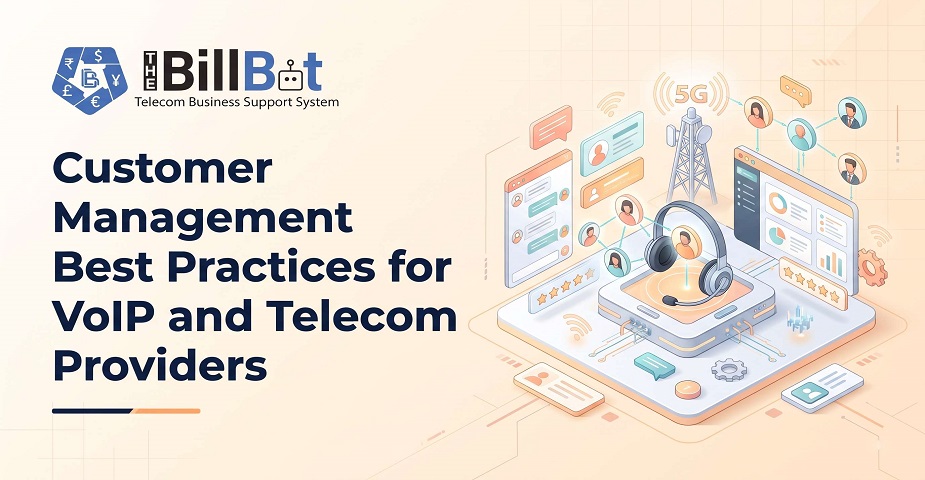
Table of Contents
- Introduction
- What Is Customer Management for VoIP Providers?
- Why Is Telecom Customer Management Important?
- 1. Better Customer Visibility
- 2. Improved Customer Retention
- 3. Reduced Administrative Work
- 4. More Consistent Communication
- 5. Greater Opportunities for Growth
- 9 Customer Management Best Practices for VoIP and Telecom Providers
- 1. Maintain a Centralised Customer Database
- 2. Simplify Customer Onboarding
- 3. Connect Customer Records With Billing Information
- 4. Use Customer Management Software for Telecom
- 5. Improve Customer Support and Response Times
- 6. Automate Routine Customer Communication
- 7. Monitor Customer Satisfaction and Engagement
- 8. Use CRM Tools to Strengthen Customer Relationships
- 9. Review Customer Data and Performance Regularly
- How VoIP Customer Management Software Supports Business Growth
- Common Customer Management Mistakes to Avoid
- How The Bill Bot Can Help VoIP and Telecom Providers
- Conclusion
- Frequently Asked Questions (FAQs)
- 1. What is customer management for VoIP providers?
- 2. Why is telecom customer management important?
- 3. What is the best customer management software for telecom businesses?
- 4. How does VoIP customer management software improve efficiency?
- 5. What is the difference between telecom CRM software and customer management software?
- 6. How can telecom providers improve customer retention?
- 7. Can customer management be integrated with telecom billing software?
- 8. Which customer management metrics should VoIP providers track?
Author : Bhargav
Published : 24 Oct 2026
Related Articles
Explore more insights
23 Oct 2026 / Bhargav
BSS vs Traditional Billing Software: Understanding the Key Differences
22 Oct 2026 / Bhargav
Managed Telecom Billing vs In-House Billing: What Businesses Need to Know

21 Oct 2026 / Bhargav