
Every IT Service Provider (ITSP) has its own way of delivering services, managing customers and generating revenue. While some providers focus on recurring monthly subscriptions, others combine usage-based services, one-time charges, customised packages and additional service fees. As businesses expand, these different pricing structures can make billing more complicated. Traditional billing systems often come with predefined processes that may not support every business requirement. Providers may find themselves adjusting their operations to fit the limitations of their software rather than using a system that supports their actual business model. This can result in manual calculations, complicated invoice management, billing errors and unnecessary administrative work. This is where Custom Billing Software for ITSPs becomes valuable. Instead of relying on rigid billing structures, providers can use a customised system that reflects their pricing strategies, service offerings and customer agreements. Custom billing solutions help ITSPs manage different billing cycles, automate recurring invoices, process service usage and support flexible pricing arrangements. More importantly, they allow businesses to adapt their billing operations as customer expectations and service portfolios change. Let's explore how custom billing software helps ITSPs manage unique business models and build more efficient billing operations. No two IT Service Providers necessarily follow the same business model. Their services, customer segments, pricing strategies and revenue structures can be completely different. For example, a VoIP provider may charge customers based on call usage, monthly subscriptions and DID numbers. An MSP may offer managed IT support through fixed monthly packages, additional support hours and project-based services. Another ITSP might combine broadband subscriptions, communication services and custom enterprise packages. Managing these different requirements through a standard billing platform can become difficult. Common billing requirements include: Monthly, quarterly and annual subscription billing. Usage-based charging for calls, data and other services. One-time setup and activation fees. Custom pricing for individual customers. Bundled products and service packages. Discounts, promotional offers and additional charges. Different billing cycles for different customers. Custom Billing Software for ITSPs allows providers to manage these requirements through a more adaptable billing structure. Rather than forcing every customer into the same pricing arrangement, businesses can configure billing rules according to their actual service agreements. One of the biggest advantages of custom billing software is the ability to support multiple billing models within a single platform. ITSPs often serve customers with different requirements. Some customers prefer predictable monthly payments, while others need billing based on actual service consumption. A flexible system makes it easier to manage these differences without maintaining separate billing processes. Some common billing models include: Recurring Billing Recurring billing is suitable for services that charge customers at regular intervals. ITSPs can create monthly, quarterly or annual billing arrangements depending on their subscription plans. Usage-Based Billing Usage-based billing allows providers to charge customers according to their actual consumption. For example, VoIP providers can calculate charges using Call Detail Records (CDRs), while other service providers may charge according to data usage or service activity. One-Time Billing Certain services require one-time payments, such as installation, activation, configuration or equipment charges. A customised billing system can include these charges alongside recurring services. Hybrid Billing Some ITSPs combine recurring subscriptions with usage-based charges and additional service fees. Hybrid billing allows providers to manage different revenue streams within one billing process. With flexible billing solutions for ITSPs, businesses can introduce new pricing models without completely changing their existing billing infrastructure. Different customers often have different service requirements, budgets and contractual arrangements. A pricing structure that works for a small business may not be suitable for a large enterprise customer. For example, an ITSP might offer: Standard pricing for small businesses. Discounted rates for high-volume customers. Special pricing for long-term contracts. Custom packages for enterprise customers. Different rates for specific products or services. A standard billing platform may provide limited pricing options, making it difficult to accommodate these arrangements. Custom Telecom Billing Software gives providers greater control over their pricing structures. Businesses can configure individual rates, service charges, discounts and customer-specific packages according to their commercial agreements. This flexibility also helps sales teams offer more competitive packages without creating unnecessary complications for the finance department. With the right ITSP billing software, providers can manage multiple pricing arrangements while maintaining consistency and accuracy across their billing operations. Manual billing becomes increasingly difficult as an ITSP grows. Managing customer accounts, calculating service usage, applying discounts and generating invoices can consume considerable time. When these activities are handled manually, even small mistakes can create problems. Incorrect calculations, missed charges and delayed invoices may affect customer satisfaction and business revenue. Telecom Billing Automation helps reduce these challenges by streamlining repetitive billing activities. A customised billing system can support: Automatic invoice generation. Recurring billing schedules. Automated usage calculations. Customer-specific pricing rules. Automatic application of discounts and charges. Payment reminders and overdue notifications. Billing reports and transaction tracking. For example, a VoIP provider processing thousands of call records does not need to calculate every customer's usage manually. An automated system can process the available CDR data, apply the relevant rate plans and prepare accurate billing information. This reduces administrative workloads and allows employees to focus on customer service, business development and other important activities. Many ITSPs expand their portfolios over time. A provider that initially offers VoIP services may later introduce DID numbers, broadband, extensions, call plans, hosted PBX services or managed IT solutions. As the number of services increases, managing billing through separate systems can become complicated. Different platforms may maintain separate customer records, pricing information, invoices and payment histories. This creates additional work and makes it harder to understand the complete customer relationship. A customised billing system can bring multiple services together under one platform. For example, a customer might subscribe to: Monthly VoIP services. Multiple DID numbers. Broadband connectivity. Additional call packages. Hosted PBX extensions. Managed IT support. Instead of managing separate billing processes for every service, providers can organise these offerings through a connected billing environment. This makes it easier to manage customer accounts, monitor service charges and generate consolidated invoices where the business arrangement supports them. For growing IT Service Providers, this approach creates a more organised billing structure and simplifies day-to-day operations. Customer agreements are not always identical. Enterprise customers may negotiate special rates, customised billing periods, minimum commitments, promotional pricing or specific payment terms. Managing these differences through spreadsheets or manual adjustments can create inconsistencies. Telecom Billing Customisation allows ITSPs to configure billing rules around individual customer agreements. For instance, a provider might offer a large enterprise customer a discounted monthly subscription alongside usage-based charges. Another customer may receive a fixed monthly package with additional charges for services outside the agreed allowance. A flexible billing platform can help manage these arrangements by supporting: Customer-specific pricing. Contract-based service charges. Special discounts and promotional rates. Different billing frequencies. Agreed payment terms. Additional usage charges. Custom service packages. When billing rules reflect the actual customer agreement, providers can reduce manual adjustments and maintain more consistent invoicing. It also becomes easier for finance teams to review customer accounts and understand how individual charges have been calculated. Billing accuracy directly affects an ITSP's financial performance and customer relationships. Incorrect invoices can lead to payment disputes, delayed collections and additional administrative work. Similarly, missed usage charges or incorrectly configured pricing rules can result in lost revenue. Custom Billing Solutions help providers establish consistent billing processes that reflect their service agreements. For example, a customised system can apply the correct pricing rules to different customer accounts, calculate recurring charges and process usage records according to configured rates. It can also help businesses identify: Missing or incomplete usage records. Incorrectly configured pricing. Unbilled services. Duplicate invoice entries. Outstanding customer payments. Differences between expected and actual billing amounts. Although software cannot eliminate every billing error, automation and well-configured billing rules can significantly reduce common manual mistakes. Better billing visibility also helps management understand revenue performance, identify collection issues and make more informed business decisions. Billing does not operate independently. ITSPs often rely on several systems to manage customers, services, communication networks, accounting and payments. When these platforms operate separately, employees may need to enter the same information multiple times. This increases administrative effort and creates opportunities for data inconsistencies. Custom Billing Software for ITSPs can be designed to integrate with other business applications through APIs and supported integration methods. Important integration possibilities include: CRM Integration: Connect customer information, sales activities and account details with billing operations. PBX Integration: Exchange relevant call and service usage information to support accurate usage-based charging. Accounting Integration: Synchronise invoices, payments and financial information with accounting systems. Payment Gateway Integration: Support online payments and improve payment tracking. Service Provisioning Integration: Connect billing processes with service activation and account management workflows. These integrations help create a connected business environment where information can move between systems more efficiently. For ITSPs managing multiple platforms, integrated telecom billing software can reduce repetitive work and improve operational visibility. A billing system that works for 100 customers may not be sufficient when the business reaches 5,000 or 10,000 customers. As ITSPs grow, they may introduce new services, enter different markets, create additional pricing plans and manage more complex customer agreements. A rigid billing platform can become a limitation during this growth. Flexible Billing Solutions for ITSPs help businesses adapt their billing processes as operational requirements change. A scalable billing platform should support: Increasing customer and account volumes. Additional products and service categories. New pricing structures. More complex billing arrangements. Multiple billing cycles. Higher transaction volumes. Additional integrations and automation. This allows providers to expand their operations without constantly replacing their billing infrastructure. Choosing scalable ITSP Billing Solutions can therefore support both current requirements and future business development. Billing is an important part of the customer experience. Even when a provider delivers excellent services, unclear invoices or unexpected charges can create frustration. Customers want to understand what they are paying for, how their charges are calculated and when payments are due. A customised billing system can help ITSPs improve billing transparency by providing: Clear and itemised invoices. Accurate service usage information. Consistent billing schedules. Transparent pricing and discounts. Automated invoice notifications. Convenient payment options. Accessible billing history. For example, a VoIP customer should be able to understand their subscription charges, call usage charges and any additional services included in the invoice. When customers receive accurate and understandable billing information, they are more likely to trust the provider and experience fewer billing disputes. A better billing experience can also support customer retention and long-term business relationships. Standard billing platforms can be suitable for businesses with straightforward billing requirements. However, providers with multiple services, customer-specific pricing and different revenue models may need greater flexibility. The main difference is how the billing system supports business operations. Custom software does not automatically mean that every ITSP needs a completely new platform built from scratch. In many cases, a configurable billing solution with flexible features and integrations can meet the required business needs. The important consideration is choosing a system that supports the provider's current operations while allowing room for future changes. Selecting the right billing platform requires more than comparing software features. ITSPs should evaluate whether the solution can support their business model, service portfolio and long-term objectives. Here are some important factors to consider: Choose software that supports recurring, usage-based, one-time and hybrid billing models. Ensure the platform can manage different customer rates, discounts, packages and contract-based pricing. Look for automated invoicing, usage calculations, payment reminders and billing workflows. Check whether the software can connect with your existing CRM, PBX, accounting applications and payment gateways. The platform should provide useful insights into revenue, customer payments, service usage and outstanding invoices. Choose a solution that can accommodate increasing customer numbers, additional services and more complex billing requirements. Reliable support is important when configuring billing rules, integrating systems and adapting workflows as your business evolves. Evaluating these factors will help ITSPs choose a billing platform that supports their operational requirements without introducing unnecessary complexity. Managing different billing models, customer agreements and telecom services requires a platform that understands the operational needs of IT Service Providers. The Bill Bot provides a business support and billing platform designed for VoIP Providers, ITSPs and MSPs. It brings important business operations together, helping providers manage customers, products, pricing, billing and payments through a connected environment. With capabilities covering billing automation, CDR processing, customer management, reporting and integrations, The Bill Bot helps businesses simplify their billing operations. Whether a provider manages recurring subscriptions, usage-based services or customised pricing arrangements, having a flexible billing platform can make everyday operations more manageable. Explore The Bill Bot to learn how its billing and business support capabilities can help streamline your operations. Every IT Service Provider has different business requirements, and its billing system should be flexible enough to support them. From recurring subscriptions and usage-based charging to customer-specific pricing and multiple service packages, modern ITSPs need billing processes that can adapt to changing business models. Custom Billing Software for ITSPs helps providers move beyond rigid billing structures by supporting flexible pricing, automated invoicing, accurate usage calculations and integrated business workflows. The right solution can reduce manual administration, improve billing accuracy, provide better financial visibility and support business growth. Rather than allowing software limitations to restrict business operations, ITSPs can choose a billing platform that adapts to their services, customers and future goals. Ultimately, flexible billing is not just about generating invoices. It is about building a more efficient, scalable and customer-focused business. Custom billing software for ITSPs is a billing solution that can be configured around the specific requirements of IT Service Providers. It supports different pricing structures, billing cycles, usage-based charges, customer agreements and service packages. ITSPs often manage multiple services and different customer pricing arrangements. Custom billing software helps them handle these requirements, automate invoicing, reduce manual calculations and improve billing accuracy. A flexible ITSP billing platform should support recurring billing, usage-based billing, one-time charges and hybrid billing models. This allows providers to charge customers according to their individual service agreements. Yes. A suitable customised billing system can manage different services, including VoIP, DID numbers, broadband, hosted PBX, extensions and additional service packages through a connected billing environment. Billing automation reduces repetitive administrative work by streamlining invoice generation, usage calculations, recurring charges and payment reminders. It also helps improve consistency and reduce manual billing errors. Yes. Depending on the platform's integration capabilities, billing software can connect with CRM, PBX, accounting applications and payment gateways through APIs or other supported integration methods. Yes. Scalable custom telecom billing software can support increasing customer volumes, additional services, new pricing plans and more complex billing requirements as an ITSP expands. Standard billing software generally offers predefined billing processes, whereas custom billing software provides greater flexibility to configure pricing, workflows, billing cycles and service-specific requirements. Yes. A suitable solution can process usage information, apply configured rates and calculate charges based on customer consumption. VoIP providers, for example, can use CDR data to calculate call-related charges. ITSPs should evaluate billing flexibility, pricing configuration, automation, integration capabilities, reporting, scalability and technical support before selecting a billing solution.Introduction
1. Every ITSP Has Different Billing Requirements
2. Supports Flexible Billing Models
3. Create Custom Pricing Plans for Different Customers
4. Automate Complex Billing Processes
5. Manage Multiple Services Through One Billing Platform
6. Adapt Billing Rules to Customer Contracts
7. Improve Billing Accuracy and Revenue Management
8. Integrate Billing with Existing Business Systems
9. Scale Billing Operations as the Business Grows
10. Improve Customer Experience with Transparent Billing
11. Why ITSPs Should Choose Custom Billing Software Instead of Rigid Systems
12. What to Consider When Choosing Custom Billing Software for ITSPs
1. Billing Flexibility
2. Customisable Pricing
3. Automation Capabilities
4. Integration Support
5. Reporting and Analytics
6. Scalability
7. Customer and Technical Support
How The Bill Bot Supports Flexible Billing Requirements
Conclusion
Frequently Asked Questions (FAQs)
1. What is custom billing software for ITSPs?
2. Why do ITSPs need custom billing software?
3. What billing models should ITSP billing software support?
4. Can custom billing software manage multiple telecom services?
5. How does billing automation benefit IT Service Providers?
6. Can custom billing software integrate with CRM and PBX systems?
7. Is custom telecom billing software suitable for growing ITSPs?
8. What is the difference between standard and custom billing software?
9. Does custom billing software support usage-based billing?
10. How can ITSPs choose the right billing solution?
How Custom Billing Software Helps ITSPs Adapt to Unique Business Models
Bhargav
Nov 04, 2026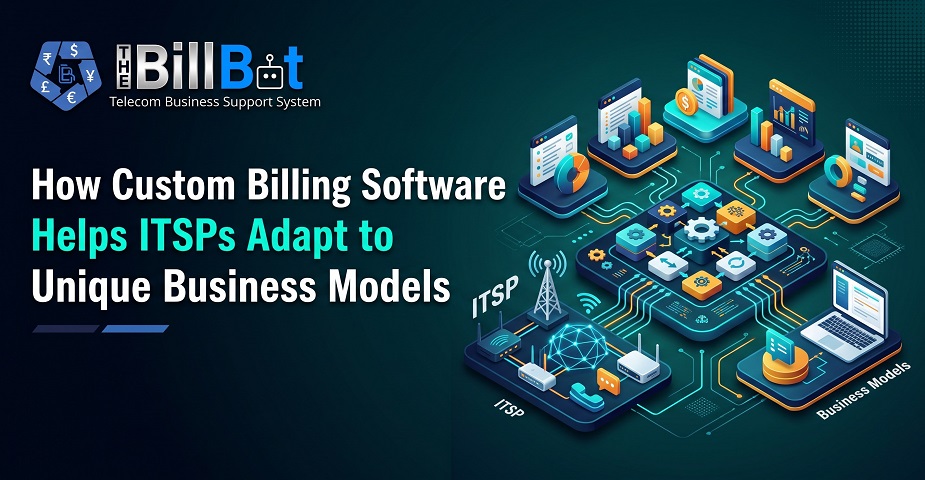
Table of Contents
- Introduction
- 1. Every ITSP Has Different Billing Requirements
- 2. Supports Flexible Billing Models
- 3. Create Custom Pricing Plans for Different Customers
- 4. Automate Complex Billing Processes
- 5. Manage Multiple Services Through One Billing Platform
- 6. Adapt Billing Rules to Customer Contracts
- 7. Improve Billing Accuracy and Revenue Management
- 8. Integrate Billing with Existing Business Systems
- 9. Scale Billing Operations as the Business Grows
- 10. Improve Customer Experience with Transparent Billing
- 11. Why ITSPs Should Choose Custom Billing Software Instead of Rigid Systems
- 12. What to Consider When Choosing Custom Billing Software for ITSPs
- 1. Billing Flexibility
- 2. Customisable Pricing
- 3. Automation Capabilities
- 4. Integration Support
- 5. Reporting and Analytics
- 6. Scalability
- 7. Customer and Technical Support
- How The Bill Bot Supports Flexible Billing Requirements
- Conclusion
- Frequently Asked Questions (FAQs)
- 1. What is custom billing software for ITSPs?
- 2. Why do ITSPs need custom billing software?
- 3. What billing models should ITSP billing software support?
- 4. Can custom billing software manage multiple telecom services?
- 5. How does billing automation benefit IT Service Providers?
- 6. Can custom billing software integrate with CRM and PBX systems?
- 7. Is custom telecom billing software suitable for growing ITSPs?
- 8. What is the difference between standard and custom billing software?
- 9. Does custom billing software support usage-based billing?
- 10. How can ITSPs choose the right billing solution?
Author : Bhargav
Published : 04 Nov 2026
Related Articles
Explore more insights
03 Nov 2026 / Bhargav
PBX, CRM and Accounting Integrations: Building a Connected Telecom Workflow
02 Nov 2026 / Bhargav
Revenue and Usage Reporting for VoIP Providers: A Practical Guide
31 Oct 2026 / Bhargav