Introduction
Pricing is one of the most important parts of running a telecom business. Whether a company provides VoIP services, internet connectivity, international calling, DID numbers or managed communication solutions, every service needs a clear and consistent pricing structure. However, not every customer has the same requirements, usage patterns or commercial agreements. This makes pricing management more complicated as a telecom business grows.
A Telecom Rate Sheet helps providers organise service rates, define pricing rules and manage different customer agreements from one structured reference. Instead of relying on spreadsheets, emails or manually updated price lists, businesses can maintain a clearer view of the rates applied to their products and services.
For telecom providers, pricing is rarely limited to a single fixed amount. Different customers may receive different rates based on contract terms, service packages, call destinations, usage volumes, negotiated discounts or business relationships. Managing these differences requires a reliable approach that keeps pricing accurate and consistent.
In this guide, we will explore what a telecom rate sheet is, why it matters, how customer-specific pricing works and how telecom businesses can improve rate sheet management through better systems and processes.
What Is a Telecom Rate Sheet?
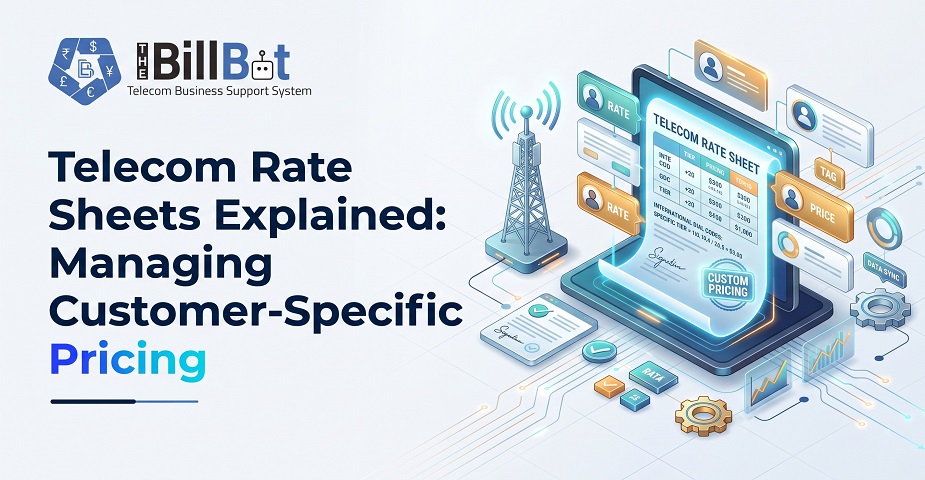
A Telecom Rate Sheet is a structured document or digital record that contains the prices associated with telecom products and services. It helps providers define how much customers should pay for specific services, usage activities or service configurations.
A rate sheet may include pricing information for:
Local and international calling rates.
VoIP and SIP trunking services.
DID numbers and telephone numbers.
Broadband and connectivity services.
Call plans and bundled packages.
Usage-based services.
Monthly recurring charges.
One-time setup and activation fees.
For example, a VoIP provider may charge different per-minute rates for calls to different destinations. Similarly, one customer might receive a discounted monthly package, while another pays standard rates based on actual usage.
A well-maintained rate sheet makes these pricing differences easier to understand and manage.
It also provides a reference for sales teams, billing departments and account managers, helping everyone work with consistent pricing information.
Why Telecom Providers Need Effective Rate Sheet Management
As a telecom business expands, managing pricing through separate spreadsheets and manually maintained documents becomes increasingly difficult. New customers, revised contracts, changing supplier costs and additional services can quickly create pricing inconsistencies.
Effective Rate Sheet Management helps businesses maintain control over these changes.
1. Maintain Consistent Pricing Information
When pricing details are stored in different files, employees may accidentally use outdated rates. This can lead to incorrect quotations, billing disputes and customer dissatisfaction.
A centralised rate sheet provides a common pricing reference. Teams can access the relevant rates without searching through multiple documents.
2. Support Different Customer Agreements
Telecom providers often negotiate individual pricing arrangements with customers. These agreements may include special discounts, customised packages or different usage charges.
A structured pricing system makes it easier to maintain these arrangements without changing the standard pricing structure for every customer.
3. Reduce Manual Pricing Errors
Manually entering rates into quotations, customer accounts and invoices increases the possibility of mistakes.
Organised telecom rate sheets reduce unnecessary duplication and make it easier to verify the correct pricing before it is applied.
4. Improve Business Visibility
Understanding which rates apply to different customers and services helps businesses review their pricing strategies.
Providers can identify outdated rates, review discount arrangements and make better decisions about service profitability.
5. Simplify Pricing Updates
Telecom pricing can change due to supplier agreements, operational costs and market conditions.
A structured rate management process helps businesses update pricing information while keeping track of which rates should apply to existing and new customers.
Understanding Customer-Specific Pricing in Telecom
Customer-Specific Pricing means offering different prices to different customers based on their individual business requirements and agreements.
Telecom providers may work with small businesses, large enterprises, resellers, IT service providers and wholesale partners. Each customer segment may have different service requirements and purchasing volumes.
Applying the same pricing structure to every customer may not always be practical.
For example:
A small business may prefer a fixed monthly VoIP package.
An enterprise customer may require customised call rates and volume-based discounts.
A reseller may receive special wholesale rates.
An international customer may need different destination-based calling charges.
A long-term customer may receive negotiated discounts under a service agreement.
A flexible pricing structure allows providers to meet these requirements while maintaining better control over their commercial agreements.
How Customer-Specific Pricing Works
Customer-specific pricing generally follows a structured process:
Understand customer requirements: Identify the services, usage expectations and pricing preferences of each customer.
Define pricing conditions: Establish applicable rates, discounts, recurring charges and additional fees.
Create customer-specific rate sheets: Maintain the agreed pricing separately or through customer-linked pricing configurations.
Apply rates to customer accounts: Ensure the correct pricing is associated with the relevant customer and services.
Review pricing regularly: Update rates when contracts, supplier charges or commercial agreements change.
This approach helps telecom providers maintain pricing flexibility without losing control of their overall pricing structure.
Key Components of a Telecom Rate Sheet
A useful Telecom Rate Sheet should contain enough information to support sales, service management and billing operations.
Here are some important components providers should consider.
1. Service and Product Details
Every rate sheet should clearly identify the products and services being offered. This may include VoIP services, DID numbers, broadband connections, SIP trunks and calling packages.
Clear product information reduces confusion when different services have similar pricing structures.
2. Standard and Custom Rates
A rate sheet should distinguish between standard prices and customer-specific rates.
Standard rates provide a pricing foundation, while custom rates allow businesses to accommodate negotiated customer agreements.
3. Usage-Based Charges
Some telecom services are charged according to usage rather than a fixed monthly amount.
For example, international calling may be billed according to destination, duration and applicable per-minute rates.
These charges should be clearly defined to support accurate billing calculations.
4. Recurring and One-Time Charges
Telecom providers often combine recurring fees with one-time charges.
A rate sheet may include:
Monthly subscription fees.
Installation and activation charges.
Equipment rental fees.
Service maintenance charges.
Additional feature charges.
Separating these charges helps customers understand their pricing arrangements.
5. Discounts and Special Conditions
Discounts may depend on contract duration, customer volume, service combinations or negotiated commercial terms.
These conditions should be documented clearly so that employees understand when a discount applies and when it expires.
6. Effective Dates and Rate Validity
Pricing information should include effective dates and validity periods.
This is particularly important when providers update wholesale rates or renegotiate customer contracts. Without clear validity information, outdated rates may continue to be used.
Wholesale Telecom Rates vs Customer-Specific Rates
Wholesale Telecom Rates and customer-specific rates serve different purposes, although they are closely connected.
Wholesale rates generally represent the prices a telecom provider receives from upstream carriers, suppliers or wholesale service partners.
Customer-specific rates represent the prices that the provider charges individual customers based on their agreements and business requirements.
For example, a provider may purchase international calling services at a particular wholesale rate and then establish different retail prices for different customer groups.
Understanding these differences helps providers manage costs, maintain suitable margins and create more flexible pricing strategies.
Common Telecom Rate Management Challenges
Managing pricing across multiple customers and services can become complicated without the right processes.
Here are some common challenges telecom businesses face.
1. Managing Multiple Pricing Structures
As the customer base grows, providers may need to maintain hundreds of different pricing arrangements.
Tracking every customer's rates manually can consume significant time and create unnecessary administrative work.
2. Frequent Rate Changes
Supplier pricing, market conditions and customer agreements can change regularly.
If rate sheets are not updated properly, businesses may continue charging outdated prices or apply incorrect rates to new services.
3. Incorrect Billing Calculations
When the wrong rate is associated with a customer account, invoices may contain incorrect charges.
This can result in billing disputes, payment delays and additional work for finance teams.
4. Limited Pricing Visibility
When different departments maintain separate pricing records, employees may struggle to identify the latest approved rates.
Sales teams might use one price list while billing teams work with another.
5. Difficulties with Contract Renewals
Special pricing agreements often have validity periods. When contracts are renewed, rates may need to be reviewed or adjusted.
Missing these changes can affect revenue and create disagreements with customers.
How Telecom Pricing Software Simplifies Rate Sheet Management
As telecom operations become more complex, managing rate sheets through spreadsheets alone may no longer be sufficient.
Telecom Pricing Software can help businesses organise pricing information, manage customer-specific rates and connect pricing configurations with wider billing operations.
Depending on the platform's capabilities, providers can benefit from the following features.
Centralised Pricing Management
A centralised system provides a structured location for maintaining product prices, service rates and customer-specific agreements.
This makes it easier for authorised employees to access the relevant pricing information.
Customer-Level Pricing Configuration
Providers can maintain different pricing arrangements for different customer accounts.
For example, an enterprise customer may have negotiated calling rates, while a reseller operates under a separate wholesale pricing arrangement.
Automated Billing Integration
Connecting rate configurations with Telecom Billing Software helps ensure that the correct rates are used when calculating customer charges.
This is particularly useful for usage-based services where pricing depends on call destinations, durations or other usage parameters.
Better Pricing Updates
A structured pricing system makes it easier to review and update rates.
Businesses can manage changes more consistently and reduce the risk of employees using outdated pricing information.
Improved Reporting and Analysis
Pricing information combined with billing and usage reports can help providers understand revenue patterns, customer activity and service performance.
These insights support better commercial decisions.
Best Practices for Managing Telecom Rate Sheets
A well-organised pricing process is not just about maintaining accurate numbers. It also requires clear procedures and regular reviews.
Here are some practical best practices.
Maintain a central pricing database: Avoid keeping multiple unverified versions of the same rate sheet.
Use consistent pricing formats: Standardise service names, destinations, billing units and pricing fields.
Document customer agreements: Record negotiated rates, discounts, contract conditions and validity periods.
Review pricing regularly: Compare customer rates with supplier costs and current commercial agreements.
Control access to pricing changes: Allow authorised employees to update approved pricing information.
Connect pricing with billing: Reduce manual rate entry by integrating pricing configurations with billing workflows.
Monitor pricing accuracy: Regularly review invoices and customer accounts to identify incorrect rate applications.
Following these practices helps providers maintain a more reliable pricing structure as their business grows.
How The Bill Bot Supports Better Telecom Billing Management
Managing customer-specific pricing becomes easier when pricing information is connected with customer accounts and billing operations.
The Bill Bot is a Business Support System (BSS) designed for VoIP providers, ITSPs and MSPs. It brings important business operations together through a unified platform.
Rather than managing customer information, billing activities and service operations across disconnected tools, providers can use an integrated system to improve operational visibility.
With capabilities covering customer management, billing, invoicing, CDR processing, payments and reporting, The Bill Bot helps telecom businesses streamline their day-to-day workflows.
For providers managing different service packages, customer agreements and usage-based charges, having a connected billing environment can make pricing administration more manageable.
By bringing essential business processes together, The Bill Bot supports providers looking to reduce manual work, improve billing accuracy and manage business growth more efficiently.
The Future of Telecom Pricing Management
Telecom pricing is becoming more flexible as providers introduce new services, develop reseller partnerships and serve customers with different usage requirements.
Traditional fixed price lists may not provide enough flexibility for businesses managing multiple customer segments and service combinations.
Future-focused pricing management will increasingly depend on:
Automated pricing configuration.
Flexible customer-specific rate structures.
Real-time usage and billing information.
Better integration between CRM and billing systems.
Improved pricing analytics.
Centralised management of service agreements.
Providers that invest in structured pricing processes and connected software systems will be better positioned to manage complexity while delivering a consistent customer experience.
Frequently Asked Questions (FAQs)
1. What is a Telecom Rate Sheet?
A Telecom Rate Sheet is a structured document or digital record that contains pricing information for telecom products and services. It helps providers manage service charges, usage rates, recurring fees and customer-specific pricing agreements.
2. Why are Telecom Rate Sheets important?
Telecom Rate Sheets help businesses organise pricing information, maintain consistent rates, reduce manual errors and manage different customer agreements. They also support accurate quotations and billing operations.
3. What is customer-specific pricing in telecom?
Customer-specific pricing allows telecom providers to offer different rates based on individual customer agreements, service requirements, usage volumes, contract terms and negotiated discounts.
4. How do telecom providers manage different customer rates?
Providers can use centralised pricing systems or telecom billing platforms to maintain customer-level rate configurations. These systems help associate the correct prices with customer accounts and applicable services.
5. What is the difference between wholesale and retail telecom rates?
Wholesale rates are generally the prices providers pay to carriers or suppliers for telecom services. Retail rates are the prices charged to end customers and may include additional costs, operational expenses and profit margins.
6. Can telecom pricing software automate rate management?
Yes. Depending on its capabilities, telecom pricing software can help centralise pricing information, manage customer-specific rates, support pricing updates and connect rate configurations with billing processes.
7. How often should telecom rate sheets be updated?
Rate sheets should be reviewed whenever supplier costs, customer contracts, service packages or commercial agreements change. Regular reviews also help identify outdated pricing information.
8. How does a telecom rate sheet improve billing accuracy?
A properly maintained rate sheet helps ensure that the correct service rates are applied during billing calculations. When integrated with billing software, it can reduce manual data entry and pricing-related invoice errors.
Conclusion
Managing different customer pricing arrangements is an important responsibility for telecom providers. As businesses expand their customer base and introduce more services, maintaining accurate pricing information becomes increasingly challenging.
A well-structured Telecom Rate Sheet provides a clear foundation for managing service rates, wholesale pricing, discounts and customer-specific agreements.
However, maintaining pricing information is only one part of the process. Connecting rate management with customer accounts, service configurations and billing operations is equally important.
By adopting effective Telecom Pricing Management practices and using suitable software solutions, providers can reduce manual work, improve billing accuracy and maintain better control over their commercial operations.
The goal is simple: make pricing easier to manage while building a more efficient and scalable telecom business.