
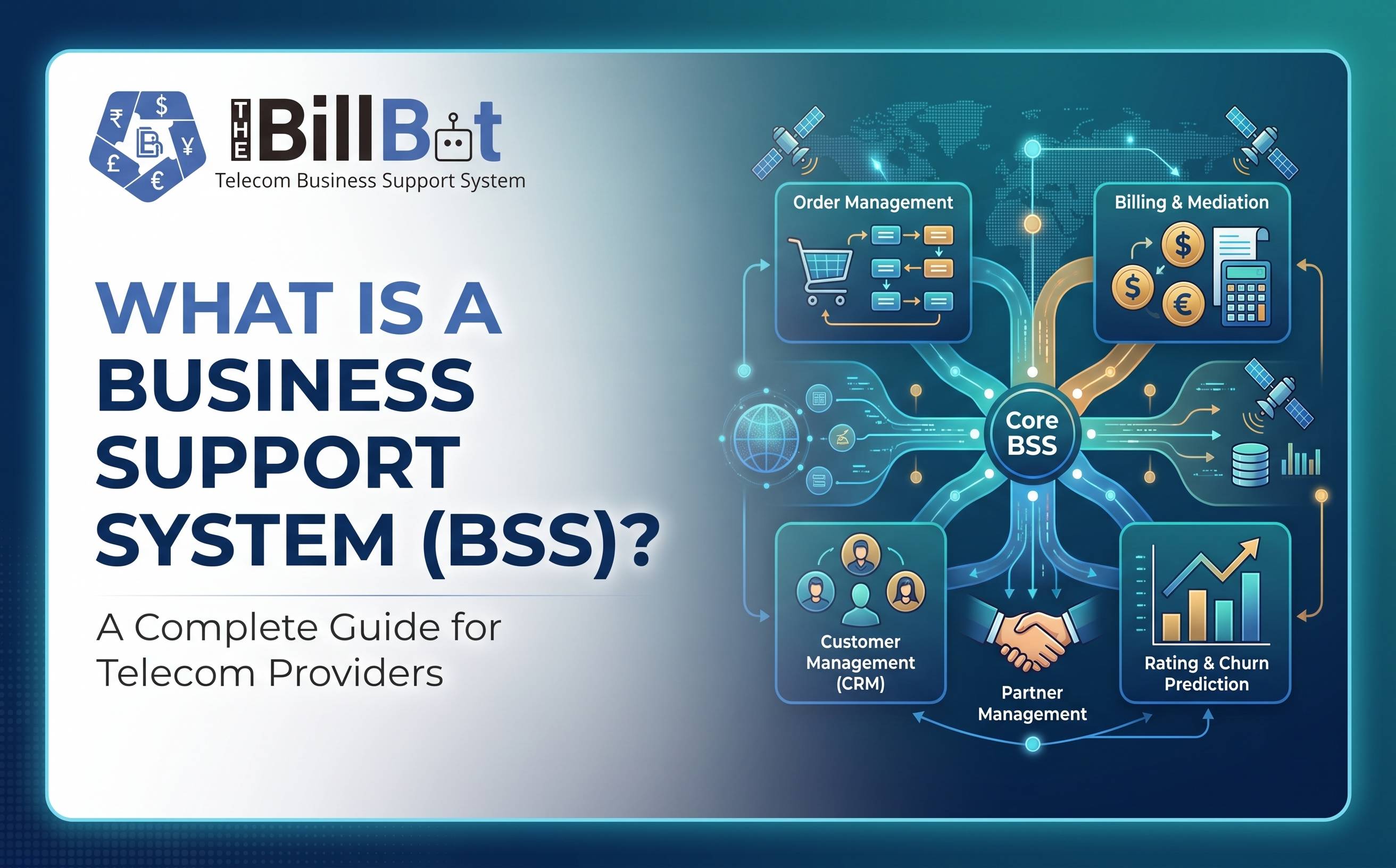
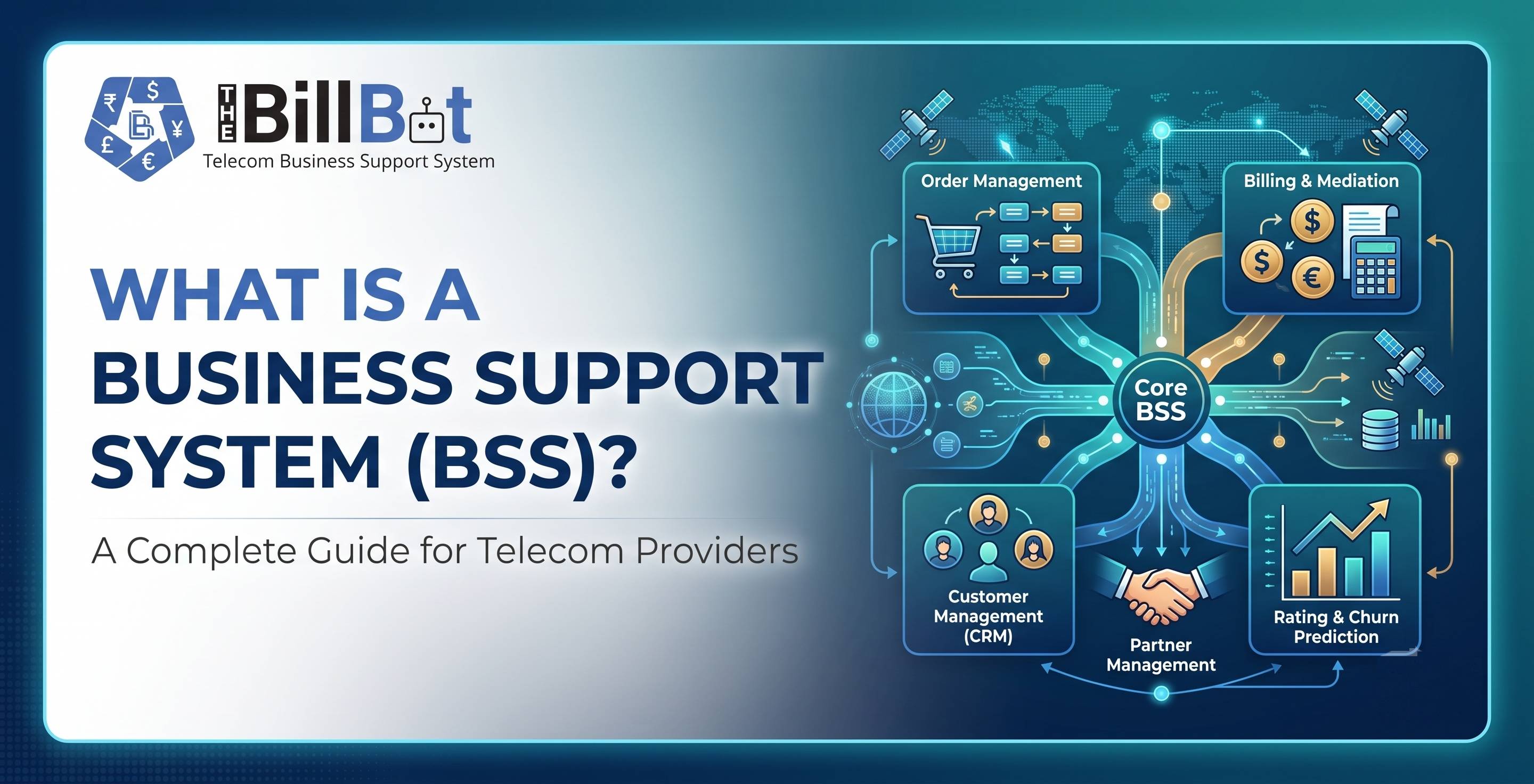
Running a telecom business involves much more than providing connectivity. Behind every customer account, service plan, invoice, payment, usage record, and support interaction, there are multiple business processes working together.
As telecom providers expand their services, managing these processes manually or through disconnected systems can become increasingly difficult. This is where a Business Support System (BSS) becomes important.
A modern Business Support System helps telecom providers manage the commercial and customer-facing side of their business. It can bring together functions such as customer management, product and service management, billing, invoicing, payments, order management, and reporting into a more connected business environment.
According to TM Forum, BSS covers customer-facing business functions such as billing, CRM, and sales, while OSS generally focuses on network and operational management. Modern BSS architectures are increasingly moving toward modular, cloud-native, and API-driven approaches.
In this guide, we will explain what a Business Support System is, how BSS in telecom works, its key components, benefits, and why it has become an important part of modern telecom operations.
What Is a Business Support System (BSS)?
A Business Support System (BSS) is a collection of software applications and processes that help telecom and communications service providers manage their business operations and customer-facing activities.
In simple terms, a BSS helps answer important business questions:
Who are your customers?
What services are they using?
What plans or products have they purchased?
How much should they be charged?
When should invoices be generated?
Which payments have been received?
Which customers have outstanding balances?
How is the business performing?
Instead of handling these activities through separate spreadsheets, disconnected applications, or manual processes, a Telecom BSS can connect them within a structured business platform.
For telecom providers, this can create a smoother flow from customer acquisition to service activation, usage tracking, billing, payment collection, and reporting.
What Is BSS in Telecom?
BSS in telecom refers to the business systems used by telecommunications and communications service providers to manage customer, commercial, and revenue-related processes.
Telecom businesses often manage complex combinations of products and services. These may include voice services, broadband, mobile services, DID numbers, extensions, calling plans, hosted communications, subscriptions, and other digital services.
Each service can have its own pricing rules, usage information, billing cycles, discounts, taxes, and payment requirements.
A Business Support System in telecom helps bring these processes together.
For example, consider a customer subscribing to a business voice service. The BSS may support the journey from:
Lead → Customer → Service → Usage → Rating → Invoice → Payment → Reporting
This connected approach can reduce repetitive manual work and give telecom providers greater visibility into their business processes.
Why Do Telecom Providers Need a BSS?
Telecom operations can become complicated very quickly.
A growing provider may have hundreds or thousands of customers, multiple service plans, recurring subscriptions, usage-based charges, different billing cycles, and a large volume of invoices and payments to manage.
When these activities are handled manually, common challenges can include:
Repetitive data entry
Billing errors
Delayed invoice generation
Difficult payment tracking
Limited customer visibility
Disconnected business systems
Time-consuming reporting
Manual payment reminders
Difficulty scaling operations
A modern Telecom business support system is designed to help address these challenges by connecting key business processes.
TM Forum notes that traditional BSS environments can become siloed and complex, making it harder for communications service providers to introduce and manage new services efficiently.
The goal is not simply to automate one task. A well-designed BSS can provide a connected foundation for managing the commercial side of a telecom business.
Key Components of a Business Support System
The exact capabilities of a BSS can vary depending on the provider and business model. However, several functions are commonly associated with modern telecom BSS environments.
1. Customer Management
Customer management is one of the core areas of a BSS.
A system can maintain customer information, account details, service subscriptions, billing information, and relevant interactions in one place.
For providers, having centralized customer information makes it easier to understand what services each customer has and how their account is performing.
2. Product and Service Management
Telecom providers often offer multiple products and service packages.
A BSS can help manage product catalogs, service plans, pricing structures, packages, and related configurations.
This becomes particularly useful when providers need to introduce new services or modify existing plans without rebuilding their entire business process.
3. Billing and Invoicing
Billing is one of the most important functions of a Business Support System (BSS).
A BSS can help automate billing cycles and generate invoices based on customer subscriptions, services, usage, pricing rules, or other applicable charges.
Automated invoicing can reduce manual work while helping businesses maintain more consistent billing processes.
For providers handling large numbers of customers, automation can make a significant difference in day-to-day operations.
4. Usage and Rating
Telecom services can involve usage-based charging.
For example, voice services may depend on call duration, destination, service type, or specific pricing rules.
A BSS can work with usage information and apply appropriate rating or charging rules before the information reaches the billing process.
This helps transform raw usage data into billable information.
5. Payment Management
Generating an invoice is only one part of the revenue cycle. Providers also need to know whether customers have paid.
A BSS can support payment tracking, outstanding balances, payment status, and other financial workflows.
Automated payment-related processes can help providers reduce the amount of manual follow-up required from finance or customer service teams.
6. Order Management
Order management connects customer requests with the business processes required to deliver products and services.
For example, when a customer purchases a new service, the order may need to move through several stages before the service is fully activated.
A connected BSS can help track these activities and provide better visibility into the customer's journey.
7. Reporting and Analytics
Data is another important part of a modern Telecom BSS.
Providers can use reporting and analytics to understand areas such as:
Revenue
Customer activity
Billing performance
Outstanding payments
Service usage
Sales activity
Business performance
Better visibility allows teams to make decisions using current business information rather than relying entirely on manually prepared reports.
BSS vs OSS: What Is the Difference?
BSS and OSS are closely related, but they generally focus on different areas of telecom operations.
BSS — Business Support System
BSS primarily supports customer-facing and commercial business functions such as:
Customer management
Sales
Product management
Billing
Payments
Orders
Customer care
OSS — Operations Support System
OSS generally focuses more on network and operational functions, including areas such as:
Network management
Service provisioning
Fault management
Network assurance
Resource management
TM Forum describes traditional BSS as covering customer-facing functions such as billing, CRM, and sales, while OSS is associated with network management and related operational functions.
In practice, BSS and OSS need to work together. A customer may purchase a service through a business process, while operational systems are responsible for delivering and managing the underlying service.
Benefits of a Modern Business Support System
Implementing a modern BSS can provide several benefits for telecom providers.
Greater Automation
Automation can reduce repetitive administrative work across billing, invoicing, payment reminders, reporting, and other processes.
Improved Billing Accuracy
Automated billing workflows can help reduce errors caused by manual calculations and repeated data entry.
Better Customer Experience
When customer, service, billing, and payment information is connected, teams can respond to customer questions more efficiently.
Faster Business Operations
Automating routine workflows can help teams spend less time on administrative tasks and more time on business growth and customer service.
Better Visibility
Centralized data and reporting can give management a clearer view of customers, revenue, billing activity, and outstanding payments.
Easier Scalability
As the customer base grows, manual processes can become a bottleneck. A scalable BSS can support increasing transaction volumes without requiring every process to be handled manually.
What Should You Look for in a Telecom BSS?
Not every BSS solution is built the same way. Telecom providers should consider their current operations and future requirements before selecting a system.
Important capabilities may include:
Automated billing
Flexible invoice management
Customer management
Product and service management
Usage processing
Payment management
Reporting and analytics
Workflow automation
API and third-party integrations
Scalable architecture
Role-based access
Data security
Customization capabilities
Integration is particularly important. Modern BSS environments increasingly rely on APIs and modular components so that different systems can work together without creating unnecessary complexity. TM Forum's Open Digital Architecture emphasizes cloud-native, reusable components and Open APIs as part of modernizing traditional BSS and OSS environments.
The Future of Business Support Systems
The role of BSS continues to evolve as telecom providers introduce more digital services and automation.
Modern BSS platforms are increasingly expected to support flexible architectures, automation, APIs, cloud technologies, analytics, and AI-enabled capabilities.
TM Forum's recent work on AI for BSS highlights the growing role of AI in business operations, revenue management, and customer management.
This does not mean that every telecom provider needs to replace its entire existing technology stack immediately. In many environments, modernization can happen gradually by integrating, replacing, or improving specific components over time.
The key objective is to create a business environment where customer management, products, billing, payments, and other commercial processes can work together more efficiently.
How a BSS Supports Telecom Business Growth
A BSS should not be viewed only as a billing tool.
Billing is important, but the broader purpose of a Business Support System (BSS) is to support the complete commercial lifecycle of telecom services.
When business processes are connected, providers can create a smoother workflow from customer acquisition through recurring billing and payment collection.
For example:
Lead Generation → Customer Onboarding → Product Selection → Service Activation → Usage Collection → Billing → Invoice Delivery → Payment → Reporting
Automating this type of workflow can help reduce operational friction and provide teams with better visibility across the customer lifecycle.
For growing VoIP providers, IT service providers, and telecom businesses, this type of automation can become particularly valuable as customer and transaction volumes increase.
Conclusion
A Business Support System (BSS) is an important part of the technology environment behind modern telecom businesses.
From customer management and product configuration to billing, invoicing, payments, usage processing, and reporting, BSS helps connect the commercial side of telecom operations.
For providers dealing with growing customer bases and increasingly complex services, moving away from disconnected manual processes can improve visibility, consistency, and operational efficiency.
The future of BSS in telecom is also moving toward more modular, integrated, automated, and intelligent systems. For telecom providers, the right approach is to build a BSS environment that supports today's requirements while remaining flexible enough to adapt to new services, business models, and customer expectations.
Frequently Asked Questions About Business Support Systems
1. What is a Business Support System (BSS)?
A Business Support System (BSS) is a collection of software applications and processes used by telecom and communications service providers to manage customer-facing and commercial activities such as customer management, product management, billing, payments, orders, and reporting.
2. What is BSS in telecom?
BSS in telecom refers to the business systems that help telecommunications providers manage customers, services, products, billing, payments, orders, and other commercial processes.
3. What is a Telecom BSS?
A Telecom BSS is a BSS environment specifically designed to support the business operations of telecom and communications service providers. It can include customer management, billing, invoicing, usage processing, product management, payments, and reporting.
4. What is the difference between BSS and OSS?
BSS generally focuses on customer-facing and commercial processes such as sales, CRM, products, billing, and payments. OSS generally focuses on network and operational processes such as provisioning, network management, and assurance.
5. Why is a Business Support System important for telecom providers?
A BSS can help telecom providers automate repetitive processes, improve billing workflows, manage customer information, track payments, connect business systems, and gain better visibility into business performance.
6. Can a BSS automate telecom billing?
Yes. Depending on its capabilities, a BSS can automate billing workflows by processing customer services, usage information, pricing rules, billing cycles, and invoice generation.
7. Can BSS integrate with other telecom systems?
Yes. Modern BSS platforms can integrate with other business and operational systems through APIs and other integration methods. This allows customer, billing, service, payment, and operational information to move between connected systems.
8. Is BSS only used by large telecom companies?
No. BSS concepts and technologies can be useful for businesses of different sizes, including telecom operators, VoIP providers, ITSPs, MSPs, and other communications service providers. The appropriate capabilities depend on the organization's services, customer base, processes, and growth requirements.
9. What features should a telecom BSS have?
Important capabilities can include customer management, product and service management, billing, invoicing, usage processing, payment management, order management, reporting, workflow automation, integrations, security, and scalability.
10. What is the future of Business Support Systems?
The BSS landscape is moving toward more modular, cloud-native, API-driven, automated, and intelligent architectures. AI and automation are also becoming increasingly relevant to business operations, revenue management, and customer management.